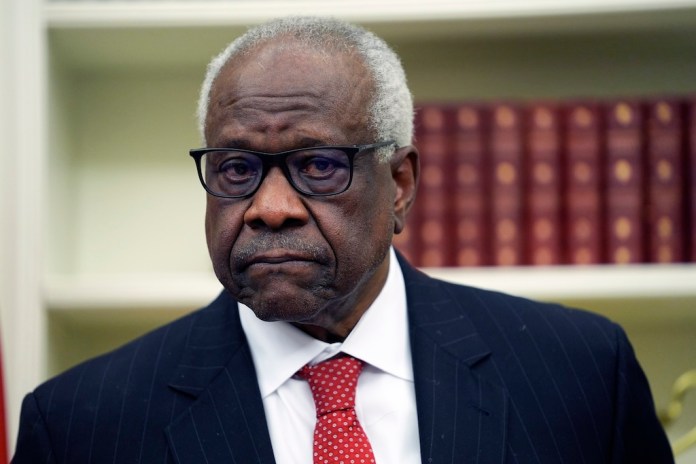
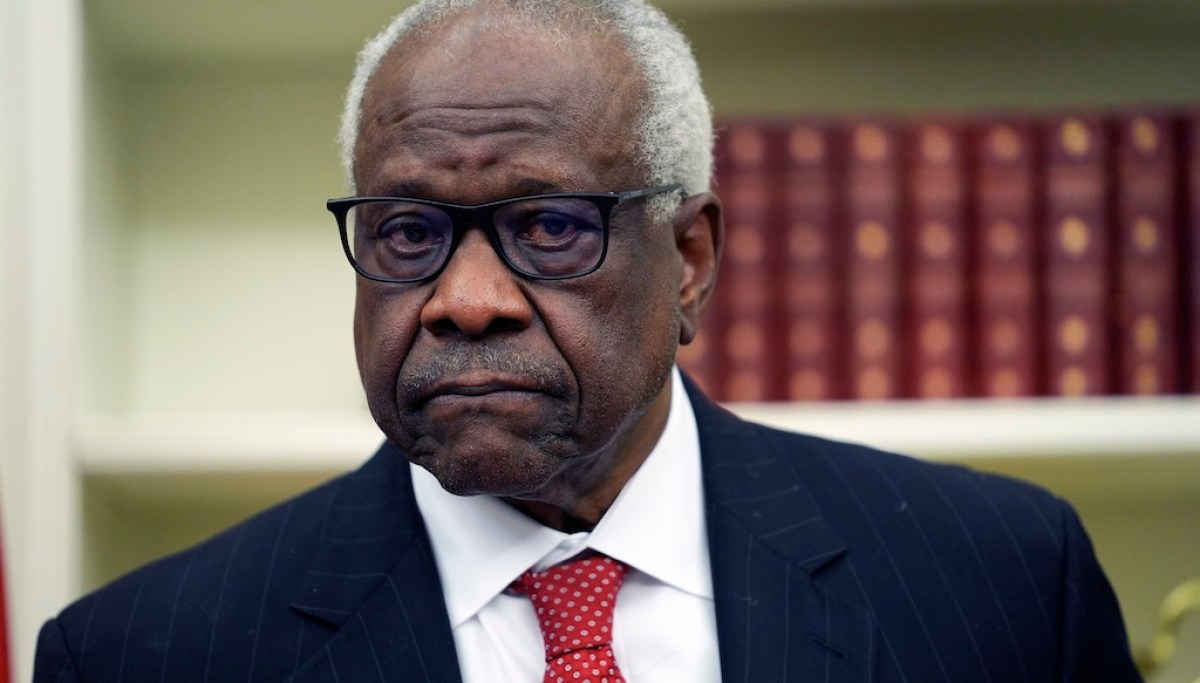
Justice Clarence Thomas shredded the Supreme Court‘s ruling striking down President Donald Trump‘s birthright citizenship order on Tuesday, accusing the majority ruling of using an “alternative history” of the 14th Amendment and expressing dismay over how it “devalues” citizenship.
The high court ruled 5-4 that the 14th Amendment provides citizenship to children born in the United States, including those born to parents in the country illegally or temporarily. Chief Justice John Roberts wrote the majority opinion finding Trump’s order, which stated that children born to parents illegally or temporarily in the U.S. were not citizens at birth, was not only unlawful, but unconstitutional under the 14th Amendment. Thomas wrote a 91-page dissent explaining why he would have upheld the order, while also ripping the majority’s ruling.
“The Court today takes the extraordinary step of holding facially unconstitutional the President’s Order excluding from citizenship the children of foreign temporary visitors and illegal aliens,” Thomas said. “In doing so, the Court adds to the sad history of the Fourteenth Amendment, which was designed and understood to secure equal rights for the freed blacks but has instead been repurposed for political projects that the Reconstruction Congress did not support. Because many potential applications of the President’s Order are consistent with the original public meaning of the Citizenship Clause, I respectfully dissent.”
Thomas’s opinion began with a discussion of the legal definition of “domiciled,” a key word in the constitutional amendment in question, which he described as the “legal word” for where someone’s home is.
“Citizens were not the people who were temporarily passing through a territory or who happened to be born within it. Citizens were the permanent members of the body politic — the people whose roots were in a place, who called that place home, and who would, if necessary, go to war for that place. The law of both state and national citizenship reflected this principle. Domicile was critical for state citizenship,” Thomas wrote.
He then described in detail the history of birthright citizenship leading up to the 14th Amendment, including the infamous Dred Scott decision, which ruled that black slaves were not citizens and which was later overturned by the 14th Amendment, the Civil Rights Act of 1866, and previous Supreme Court decisions on the citizenship clause. Thomas then explained how he believes the president’s executive order is not unconstitutional and instead actually upholds the original meaning of the citizenship clause.
“The Citizenship Clause was enacted for people who were born in this country and called it home. It was enacted for freed slaves such as Dred Scott, who had ‘a domicil’ here and therefore were entitled to sue as citizens. It was enacted for men such as Frederick Douglass, who demanded citizenship ‘not as aliens nor as exiles,’ but as ‘Americans.’ Its authors and supporters promised, over and over again, that it would exclude the children of ‘persons temporarily resident’ here, whom ‘we would have no right to make citizens,’” Thomas wrote.
Thomas argued the majority’s “alternative history is mistaken,” and he pushed back on accusations from the majority that the evidence for his own viewpoint is “scant.”
“I see it differently. The Court cites little evidence from the Reconstruction Congress that gave us the Citizenship Clause. And, its other 19th-century evidence is slim in comparison,” Thomas wrote. “As for the evidence in support of my position, it is substantial. Representative Bingham, the architect of the Fourteenth Amendment, believed that the Citizenship Clause would not apply to the children of temporary visitors. Senator Trumbull, a principal champion of the Amendment, agreed. Jacob Howard, who introduced the Citizenship Clause, agreed. Congressman after Congressman during the legislative debates agreed. Congress in 1870 agreed.”
“President Grant’s Attorney General agreed. President Grant’s Attorney General before that agreed. The Supreme Court in 1873 agreed. State legislatures agreed. Executive Branch decisionmakers over the course of multiple decades agreed. Justice Miller agreed. Thomas Cooley agreed. A battery of other eminent scholars agreed. And, the great Justice John Marshall Harlan, on three separate occasions, agreed. Once again, ‘I am quite comfortable in the company I keep,’” Thomas added.
He concluded by accusing the majority of reaching its decision based on its “preferred rights” rather than looking to the text and history of the citizenship clause, and he delivered a grim prediction for the fate of Tuesday’s ruling.
“Meanwhile, the Court has repurposed the Fourteenth Amendment to protect its own set of preferred rights that the Reconstruction Congress never contemplated and that cannot find support in its text. Today, the Court does so again by recognizing a constitutional right to citizenship for the children of all foreign birth tourists and illegal aliens,” Thomas wrote.
“I am not sure that today’s opinion will stand the test of time. The Citizenship Clause ‘added greatly to the dignity and glory of American citizenship.’ Today’s opinion devalues that citizenship. I respectfully dissent,” Thomas concluded his opinion.
SUPREME COURT STRIKES DOWN TRUMP’S BIRTHRIGHT CITIZENSHIP EXECUTIVE ORDER
Thomas’s dissent was one of three written in the birthright citizenship case. Justices Samuel Alito and Neil Gorsuch also penned their own dissents.
The high court’s ruling in Trump v. Barbara was the final opinion released of the cases argued this term, as the Supreme Court goes on its summer break until it begins its next term in October.