The 2026 FIFA World Cup stands as the largest edition in the tournament’s history, featuring 48 teams and 104 matches across 16 venues in the United States, Canada, and Mexico. It opened on June 11 against the backdrop of America’s 250th anniversary celebrations, a milestone that President Donald Trump has explicitly linked to the event through the creation of a dedicated White House task force charged with coordinating federal efforts. Trump has described the tournament as an opportunity to showcase the nation’s greatness while ensuring robust security for participants and spectators alike. The scale alone — several million visitors have poured through the country over the tournament’s five-week run — has made the World Cup both a massive sporting spectacle and a test of logistical and policy coordination on an unprecedented level.
This gathering has arrived at a moment when the United States is simultaneously hosting the world and handling our own domestic priorities. Just days after the opening matches, on Flag Day and the president’s 80th birthday, the South Lawn hosted another high-profile athletic event framed as part of the semiquincentennial observances, which I wrote about in these pages several weeks ago. The World Cup has extended that emphasis on competition and national pageantry across soccer‘s global platform, where teams from every continent compete under the same rules with outcomes decided solely by skill, preparation, and execution on the field. If sports is the last arena in life in which pure meritocracy still reigns, during the World Cup, this arena expands to encompass the entire globe — and those of us here in the U.S. have had the once-in-a-generation chance to watch it all play out right here in our backyard.
During the opening weeks of the tournament, the U.S. secured a convincing 4-1 victory over Paraguay in our Group D opener, with Folarin Balogun scoring twice during the first half alone. Former U.S. soccer star Alexi Lalas, now broadcasting for Fox Sports, characterized it as the greatest half of group-stage play that a U.S. men’s team has produced at a World Cup. Two days later, the Netherlands and Japan delivered a 2-2 draw in Arlington, Texas, with Japan twice fighting back from deficits — and their fans, continuing a longstanding tradition, stayed behind after the final whistle to collect litter, leaving the venue cleaner than they found it. (Even after they lost a heartbreaker to Brazil, their fans still stayed behind to clean up the stadium. Japan may’ve lost in the World Cup, but it surely won this year’s international etiquette award.)
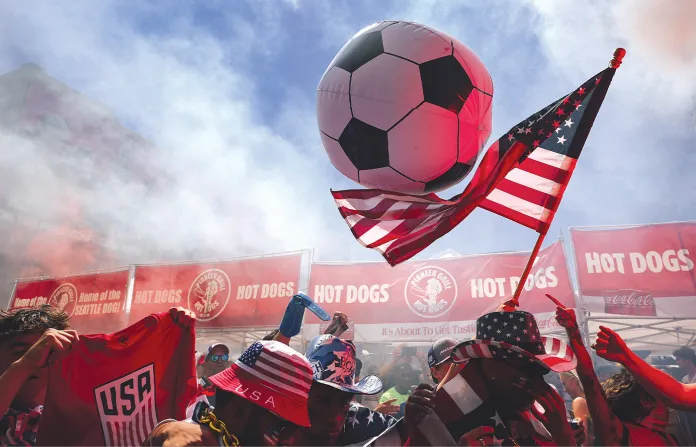
An inflatable football and a flag of the United States as fans enjoy the pre match atmosphere during the FIFA World Cup 2026 Round Of 16 match between USA and Belgium at Seattle Stadium in Seattle, Washington on July 6. (Alex Pantling/FIFA via Getty Images)
” data-large-file=”https://conservativenewsbriefing.com/wp-content/uploads/2026/07/the-world-cup-comes-to-america-passion-resilience-and-the-politics-of-hosting.webp” height=”658″ width=”1024″ src=”https://conservativenewsbriefing.com/wp-content/uploads/2026/07/the-world-cup-comes-to-america-passion-resilience-and-the-politics-of-hosting.webp” alt=”An inflatable football and a flag of the United States as fans enjoy the pre match atmosphere during the FIFA World Cup 2026 Round Of 16 match between USA and Belgium at Seattle Stadium in Seattle, Washington on July 6. (Alex Pantling/FIFA via Getty Images)” class=”wp-image-4644394″ srcset=”https://conservativenewsbriefing.com/wp-content/uploads/2026/07/the-world-cup-comes-to-america-passion-resilience-and-the-politics-of-hosting-3.webp 1400w, https://conservativenewsbriefing.com/wp-content/uploads/2026/07/the-world-cup-comes-to-america-passion-resilience-and-the-politics-of-hosting-3.webp?resize=300,193 300w, https://conservativenewsbriefing.com/wp-content/uploads/2026/07/the-world-cup-comes-to-america-passion-resilience-and-the-politics-of-hosting-3.webp?resize=768,494 768w, https://conservativenewsbriefing.com/wp-content/uploads/2026/07/the-world-cup-comes-to-america-passion-resilience-and-the-politics-of-hosting-3.webp?resize=1024,658 1024w, https://conservativenewsbriefing.com/wp-content/uploads/2026/07/the-world-cup-comes-to-america-passion-resilience-and-the-politics-of-hosting-3.webp?resize=150,96 150w, https://conservativenewsbriefing.com/wp-content/uploads/2026/07/the-world-cup-comes-to-america-passion-resilience-and-the-politics-of-hosting-3.webp?resize=696,447 696w, https://conservativenewsbriefing.com/wp-content/uploads/2026/07/the-world-cup-comes-to-america-passion-resilience-and-the-politics-of-hosting-3.webp?resize=1068,687 1068w” sizes=”(max-width: 1024px) 100vw, 1024px”>
The following day produced the tournament’s most charming early story: Spain, among the pre-tournament favorites, were held to a goalless draw by first-time World Cup qualifier Cape Verde, whose 40-year-old goalkeeper Vozinha turned away 27 shots. It turned out to be no fluke. The tiny island nation kept advancing, drawing Uruguay and Saudi Arabia to reach the Round of 32 before finally bowing out to defending champion Argentina in an exhilarating match that may have been the best of the tournament so far.
The Americans, meanwhile, beat Bosnia and Herzegovina in the Round of 32 to reach the Round of 16 for the first time since 2014, only to be undone by Belgium on July 6 in a match that was clouded by controversy (more on that below). By the time the Round of 16 wrapped up this week, all three co-host nations — Canada, Mexico, and the United States — had been eliminated. The final eight now includes Morocco, France, Spain, Belgium, Norway, England, Switzerland, and (miraculously) Argentina, with the quarterfinals running July 9-11 and the final set for July 19 at the “New York/New Jersey Stadium” in the Meadowlands.
The Balogun balagan
No World Cup storyline has generated more controversy, or more evidence of Trump’s personal stake in this tournament, than the balagan (Hebrew slang for “craziness”) surrounding Folarin Balogun and his red card. During our win over Bosnia and Herzegovina, Balogun, our top goal-scorer, was sent off after replay showed him stepping on the leg a Bosnian defender, triggering a standard automatic one-match suspension which would have kept him out of the Round of 16 clash with Belgium.
Left: Referee Raphael Claus shows Folarin Balogun of the United States a red card for a foul on Tarik Muharemovic of Bosnia and Herzegovina during the FIFA World Cup 2026 Round of 32 match on July 1, 2026, in Santa Clara, California; Right: Members of the Tartan Army lead the march around the ballpark prior to the baseball game between the Miami Marlins and the Texas Rangers in Miami on June 22. (Charlotte Wilson/Getty Images; Jasen Vinlove/Miami Marlins/Getty Images)
” data-large-file=”https://conservativenewsbriefing.com/wp-content/uploads/2026/07/the-world-cup-comes-to-america-passion-resilience-and-the-politics-of-hosting-1.webp” height=”658″ width=”1024″ src=”https://conservativenewsbriefing.com/wp-content/uploads/2026/07/the-world-cup-comes-to-america-passion-resilience-and-the-politics-of-hosting-1.webp” alt=”Left: Referee Raphael Claus shows Folarin Balogun of the United States a red card for a foul on Tarik Muharemovic of Bosnia and Herzegovina during the FIFA World Cup 2026 Round of 32 match on July 1, 2026, in Santa Clara, California; Right: Members of the Tartan Army lead the march around the ballpark prior to the baseball game between the Miami Marlins and the Texas Rangers in Miami on June 22. (Charlotte Wilson/Getty Images; Jasen Vinlove/Miami Marlins/Getty Images)” class=”wp-image-4644396″ srcset=”https://conservativenewsbriefing.com/wp-content/uploads/2026/07/the-world-cup-comes-to-america-passion-resilience-and-the-politics-of-hosting-4.jpg 1400w, https://conservativenewsbriefing.com/wp-content/uploads/2026/07/the-world-cup-comes-to-america-passion-resilience-and-the-politics-of-hosting-4.jpg?resize=300,193 300w, https://conservativenewsbriefing.com/wp-content/uploads/2026/07/the-world-cup-comes-to-america-passion-resilience-and-the-politics-of-hosting-4.jpg?resize=768,494 768w, https://conservativenewsbriefing.com/wp-content/uploads/2026/07/the-world-cup-comes-to-america-passion-resilience-and-the-politics-of-hosting-4.jpg?resize=1024,658 1024w, https://conservativenewsbriefing.com/wp-content/uploads/2026/07/the-world-cup-comes-to-america-passion-resilience-and-the-politics-of-hosting-4.jpg?resize=150,96 150w, https://conservativenewsbriefing.com/wp-content/uploads/2026/07/the-world-cup-comes-to-america-passion-resilience-and-the-politics-of-hosting-4.jpg?resize=696,447 696w, https://conservativenewsbriefing.com/wp-content/uploads/2026/07/the-world-cup-comes-to-america-passion-resilience-and-the-politics-of-hosting-4.jpg?resize=1068,687 1068w” sizes=”(max-width: 1024px) 100vw, 1024px”>
Trump, like most observers, thought that the red card was absurd. He called FIFA President Gianni Infantino directly to ask for a review, later telling reporters, “I asked for a review because I didn’t think it was a foul,” and adding that he saw “two great athletes” who had simply collided. I and the vast majority of other sports commentators agreed with the president on this one: The contact that Balogun made with the Bosnian player was incidental and accidental — Balogun did not intend to hurt the Bosnian player; he was merely making an aggressive play for the ball, which is what players do throughout 99% of an average soccer match. To eject him not only from the match for an action that merited a yellow card at most, but to disqualify him from the next match as well, was patently unjust.
On July 5, FIFA’s disciplinary committee announced that it would suspend the enforcement of Balogun’s ban for a one-year probationary period, citing Article 27 of its disciplinary code, which allows judicial bodies discretion to hold sanctions in abeyance. Trump thanked FIFA on Truth Social “for doing what was right, and reversing a great injustice.” Belgium’s federation was, in its own word, “astonished,” and had its formal appeal rejected on the grounds that it had no legal standing to challenge a ruling involving another team. UEFA called the reversal “unprecedented, incomprehensible and unjustifiable,” while Belgian coach Rudi Garcia dryly noted that he “didn’t know that in the offices of FIFA the fifth of July was the first of April.” (If you thought that Belgians weren’t exactly known for their humor, well, that attempt at a joke— I think it was an attempt at a joke — pretty much confirmed it.) FIFA, for its part, pointed out that it had made similar probation calls before, including one last year that let red-carded Cristiano Ronaldo avoid missing Portugal’s World Cup opener.
In the end, it was all moot: Even with Balogun, we lost to Belgium, and it wasn’t particularly close. Whatever one thinks of how it happened, the episode was a small but vivid illustration of the unusually close relationship the president has cultivated with FIFA’s leadership. Infantino, you may recall, awarded Trump the inaugural “FIFA Peace Prize” at the World Cup draw last December, and has appeared alongside him at the White House and at league offices FIFA opened inside Trump Tower. That relationship is set to be on display again at the final on July 19, when Trump is expected to help present the trophy to the winning team.
A tournament fans are loving
Whatever the controversies, the on-the-ground experience for the millions of supporters who have poured into America’s stadiums and fan zones, by nearly every account, has been a blast. Al Jazeera’s own correspondent, no natural cheerleader for anything happening in Trump’s America, admitted that the opening night in Los Angeles produced “an electric, hometown celebration.” Scotland’s Tartan Army, with time to kill between matches, marched roughly 8,000 strong into a Miami Marlins game and serenaded the ballpark with soccer chants remixed for baseball. Dutch supporters in Houston, spotting a Dutch Bros. coffee shop, turned a caffeine run into a small parade. Norway fans were seen doing the “Viking Row” up mall escalators. And after the USMNT’s win over Australia in Seattle, the home crowd broke into an impromptu rendition of John Denver’s “Take Me Home, Country Roads,” the song that, for some reason, became our official team anthem during this World Cup.
From top left: Argentine fans react as their team scores against Egypt during a World Cup match watch party at on July 7 in Miami; Japan supporters have fun prior to the FIFA World Cup 2026 Group F match between Japan and Sweden on June 25, 2026; Fans support their team prior the World Cup match between Colombia and Portugal in Miami on June 27, 2026; U.S. fans march through Pioneer Square before the 2026 World Cup round of 16 match between USA and Belgium in Seattle on July 6, 2026. (Photos via Getty Images)
” data-large-file=”https://conservativenewsbriefing.com/wp-content/uploads/2026/07/the-world-cup-comes-to-america-passion-resilience-and-the-politics-of-hosting-2.webp” height=”658″ width=”1024″ src=”https://conservativenewsbriefing.com/wp-content/uploads/2026/07/the-world-cup-comes-to-america-passion-resilience-and-the-politics-of-hosting-2.webp” alt=”From top left: Argentine fans react as their team scores against Egypt during a World Cup match watch party at on July 7 in Miami; Japan supporters have fun prior to the FIFA World Cup 2026 Group F match between Japan and Sweden on June 25, 2026; Fans support their team prior the World Cup match between Colombia and Portugal in Miami on June 27, 2026; U.S. fans march through Pioneer Square before the 2026 World Cup round of 16 match between USA and Belgium in Seattle on July 6, 2026. (Photos via Getty Images)” class=”wp-image-4644397″ srcset=”https://conservativenewsbriefing.com/wp-content/uploads/2026/07/the-world-cup-comes-to-america-passion-resilience-and-the-politics-of-hosting-10.jpg 1400w, https://conservativenewsbriefing.com/wp-content/uploads/2026/07/the-world-cup-comes-to-america-passion-resilience-and-the-politics-of-hosting-10.jpg?resize=300,193 300w, https://conservativenewsbriefing.com/wp-content/uploads/2026/07/the-world-cup-comes-to-america-passion-resilience-and-the-politics-of-hosting-10.jpg?resize=768,494 768w, https://conservativenewsbriefing.com/wp-content/uploads/2026/07/the-world-cup-comes-to-america-passion-resilience-and-the-politics-of-hosting-10.jpg?resize=1024,658 1024w, https://conservativenewsbriefing.com/wp-content/uploads/2026/07/the-world-cup-comes-to-america-passion-resilience-and-the-politics-of-hosting-10.jpg?resize=150,96 150w, https://conservativenewsbriefing.com/wp-content/uploads/2026/07/the-world-cup-comes-to-america-passion-resilience-and-the-politics-of-hosting-10.jpg?resize=696,447 696w, https://conservativenewsbriefing.com/wp-content/uploads/2026/07/the-world-cup-comes-to-america-passion-resilience-and-the-politics-of-hosting-10.jpg?resize=1068,687 1068w” sizes=”(max-width: 1024px) 100vw, 1024px”>
These are small moments, but they add up. Fan festivals have sprung up in 13 host cities, and armies of local volunteers have fanned out to help disoriented visitors find their way to kickoff. None of this is to say the logistics have been flawless — traffic around SoFi Stadium on opening night was, by most accounts, dreadful, and ticket and concession prices have drawn plenty of grumbling — but the overwhelming weight of the reporting, even from outlets with no particular affection for this administration, is that America has thrown a pretty good party.
The challenges of hosting a global tournament
Staging an event of this magnitude has required extensive coordination between federal, state, and local authorities. The Department of Homeland Security has overseen security planning across the 11 U.S. host cities, working with hundreds of agencies to implement measures including enhanced screening protocols, counter-drone technology, and facial recognition systems.
The most persistent point of friction has been immigration enforcement. DHS officials confirmed months before kickoff that ICE agents would be present at stadiums, primarily in a security capacity, though the agency has not ruled out immigration arrests occurring incidentally. Human Rights Watch has estimated that ICE made roughly 167,000 arrests in and around the 11 host cities between January 2025 and March 2026, and the group, along with more than 100 allied organizations, has pushed FIFA’s corporate sponsors to back what they call an “ICE truce” for the tournament’s duration, a request FIFA has not adopted. The administration has countered that legitimate visitors “have nothing to worry about,” in the words of one DHS spokesperson, and that only those unlawfully present in the country would be targeted.
Security concerns have not been confined to the U.S. side of the border. Co-host Mexico had to double security and cap crowds at its landmark Angel of Independence monument in Mexico City after four fans died amid the euphoric street celebrations that followed Mexico’s win over Ecuador, a reminder that crowd management, not just border policy, is one of the genuine burdens of hosting a tournament this large across three countries at once.
One of the more complicated threads running through this World Cup involved Iran’s participation in matches held partly on American soil, against the backdrop of the recent brief but intense war between the U.S. and Iran. Iran moved its training base from Arizona to Mexico and was permitted to cross into the U.S. only briefly around its matches rather than stay overnight.
Even if you had been rooting against the Iranian regime during the war, it was hard to not feel for how their soccer team’s World Cup campaign ended in the most excruciating fashion possible. All the team needed to advance was for either Austria or Algeria to win in the group-stage final match that they were playing against one another. I won’t go into how crazy the ending of this match was, but suffice it to say, it ended in the most dramatic tie I (and I think almost anyone) had ever seen, and it resulted in Iran’s seventh World Cup appearance ending without the team ever reaching the knockout stage.
The World Cup and America 250
For us here in the U.S., the tournament has arrived during a period of heightened national reflection tied to our 250th anniversary. Our founding principles, articulated in 1776, emphasized self-reliance, resolve in the face of adversity, and the courage to compete on terms of one’s own choosing. The current generation of American players and supporters engages with the sport in a landscape where domestic leagues and youth development have grown substantially over recent decades, and the USMNT’s run to the Round of 16 — its deepest since 2014 — offered a glimpse of that continued growth, even if its loss to Belgium cut the run short of the quarterfinals that many of us had been hoping for. (No, the “USMNT” acronym you’ve been seeing everywhere these past few weeks does not stand for “United States Mutant Ninja Turtles”! It stands for “United States Men’s National Team.” But every time I see those five letters, the five-year-old Teenage Mutant Ninja Turtles lover in me can’t help but think, “Wait, Michelangelo and Leonardo are playing for us?!”)
Trump’s direct involvement in this World Cup — through the task force, his public statements, his phone call to Infantino on Balogun’s behalf, and his coming turn presenting the trophy at MetLife Stadium — aligns with his consistent emphasis on strength, spectacle, and unapologetic national pride. His administration’s approach to the tournament echoes his earlier engagements with sports, as I’ve been chronicling in these pages over the past few years. This World Cup has given him a similar platform on a much larger international scale — one which will culminate on July 19 when we’ll get to say something that we haven’t said since Alexander Hamilton dueled Aaron Burr: The eyes of the world are on (gulp!) New Jersey! (FanDuel has the over/under at 0.5 for the number of times that players during that match will use the “everything is legal in New Jersey” line from Lin-Manuel Miranda’s musical.)
With the Round of 16 now complete and the quarterfinals set to run from July 9 through July 11, the 2026 World Cup retains ample capacity for further surprises and defining performances. Morocco faces France in a rematch of the 2022 semifinal; Spain, in the quarterfinals for the first time since its title run in 2010, meets a resurgent Belgium; and Norway’s Erling Haaland (“Soccer Thor,” as I like to call him) squares off against England.
For the United States, our tournament ended with mixed feelings: a group-stage title, a first Round of 16 appearance since 2014, a controversy that could follow our program for years (though, let’s be real — the red card should’ve never been given out in the first place), and an elimination that will sting for some time. Beyond the actual play on the field, this tournament will be measured by how effectively we, as host nation, balanced our dual roles: enthusiastic participant and responsible convener.
As the final matches unfold across the country and millions continue to follow from afar, the World Cup continues to affirm that strength and determination remain central to both sporting success and national vitality. In the arena of nations, as on the pitch, those who prepare thoroughly, compete directly, and refuse to yield ground unnecessarily position themselves to endure and prevail. The 2026 World Cup, staged during our 250th anniversary (raise a glass to freedom!), has offered a sustained opportunity to observe those principles in action, right up through the final whistle on those dueling grounds in Jersey on July 19. (Current odds on FanDuel for a World Cup finalist using the line “we are not throwing away our shot!” in a pre-final social media post are at +150. Odds that they’ll use a Tony Soprano GIF instead: -150.)
Daniel Ross Goodman (@DanRossGoodman) is a Washington Examiner contributing writer and teaches theology and religious studies at St. John’s University. His next book, Dante’s Guide to Life: How The Divine Comedy Can Change Our Fortunes, Our World, and Ourselves, will be published this fall by Angelico Press.