
Historic housing legislation designed to boost supply is now the law of the land.
The bill, the 21st Century ROAD to Housing Act, became law at midnight on Friday without President Donald Trump‘s signature. Instead, he allowed a 10-day window to run its course without signing or vetoing the bipartisan bill, which under the Constitution means it is enacted by default.
Trump announced on Friday morning that he was not going to sign the bill in a “protest” over the Senate not passing voting legislation he has long favored.
“I will not sign the Housing Bill, which has been fully approved by Congress and sent to the White House, in PROTEST over the fact that the United States Senate is not capable of passing THE SAVE AMERICA ACT, which is polling at 97% with the Republican Party, and very high with the non-politician Dumocrats,” Trump posted on Truth Social.
The White House had previously endorsed the legislation, and Trump was scheduled to sign it during a ceremony on Capitol Hill last month, but he unexpectedly said at the last minute he would delay doing so until the passage of the SAVE America Act, which would require voter ID and proof of citizenship when registering to vote.
INVESTORS NOW THINK NEW FED CHAIRMAN WARSH WILL HIKE RATES BEFORE MIDTERM ELECTIONS
No progress was made on the SAVE America Act, despite using the housing bill as leverage, and Trump declined to veto the legislation, which is designed to bring down costs by easing federal regulations and encouraging states and cities to loosen land use restrictions.
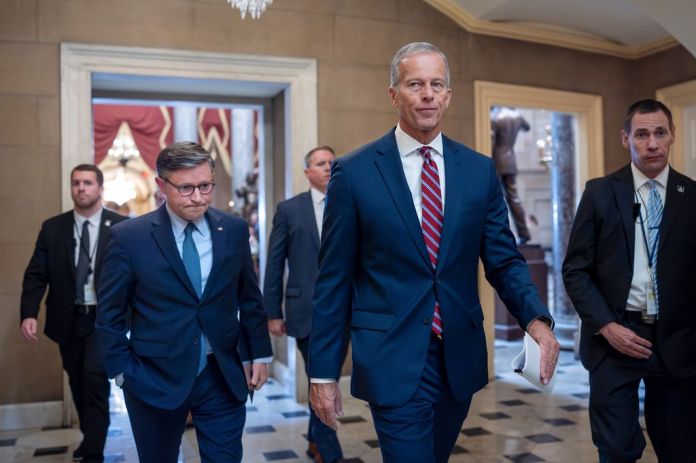
House Speaker Mike Johnson (R-LA) transmitted the bill to the White House for approval, which began a 10-day timeline for it to become law unless Trump vetoed it.
Johnson had previously denied that Trump would veto the bill.
“He won’t veto the bill,” Johnson said after meeting with the president late last month. “We already know that. He’ll either allow it to just go into law, or he’ll put his signature on it and take partial ownership, and I hope he does the latter.”
Trump criticized the legislation ahead of his first aborted signing ceremony.
“The Elizabeth ‘Pocahontas’ Warren centric housing bill, which is of minor importance compared to lower interest rates, and even FISA, pales in comparison to passing THE SAVE AMERICA ACT,” Trump said, before canceling the ceremony just hours before.
Still, with the bipartisan housing legislation now law, it gives both Republicans and Democrats a legislative win that they can campaign on heading into the midterm elections, where voters’ No. 1 concern is inflation and affordability — although Democrats may emphasize that Trump never signed it.
The bill was overwhelmingly bipartisan.
The House voted 358-32 to pass the 21st Century ROAD to Housing Act, and the Senate voted 85-5 to do the same.
Boosting housing supply has long been a goal for affordable housing advocates, who say the U.S. housing market is millions of homes short of where it should be.
Affordability, given years of red-hot inflation, has become a top consideration in the midterm elections.
Republicans are hoping to hold on to control of the House and Senate in November, but Democrats are pushing hard to blame high prices on Trump and the GOP. Housing costs are a major part of the problem. Purchasing the average-priced home now requires about 30% of median household income, according to ICE Mortgage Technology, up about 50% from before the pandemic.
Trump’s economic approval ratings have soured after he swept into office running on lowering costs. The bipartisan housing legislation is a tangible measure that Republicans can point to when making the argument to constituents that they are working to address high costs.
The deal on the final version of the 21st Century ROAD to Housing Act finally came together in June after talks between the “four corners” on the legislation — Banking Committee Chairman Tim Scott (R-SC) and ranking member Elizabeth Warren (D-MA) in the Senate, and Financial Services Committee Chairman French Hill (R-AR) and ranking member Maxine Waters (D-CA) in the House.
The final version of the bill includes 47 total housing supply provisions.
The legislation streamlines environmental reviews to speed up affordable housing development and makes it cheaper and easier to build manufactured homes.
In addition to easing federal regulations, the bill also encourages states and cities to reform their land use rules, which would mark a significant change in the federalist system of land use rules.
One provision steers federal grants to localities that permit greater housing construction and away from areas that fail to build. Another would promote zoning codes that allow for greater construction, and essentially grade cities and states on how closely they conform.
Most of the provisions in the bill were carefully negotiated between Republicans and Democrats and have the support of the vast majority of Congress, municipal officials, and the housing industry.
But one provision had courted significant controversy: a ban on large investors purchasing single-family homes.
That provision, which was added to the bill after Trump demanded it during his State of the Union address, had strong support from some populist Democrats but had faced pushback from free marketeers and some in the industry.
The Senate’s initial version of the ban received backlash from industry groups, specifically over a provision that would have required investors in build-to-rent homes to sell those houses within seven years. House negotiators later nixed that part, much to the relief of the housing industry.
Still, despite the measures in the bill, experts argue it wouldn’t offer many tangible affordability benefits ahead of the midterm elections — but would rather be a key talking point for lawmakers.
HOUSING BILL WOULDN’T OFFER MUCH AFFORDABILITY RELIEF UNTIL AFTER MIDTERM ELECTIONS
“I think this is something that can be measured in years rather than months,” Francis Torres, director of the Bipartisan Policy Center’s housing and infrastructure projects, told the Washington Examiner.
“But it’s hard to give you a specific prediction, because Congress is not the only actor,” Torres continued. “There’s some stuff in here that will require state and local action for the full promise of this bill to be realized.”