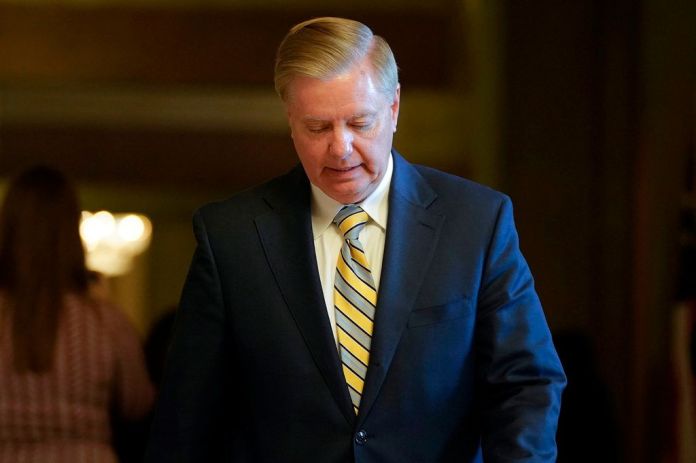
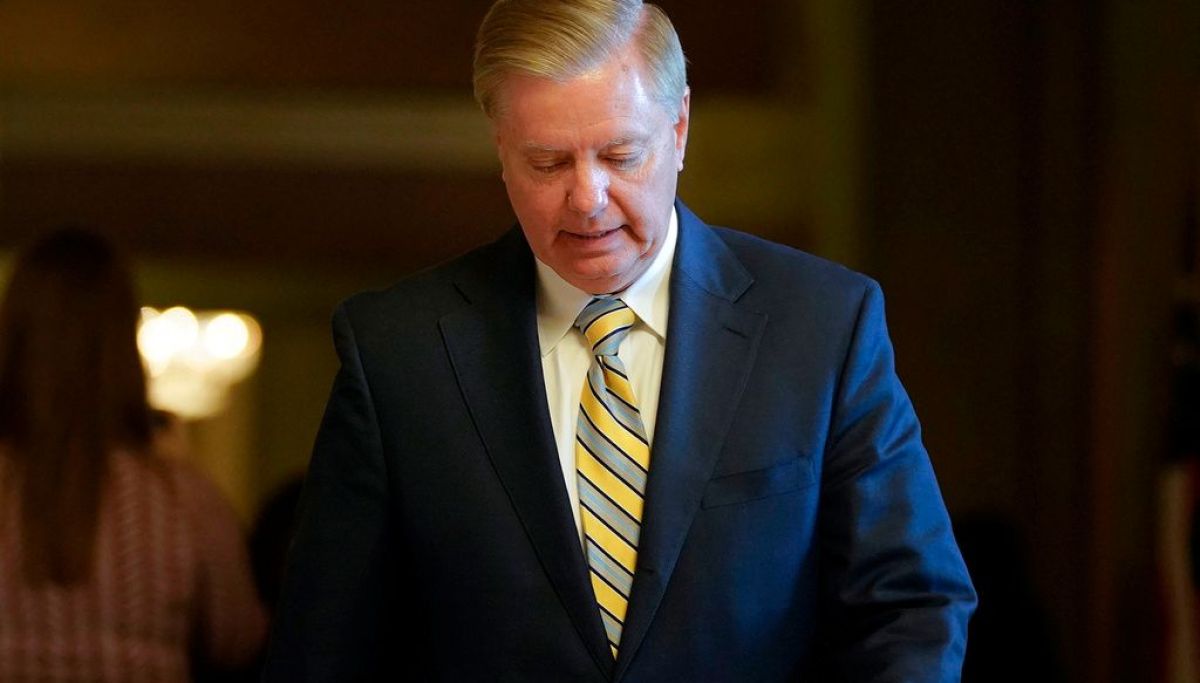
The future of the Republican Party’s foreign policy posture took an uncertain turn following the sudden death of Sen. Lindsey Graham (R-SC), one of the Senate‘s most influential champions of an interventionist, Reagan-era worldview.
Graham was one of Washington’s leading voices on foreign policy, serving as a key adviser to President Donald Trump on issues including Iran and Russia.
For years, Graham occupied a unique position inside the GOP, pairing his close relationship with Trump with an unapologetically hawkish approach to national security. He championed military aid to Ukraine, urged a hard-line approach toward Iran, fiercely defended Israel, and regularly argued that American leadership abroad was essential to U.S. security.
Ukraine lost one of its strongest advocates in Washington with Graham’s death. He died just hours after returning from his 10th trip to Kyiv since Russia’s 2022 invasion. Days before his death, Graham announced an agreement with the Trump administration to move forward with a new package of sanctions targeting Russia.
“America and the world have lost a resolute leader,” Ukrainian President Volodymyr Zelensky posted on X, offering condolences to Graham’s family and colleagues.
Graham also became a frequent golf partner and fierce public defender of Trump. Foreign diplomats viewed that relationship as strategic, believing Graham understood that the best chance of protecting NATO, Ukraine, and foreign aid in a MAGA-dominated Washington was to maintain the president’s ear.
His death comes as the Republican Party has increasingly embraced an America First foreign policy that is more skeptical of overseas military intervention and foreign aid, leaving allies and strategists wondering whether anyone has the political influence to carry Graham’s mantle.
“In an increasingly isolationist America, Sen. Graham was one of the last titans of the Senate who favored a muscular and engaged U.S. foreign policy,” Paul Foldi, a top Republican staffer on the Senate Foreign Relations Committee, said in comments to the Associated Press. “He is irreplaceable.”
While Republican senators like Tom Cotton (R-AR), Ted Cruz (R-TX), Jim Risch (R-ID), and Roger Wicker (R-MS) remain active on foreign policy, Graham occupied a distinctive position as a senior senator with close ties to Trump and long-standing relationships with foreign leaders. The result, Republicans say, could accelerate a shift already underway inside the party.
“There is a real debate inside the Republican coalition over America’s role abroad,” Republican strategist Dennis Lennox said. “Sen. Tom Cotton will almost certainly step in to fill the void and advocate for the more traditional Republican line on foreign policy. You are also seeing Ted Cruz become more willing to confront voices who are drifting away from supporting Israel.”
Another Republican strategist, speaking on the condition of anonymity to candidly discuss internal party dynamics, said Graham represented a fading faction within the GOP.
“The kinds of lawmakers like Lindsey Graham are definitely on the decline,” the strategist said. “I worry about our standing in the world in the face of this isolationist new coalition in the Republican Party, especially with Graham gone and Mitch McConnell is on the decline and leaving the Senate next year.”
The ideological divide was one Graham acknowledged publicly last year. Speaking at an Orthodox Union Advocacy Center attorneys conference in Fort Lauderdale, Florida, Graham warned that the Republican Party was undergoing a profound foreign policy shift.
“On the right, there’s a growing isolationist movement that I fight all the time,” Graham said.
The South Carolina senator said he was particularly concerned that skepticism toward overseas military engagement was beginning to extend to Israel, arguing that some Republicans increasingly viewed the U.S.-Israel alliance through the same lens as America’s involvement in other overseas conflicts.
“It’s beginning to include Israel,” Graham said. “In the past it really hasn’t, but now it’s more open, and so there is an element of our party that’s saying, ‘We don’t want to get sucked into endless war because of Israel.’”
Cruz echoed Graham’s worldview during Monday’s episode of his Verdict podcast, reflecting on the decades they worked together on national security issues.
“We were close allies fighting to defend our national security, to stand with our allies, to stand with Israel, and to stand against America’s enemies, especially Iran,” Cruz said. He called Graham “a force of nature.”
Those relationships also made Graham one of the most trusted Republican voices among U.S. allies, particularly Israel, where officials viewed him as a steadfast advocate inside the Republican Party.
“Sen. Lindsey Graham was a great American patriot,” Zionist Organization of America National President Morton Klein said in a statement. “He was a most sincere and heartfelt friend of and advocate for the Jewish people and the Jewish state. He fought for strong U.S.-Israel relations and fought those who were hostile to Israel.”
Klein added that Graham “understood the dangers posed by the Islamic Republic of Iran to America and the West” and “would always make clear that whatever endangers Israel also endangers America.”
Israeli Prime Minister Benjamin Netanyahu said Graham understood that “the security of Israel and America are inseparable.”
“Israel has lost one of its greatest friends,” Netanyahu said.
SOUTH CAROLINA GOVERNOR NAMES DARLINE GRAHAM NORDONE AS SENATE REPLACEMENT FOR LATE BROTHER
Republicans say replacing Graham will require more than simply adopting similar policy positions. His influence stemmed from his ability to bridge the gap between the party’s traditional national security establishment and Trump’s political movement, allowing him to remain one of the few Republican senators capable of publicly pushing for a more interventionist foreign policy while retaining the president’s ear.
“There are no words to describe his impact on the foreign and domestic policy of the United States,” Wicker, chairman of the Senate Armed Services Committee, said in a statement. “Lindsey served his beloved country in uniform and in the House and Senate. He stood solidly for freedom and strength, and he fought for liberty across the globe. Lindsey Graham can be succeeded in office, but he cannot be replaced.”