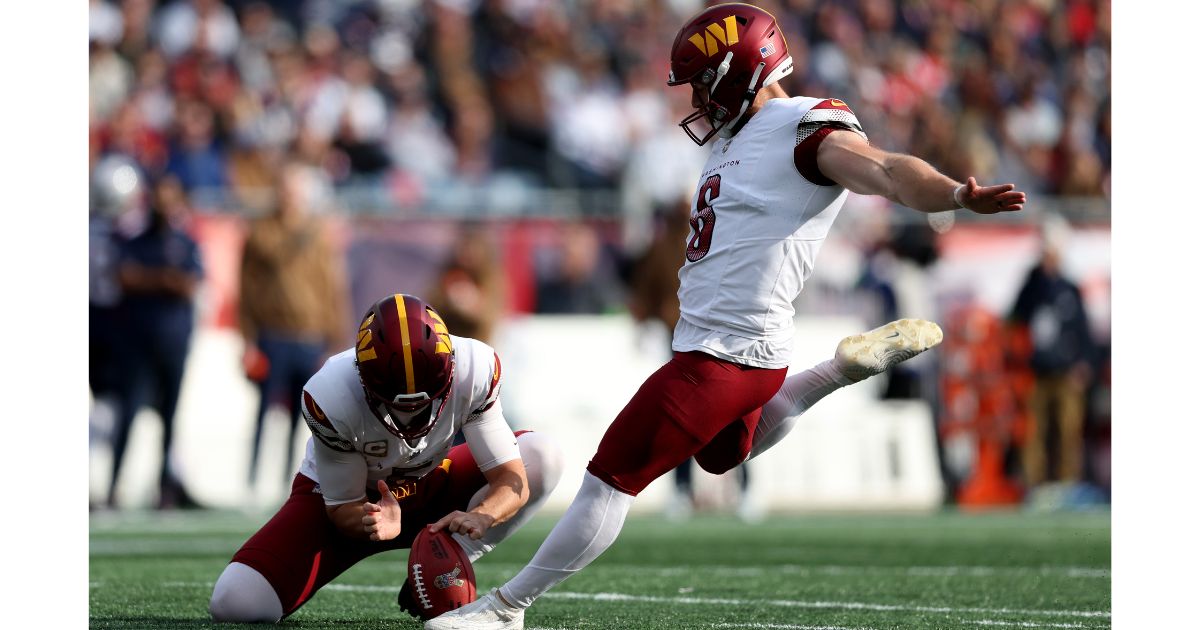
NFL fans outside of New England just got another reason to despise the Patriots.
In a lengthy post Monday on the social media platform X, NFL analytics maestro Ryan Paganetti revealed what appears to be a devious tactic at Gillette Stadium in Foxborough, Massachusetts, to use technology built into the stadium itself to give the home team an edge against visiting kickers and field goal attempts.
And according to an analysis by Barstool Sports’ “Stathole” published Tuesday, the trick worked brilliantly.
In sum, Paganetti reported going over video from Patriots games spanning a decade and noting that when visiting teams were attempting a field goal, the massive video board behind the goalposts was used to display a reverse view of the field.
That produced a second set of yellow uprights behind but offset to the actual uprights on the field that the opposing kicker would be aiming at — in effect, producing two separate targets.
Much has been made of the Patriots’ mysterious “Pink Stripes.” How about yellow ones?
I went through more than a decade of TV broadcasts and uncovered a diabolically clever piece of Patriots gamesmanship.
When opposing kickers lined up at Gillette Stadium, the video board… pic.twitter.com/Y5nf0F5vm6
— Ryan Paganetti (@RyanPaganetti) September 2, 2026
“In windy conditions, even the orange streamers on the video board appeared to point in the opposite direction from those atop the physical uprights, making the illusion even more disorienting,” Paganetti wrote.
Crucially, Paganetti noted, the reverse-field image was only used when visiting teams were kicking.
“The illusion appeared on Patriots kicks exactly zero times,” he wrote.
And it was effective, the Barstool Sports piece found.
Since Gillette opened in 2002, it reported, Patriots kickers nailed their field goals almost exactly at the rate they were statistically expected — 86.5 percent completed versus 86 percent expected.
Kickers for opposing teams, however, missed field goals at a rate much higher than they would be statistically expected to — 77.2 percent of kicks successful vs. 84.1 percent expected.
Those same kickers, according to the analysis, were slightly above average in making their kicks in other stadiums.
And the variables inherent in sports played outdoors, such as temperature, wind, and precipitation, did not explain the difference either.
“Even controlling for distance, weather, kicker, temperature, and wind, opposing kickers are still 5.8 percentage points under expectation as opposed to our 6.3% observed starting point,” the piece explained.
Adding fuel to the idea that the optical trick tricked kickers, the Barstool Sports analysis noted that opposing teams’ missed field goals were almost always because the ball had gone wide of the goal posts, rather than falling short or hitting the crossbar.
In other words, it was the aim that was off, not the physical power that propelled the ball.
To drive the point home further, the Barstool Sports analysis looked at games from Foxborough Stadium, the Patriots’ home field before Gillette opened with its video screen technology.
In Foxborough’s final year, opposing kickers succeeded in field goal attempts 75.9 percent of the time 2versus their statistically expected 77.3 percent — slightly lower.
That percentage difference more than doubled the following year in the new venue.
Any football fan knows that the impact of a field goal attempt goes far beyond simply the three points it would add to the score. Those three points can make all the difference in strategy for the rest of the game. And a missed field goal, of course, gives the Patriots possession of the ball at the line of scrimmage where the kick was attempted — drastically affecting the real-time situation in the game.
Neither Paganetti nor the Barstool Sports piece alleged any rules violation involved in the reverse-field image. But the Patriots and their six-Super Bowl-winning dynasty under former coach Bill Belichick certainly had a reputation for bending — or maybe breaking — rules to obtain an advantage.
A timeline published by the sports site Sporting News included 2007’s “Spygate” scandal, when Patriots employees were caught cheating. Belichick himself was fined $50,000 by the NFL
It also included the infamous 2014 “Deflategate” scandal, when the Patriots were accused of helping then-quarterback Tom Brady by using under-inflated footballs that would be easier to grip.
The NFL suspended Brady — one of the league’s premier superstars — for four games, fined the Patriots $1 million, and forced it to lose two draft picks.
And those are just the most blatant of Patriot games. The Sporting News timeline included a series of other suspicious incidents around the team during its Belichick-Brady glory years.
(It did not discuss the “pink stripes,” Paganetti referred to in his post. They were two mysterious words that appeared on a whiteboard during an interview included in the “Do Your Job” documentary about the team. Even Belichick claimed he didn’t know what the words meant.)
Those controversies — combined with the team’s year-after-year dominance of its conference and the league itself — wearied a good deal of the American football fan base outside the Patriots’ New England region.
Also known as CHEATING. On brand for the Cheatriots.
— Love.Hope.Light (@DoctorKess) September 2, 2026
The field goal revelation isn’t going to help that at all.
Advertise with The Western Journal and reach millions of highly engaged readers, while supporting our work. Advertise Today.