Secretary of State Marco Rubio warned from the birthplace of Western civilization Wednesday that the West must rediscover the qualities that made it great or resign itself to “atrophy and servitude and decline,” declaring that the choices made over the next decade could determine its course for the next century.
The post Rubio at Birthplace of Western Civilization: West Must Rediscover Greatness or Face ‘Servitude and Decline’ appeared first on Breitbart.
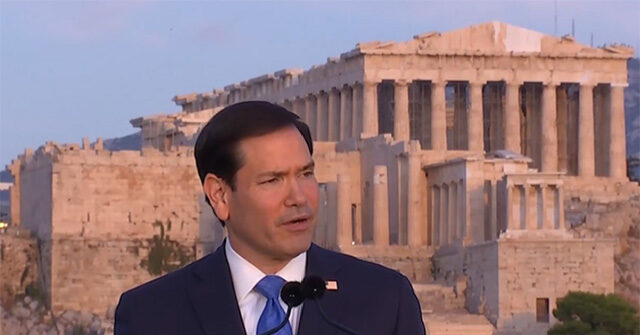
Secretary of State Marco Rubio warned from the birthplace of Western civilization Wednesday that the West must rediscover the qualities that made it great or resign itself to “atrophy and servitude and decline,” declaring that the choices made over the next decade could determine its course for the next century.
Speaking beneath the Acropolis, Rubio traced the West’s inheritance from ancient Greece through Rome and Christendom to the American founding before turning to what he described as its modern retreat: nations ashamed of their achievements, nationalism made a “dirty word,” open borders, outsourced industry, weakened militaries, and sovereignty increasingly surrendered to global bureaucracies.
At the center of Rubio’s argument was the ancient Greek concept of thumos — the spirit of ambition, courage, and pride that he said allowed civilizations not merely to survive, but to strive.
“The thumos, as the ancient Greeks called it — the fire of passion, strength, courage, pride — is the heart of great civilization,” Rubio said. “And without it? Without it, nations lose their will to fight, the will to strive, the will to survive.”
Rubio argued that much of the modern West had lost precisely that quality, becoming ashamed rather than proud of the achievements that distinguished it.
“Over time, we in the West came to feel ashamed of the very things that made us exceptional,” he said. “We felt embarrassed that our achievements set us apart from the rest of the world. Our prosperity somehow became a source of guilt.”
That loss of confidence, Rubio argued, became a rejection of the West’s own national identity and inheritance: nationalism became “a dirty word,” monuments came down, Western history was condemned, and children were taught to be ashamed of the nations they would inherit.
The consequences, he said, were not merely cultural.
“In the process, we opened our borders and outsourced our industry, and allowed our militaries to wither and to decay,” Rubio said.
Rubio said that retreat also came at the expense of national sovereignty, as Western governments increasingly transferred decisions “to global bureaucracies far beyond the reach of our control.”
The resulting vacuum, he argued, was filled by adversaries that grew more assertive, wealthy, and powerful as Western confidence receded.
Rubio warned that those choices have brought the West to a crossroads at which the decisions of the next decade could shape the next century.
“And now, today, we find ourselves at a crossroads,” he said. “Because the next decade and the decisions we make will write the story of the next century.”
“The course we take will determine whether the West maintains its place at the head of the world or resigns itself to a future of atrophy and servitude and decline,” Rubio warned. “We will either choose to act now or lose the choice to act at all.”
Rubio said the United States has already made its choice under President Donald Trump, casting the America First agenda as a reversal of the decline he attributed to open borders, deindustrialization, military weakness, and the surrender of national sovereignty.
“Under President Trump, the United States has made its choice,” Rubio declared. “We choose the unapologetic pursuit of national power: to take back control of our critical supply chains, to reindustrialize our economy, to rebuild our defense, to fight for dominance of the technologies and industries of the future.”
That pursuit, Rubio said, means competing across advanced manufacturing, artificial intelligence, semiconductors, minerals, cyber, energy, and weapons while rebuilding American factories and pushing again into space.
He cast that agenda not as a departure from Western statecraft, but as a return to its classical foundations: diplomacy and prudence backed by military power — and by an adversary’s belief that the West is prepared to use it.
“This is the classical understanding of politics and of statecraft that the Trump Administration hopes to reclaim — reclaim not just for our country, but for the whole of our civilization,” Rubio said.
Having laid out the course he said the United States has chosen under Trump, Rubio urged Europe to undertake a renewal of its own, pointing to rising defense spending, new partnerships, and expanded manufacturing as signs that a broader shift may already be underway.
“We believe that Europe can awaken from its long slumber and rekindle the fire that was lit here millennia ago,” Rubio said.
He held up Greece as “a model ally” on energy, migration, and defense and expressed hope that the rest of Europe would follow its example.
But Rubio made clear that his defense of national sovereignty was not an argument for dismantling the transatlantic alliance. Rather, he argued that an alliance of sovereign nations pursuing common interests would be stronger.
“Though passions may, at times, have strained the bonds of affection between the United States and Europe, it must not be allowed to break them,” he said. “Together, we must strengthen an alliance capable of confronting threats of our age.”
Rubio tied that renewal to a broader defense of national loyalty, rejecting the increasingly fashionable notion, as he put it, that “enlightened foreign policy means prioritizing the global community over one’s own people.”
The ancient Greeks, he said, understood “that there was nothing selfish or wrong about loyalty to your nation, nor anything selfish or wrong about fighting to defend its interests above all else.”
Rubio then drew one of the speech’s sharpest civilizational dividing lines, contrasting the Western ideal of the hero willing to sacrifice his life rather than betray his faith, country, or principles with what he described as the Iranian regime’s glorification of death itself.
“This is wholly different from what we see, even now, for example from fanatics like the radical mullahs of Iran, whose cult of death hails child suicide bombers as national heroes, and portrays martyrdom as an end to itself,” Rubio said.
For Rubio, the dividing line was not simply a willingness to die for a cause, but whether sacrifice flows from a reverence for life and principle or from the worship of death itself.
“Our heroes may be willing to die for their cause; but our heroes do not worship death,” he said. “It is precisely because we value life that we come to recognize the heroism in those who would sooner sacrifice it than to betray their principles.”
Wednesday’s address expanded on a theme Rubio laid out in Munich in February, when he warned that mass migration and globalism threatened the survival of the West and urged Europe to resist what he called the forces of “civilizational erasure.”
From there, Rubio widened the lens again, tracing the Western inheritance from Greece through Rome and Christendom to the American republic — a civilization he described as bound together across centuries by common ideas of truth, duty, excellence, exploration, sacrifice, and national loyalty.
Rubio said confronting today’s challenges requires the West first to recover the civilizational confidence that produced its institutions in the first place.
“Together, we must now rediscover that spirit,” he said. “We are at an inflection point — an inflection point not only in the history of my nation, but an inflection point in the whole of our civilization.”
The stakes, he argued, are no longer theoretical. National interests did not disappear with international institutions, nor did war disappear simply because the West preferred peace. Other powers continued to arm and compete for territory, technology, resources, markets, energy, and influence.
“And now, there is war again. There is new competition between great powers again. There is vulnerability, aggression, terrorism, a whole universe of new threats and attacks again,” Rubio said.
He called for Western institutions and alliances to be rebuilt around what he described as their proper purpose — not erasing the sovereignty or distinct identities of their member nations, but defending them against common threats.
Rubio pointed to U.S.-Greek cooperation in defense, energy, and technology as an example of that approach, along with what he called their “shared ambition to secure Europe’s borders from the threats of mass migration.”
In closing, Rubio returned to the larger inheritance at the heart of his address, arguing that Western renewal begins with recovering pride in the civilization handed down to the present generation rather than apologizing for it.
“It shows us that ours is the inheritance of great heroes, and that we should be proud — that we should be intensely proud — of where we come from,” Rubio said. “We should marvel at what our forefathers carved out of this countryside.”
“The story of our civilization is the greatest story ever known to man. And it began here, with the first men and women of the West.”
“From them,” Rubio concluded, “we can rediscover the virtues, the courage, and the strength to confront the dangers that we face in our time.”
Joshua Klein is a reporter for Breitbart News. Email him at [email protected]. Follow him on Twitter @JoshuaKlein