Secretary of State Marco Rubio accused Iran of employing “Nazi U-boat tactics” against commercial shipping in the Strait of Hormuz, warning that reaching an agreement with Tehran remains difficult because its leadership is controlled by “radical Shia clerics.”
The post Rubio Accuses Iran of ‘Nazi U-Boat Tactics’ — Warns It’s ‘Tough to Make a Deal’ with ‘Radical Shia Clerics’ appeared first on Breitbart.
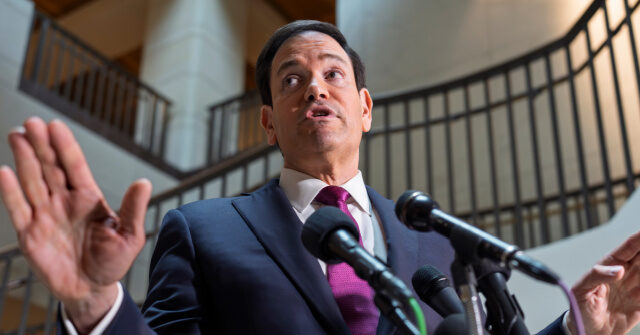
Secretary of State Marco Rubio accused Iran of employing “Nazi U-boat tactics” against commercial shipping in the Strait of Hormuz, warning that reaching an agreement with Tehran remains difficult because its leadership is controlled by “radical Shia clerics.”
In an interview with India’s News18, Rubio condemned Tehran’s continued attacks on civilian vessels despite American forces successfully defending the vast majority of commercial traffic through the strategic waterway.
Asked whether the conflict was headed toward further military escalation or a negotiated settlement, Rubio expressed deep skepticism about Tehran’s willingness to reach an agreement.
“Well, it’s tough to make a deal with the Iranian regime,” he said.
“Unfortunately, they don’t know how to make a deal, and they’re controlled by radical Shia clerics.”
Rubio underscored the ideological extremism of Iran’s leadership, portraying its religious convictions as a fundamental obstacle to reaching an agreement.
“And I don’t mean Shia clerics; I mean radical Shia clerics who are driven by theology — very difficult to make a deal with them.”
Despite Iran’s attacks, Rubio said American efforts to safeguard the Strait of Hormuz had enabled commercial shipping to recover to nearly prewar levels.
“The amount of traffic and oil and energy flowing through there is on — it’s 80 to 100 percent equal to what it was before the conflict,” he said.
But Rubio argued that the restoration of maritime traffic should not overshadow Iran’s deliberate targeting of civilian vessels and their crews.
“What they really should be talking about is that we have a nation-state that is openly — openly — saying: We are targeting commercial vessels; we are trying to kill sailors who have nothing to do with the war; we are trying to sink commercial ships,” he said.
“You haven’t seen that since the Second World War,” Rubio said. “They are doing Nazi U-boat tactics. And that’s what the world should be rallying around and condemning.”
The comparison invoked Nazi Germany’s submarine campaign against Allied and neutral merchant vessels, when U-boats sought to disrupt vital supply routes by sinking commercial ships.
Iran has continued launching missiles and drones at commercial vessels in the Strait of Hormuz, even as American forces intercept the overwhelming majority of those attacks and maintain maritime security operations.
“Every single night, the United States defends shipping,” Rubio said.
American forces destroy the overwhelming majority of missiles and drones Iran launches at commercial vessels, he explained, although some occasionally penetrate those defenses.
“Every now and then, unfortunately, one will get through and strike the ship,” he said.
Rubio noted that most damaged vessels are still able to continue their journeys, but some attacks have struck engine rooms and caused fatalities, including among Indian sailors.
His remarks followed an Iranian attack on the container ship GFS Pride, which caught fire and subsequently sank while under tow, underscoring the continuing danger posed by attacks that evade American defenses.
Washington has maintained its naval protection of commercial shipping while enforcing a blockade designed to cut off Iranian oil revenues and intensify pressure on Tehran’s already weakened economy.
Rubio said the administration would continue applying economic pressure because the Iranian regime diverts its resources toward terrorism, weapons production, and regional terrorist proxies rather than improving the lives of its people.
“In the meantime, we’re going to continue putting extraordinary economic pressure on them,” Rubio said.
He accused Tehran of diverting revenues away from its population and toward terrorism and weapons production.
“They use it to sponsor terrorism. They use it to make missiles and drones to try to sink commercial vessels,” he said.
The comments come as Tehran continues demanding American concessions before agreeing to negotiations or formally reopening the Strait of Hormuz.
Iranian Foreign Minister Abbas Araghchi said Tuesday that the waterway would remain formally closed unless Washington accepted Tehran’s conditions, despite Rubio’s assessment that commercial traffic had already returned to between 80 and 100 percent of prewar levels.
The diplomatic standoff comes as Reuters reported Tuesday, citing senior Iranian officials, that Tehran was deliberately prolonging negotiations in an effort to deny Trump a political victory ahead of the November 3 midterm elections.
Rubio did not rule out diplomacy or predict an imminent American escalation. His remarks instead underscored the administration’s position that Iran’s attacks on commercial vessels must end while economic and military pressure continues.
Joshua Klein is a reporter for Breitbart News. Email him at [email protected]. Follow him on Twitter @JoshuaKlein.