President Donald Trump said Tuesday that the United States must decide whether to secure victory over Iran the “nice way or the not nice way,” as his administration weighs further military action to prevent Tehran from rebuilding its nuclear weapons capabilities.
The post Trump Weighs Next Move Against Iran: ‘The Nice Way or the Not Nice Way’ appeared first on Breitbart.
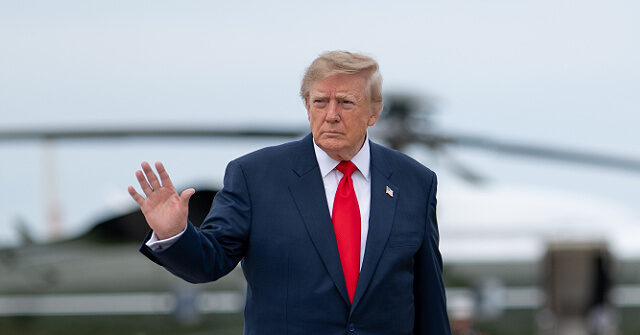
President Donald Trump said Tuesday that the United States must decide whether to secure victory over Iran the “nice way or the not nice way,” as his administration weighs further military action to prevent Tehran from rebuilding its nuclear weapons capabilities.
“We’re doing very well with Iran; we just have to make a final decision of which way do we want to win. Do we want to win the nice way or the not nice way,” Trump told reporters in the Oval Office.
The president indicated that the extensive damage inflicted on Iran’s nuclear facilities was insufficient if Tehran could rebuild its nuclear program in the years ahead.
“We could leave right now, and we would have done a good job, a great job,” Trump said, referring to previous American strikes against Iran’s nuclear facilities.
“But it’s not good enough for me. We have to make sure it doesn’t happen in five years, six years, ten years,” he added.
His remarks came as War Secretary Pete Hegseth confirmed that American forces were prepared to carry out additional operations against Iran if Trump ordered them, following an unannounced visit to Israel during which he met with Prime Minister Benjamin Netanyahu.
“We want to make sure that Iran never gets a nuclear weapon. We’re prepared to contribute any way necessary,” Hegseth told reporters Tuesday.
“We’ve done historic devastation to their military capabilities, but if they’re not willing to give it up and the president asks to go even further – we’re prepared.”
Hegseth visited American troops stationed at Israel’s Uvda Air Base on Monday and met privately with Netanyahu amid growing speculation over whether Washington would resume major strikes against Iran.
Three Israeli officials told Reuters that Iran was discussed during the meeting, while Netanyahu’s spokesman said the talks addressed regional threats and American-Israeli cooperation on offensive and defensive measures.
Hegseth praised Israel’s military capabilities and its role in preventing Iran from obtaining nuclear weapons but declined to disclose the substance of his conversation with Netanyahu.
“They have great capabilities, and we appreciate their contribution to ensuring Iran never gets a nuclear weapon,” he said.
“I was there visiting our troops — I had a chance to talk to the Prime Minister. Of course, the nature of our conversation is not something I would talk about.”
Asked separately whether he could elaborate on the meeting, Trump was similarly guarded.
“I can’t do that now, no,” the president replied.
The meeting came as Netanyahu renewed his call for eliminating Iran’s ruling regime, arguing that leaving it in power would allow Tehran to rebuild its nuclear program and regional network of armed proxies.
“We are committed to completing the elimination of the Iranian regime,” Netanyahu said Tuesday, adding that he had discussed the objective with Trump repeatedly.
Speaking at Tel Hai University in northern Israel, Netanyahu described Tehran as the center of a regional network of terrorist organizations and argued that removing its leadership would also weaken Hezbollah in Lebanon.
“Finishing the job means bringing down the terrorist regime in Iran. It is the head of this poisonous octopus. You cut it off, and it will fall. We will also have peace with Lebanon,” he said.
Trump had publicly endorsed Netanyahu ahead of Israel’s October 27 election, praising the prime minister as a partner in confronting Iran.
Netanyahu’s explicit call for regime change goes beyond Trump’s publicly stated objective of ensuring Iran never acquires nuclear weapons. Trump has not announced a decision to pursue the overthrow of Tehran’s government.
Meanwhile, Iranian officials signaled little willingness to make the nuclear concessions Washington has sought.
Maj. Gen. Mohsen Rezaei, secretary of Iran’s Supreme National Security Council, declared Tuesday that Tehran would not permit any of its enriched uranium to leave the country.
“Not a single gram of enriched uranium will be removed from Iran,” Rezaei wrote on X following a meeting with Pakistan’s army chief, Field Marshal Asim Munir, in Tehran.
“There will be no negotiations until the United States takes steps to build trust,” he added, insisting that Washington must first fulfill Iran’s conditions.
Iranian President Masoud Pezeshkian and Parliament Speaker Mohammad Bagher Qalibaf delivered similar messages during Munir’s visit, demanding an end to American sanctions and military threats and adherence to Tehran’s conditions for a negotiated settlement.
The diplomatic impasse comes as Iranian officials are deliberately prolonging negotiations in an effort to deny Trump a political victory ahead of the November 3 midterm elections, according to a Reuters report Tuesday citing three senior Iranian officials and another Iranian insider.
“Iran is preparing for renewed Israeli and US attacks, not for a deal with America to end the war,” one of the officials told the outlet.
“The clerical establishment is determined not to give Trump a political victory,” the official added.
The White House, however, said Tuesday that the United States would not attack Iran before the midterms, while maintaining its naval blockade and economic pressure on Tehran.
Deputy White House Press Secretary Anna Kelly said the blockade would remain in force as the administration continued efforts to restrict Iran’s access to oil revenues.
The confrontation follows months of American and Israeli military operations that have severely damaged Iran’s nuclear facilities, conventional forces, and military-industrial infrastructure without producing a lasting agreement over its nuclear program or the Strait of Hormuz.
Trump also disclosed Tuesday that he had approached several European governments about assisting the United States, only to have them decline.
“We don’t need any help, but I was testing them,” he said.
With Tehran refusing to relinquish its enriched uranium, Netanyahu pressing for the removal of Iran’s leadership, and American forces prepared for additional operations, the administration faces the question Trump raised Tuesday: whether Washington can secure its objectives through diplomacy or will turn again to military force.
Joshua Klein is a reporter for Breitbart News. Email him at [email protected]. Follow him on Twitter @JoshuaKlein.