Republicans need strong turnout from evangelical Protestants and to get close to Trump’s support levels among Catholics in order to defend their narrow congressional majorities in November.
Instead, high-profile Catholic social media influencers and their evangelical equivalents have been duking it out over Pope Leo XIV’s denunciations of the Iran war while members of both groups have been publicly critical of Trump recirculating posts some went so far as to describe as blasphemous.
It is possible this infighting is a purely online phenomenon with little real-world impact on ordinary voters or electoral outcomes.
Certainly, contentious debates among right-leaning podcasters on subjects like Iran and American support for Israel have done little to dent Trump’s poll numbers with Republicans, conservatives, or self-described MAGA supporters.
Similarly, prominent evangelical intellectuals and leaders in some Protestant conservative denominations have publicly dissented on Trump since he entered national politics more than a decade ago with little discernable effect on how conservative Christians as a group have voted in the past three presidential elections.
But strategic use of influencers and new media platforms helped Trump reach low-propensity voters as he won the popular vote and swept all seven battleground states in 2024.
The get-out-the-vote strategy was spearheaded by billionaire Elon Musk, from whom Trump is at least partially estranged, and conservative activist Charlie Kirk, who was assassinated last year. Their influence will need to be replicated elsewhere. Low-propensity voters will be even more difficult to turn out in a midterm election without Trump on the ballot.
Trump hasn’t gotten as much support from conservative Catholic intellectuals on the Iran war as then-President George W. Bush did when Pope John Paul II criticized the 2003 invasion of Iraq. John Paul II used less pacifistic language than Pope Leo and had been heralded as a hero by conservative anticommunists during the Cold War. Some prominent conservative Catholic laymen, like Fox News host Sean Hannity, have risen to Trump’s defense.
Conservative Catholics have also generally been more outspoken about perceived backsliding on social issues in Trump’s second term. The Trump administration has been permissive on the abortion drug mifepristone and appointed a longtime abortion rights supporter, Robert F. Kennedy Jr., to run the Department of Health and Human Services.
Candidate Trump also weakened the Republican platform planks on abortion and marriage during the 2024 GOP convention in Milwaukee after leaving them largely intact in 2016 and 2020.
Since being tossed from the White House Religious Liberties Commission for making anti-Israel comments at a public meeting earlier this year, Catholic influencer Carrie Prejan Boller has become an increasingly vocal Trump detractor. It is worth noting that she is a relatively recent Catholic convert and actual church teaching on Israel and related subjects is far more nuanced than her strident positions.
Evangelicals have mostly stuck by Trump, even with prominent defectors such as Southern Baptist leader Russell Moore and New York Times columnist David French railing against widespread Christian support for the president, given his personal life and tendency to make incendiary statements. More typical has been Franklin Graham, son of and successor to the great evangelist Billy Graham, who hailed Trump as the “most pro-Christian, pro-life president in my lifetime” in a speech to the Conservative Political Action Conference in March.
Growing cooperation between Catholics and evangelicals throughout the 1990s helped make the Christian Right a more powerful force than it had been during the early years of Jerry Falwell’s Moral Majority.
The organized Christian Right was slow to embrace Trump in 2016, with many preferring Sen. Ted Cruz (R-TX) or political neophytes like Ben Carson. One significant exception was Falwell’s son, Jerry Falwell Jr., but he had been more active at Liberty University than in his father’s political work. Trump had little record on social issues and was more drawn to religious leaders like Norman Vincent Peale, who wrote The Power of Positive Thinking. Many of Trump’s early religious supporters were proponents of the prosperity Gospel, which maintains God rewards believers with material wealth.
Trump worked to get to know evangelical voters, buying a table at Billy Graham’s 95th birthday party and bringing 2008 Republican vice presidential nominee Sarah Palin as a guest. He made specific commitments to choose conservative Supreme Court justices and switched his position to oppose legal abortion in most cases. Trump picked evangelical Mike Pence, a proven social conservative, as his running mate in 2016.
Pence and many of his socially conservative aides broke with Trump in the aftermath of the 2020 election and the Jan. 6, 2021, attack on the Capitol. But evangelical voters noted Trump kept many of his campaign promises. He was a strong defender of Christianity’s cultural significance. In 2022, all three Trump appointees to the Supreme Court voted to overturn Roe v. Wade. Past Republican nominees unexpectedly saved Roe in Planned Parenthood v. Casey 30 years earlier.
Mormon voters expressed moral qualms about Trump, but he still managed to win Utah in three straight presidential elections, including when conservative independent Evan McMullin made a serious attempt to spoil the state in 2016.
In 2024, Trump won 63% of Protestants and 59% of Catholics, according to exit polls. Trump carried 72% of white Protestants and 63% of white Catholics. Among white born-again or evangelical Christians, Trump took 82% of the vote.
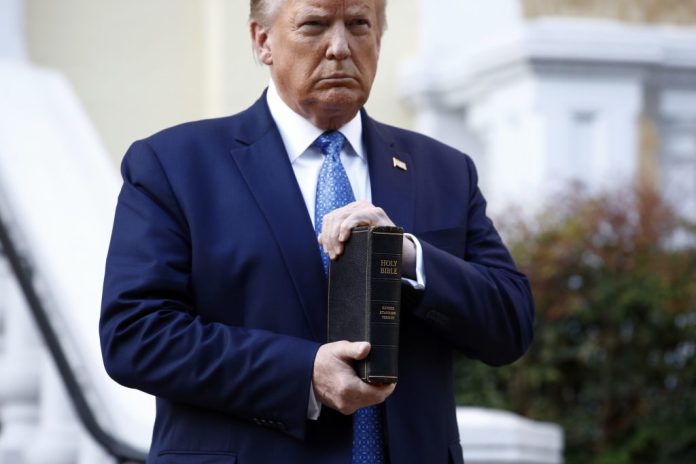
Trump has recorded himself reading Bible verses that will be released on Tuesday as part of a marathon session at the Museum of the Bible. Other key administration figures participated. Vice President JD Vance is set to publish a book about his faith journey, which included a stint as an evangelical and culminated in his conversion to Catholicism.
Democrats will try to make inroads with Catholics this year while hoping for lower evangelical turnout. Democratic operatives are especially interested in playing up Trump’s spat with the pope.
HEGSETH-AFFILIATED PASTOR DOUG WILSON SAYS TRUMP ‘HAS TO DO BETTER’ AFTER AI JESUS DEBACLE
“I have nothing against the pope,” Trump told reporters at the White House on Thursday. “If the pope looked at the 42,000 people that were killed over the last two or three months, as [protesters] with no weapons, no nothing … I have a right to disagree with the pope.”
“I want him to preach the Gospel,” Trump later added. “I’m all about the Gospel — but I also know that you cannot let a certain country, which is a very mean-spirited country, have a nuclear weapon. If they did, they would use it.”