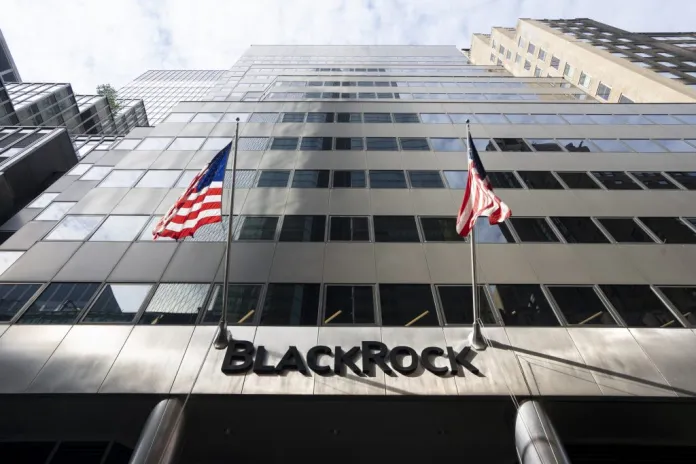
EXCLUSIVE — Three of the world’s largest asset management firms have used retirement shares as leverage in corporate political fights to push environmental, social, and governance investing goals on Wall Street, a free market watchdog is claiming.
BlackRock, Vanguard, and State Street have effectively turned clients’ retirement accounts into pro-ESG voting power, according to a new report from the Bull Moose Project shared exclusively with the Washington Examiner.
The Bull Moose Project, a populist conservatism advocacy group, found that the Big Three asset managers have cornered the market on “passive funds,” which many Americans rely on for retirement, to accumulate outsized voting power inside major American corporations.
These funds are considered “passive” because they simply track the stock market and are designed to replicate its performance. Mimicking market returns, passive funds fluctuate in accordance with the index they are tied to, such as the S&P 500 or Nasdaq.
The Bull Moose Project says passive funds that automatically mirror the market do not draw from detailed, company-specific research that informs how traditional active investors choose to cast shareholder votes. Rather, according to the Bull Moose Project, the massive reservoir of shareholder voting power consolidated by the Big Three is largely delegated to the whims of small “stewardship” teams inside these firms that focus on top-down ideologies and political trends, not bottom-up business analysis.
Stewardship team members entrusted with such decision-making concerning corporate governance are often advocates of ESG principles, such as racial hiring quotas or net-zero carbon emission goals. For instance, State Street’s Americas head of asset stewardship, Holly Fetter, has championed wealth redistribution in order to disrupt “class oppression” and encouraged companies to consider the racial diversity of their boards.
BlackRock, Vanguard, and State Street accordingly hold significant sway over shareholder voting outcomes. When it comes to voting on shareholder proposals, their internal stewardship teams can weigh in on ESG resolutions, DEI policies, and other ideological corporate battles.
DOJ BACKS ANTITRUST LAWSUIT ACCUSING BLACKROCK AND OTHERS OF COLLUDING TO BOOST ESG
“Three Wall Street firms have quietly become the most powerful unelected force in American corporate policy, using ordinary Americans’ retirement savings to advance a political agenda those same Americans never voted for,” Aiden Buzzetti, president and founder of the Bull Moose Project, told the Washington Examiner.
BlackRock referred the Washington Examiner to its recently published annual report on investment stewardship, which outlines the company’s fiduciary obligations to act in the best interest of its clients as stewards of their assets.
The yearly report mentions that BlackRock is legally required to make proxy voting determinations on behalf of clients, who have delegated voting authority to the asset manager, “in a manner that is consistent with their investment objectives.”
BlackRock says its benchmark policies governing investment stewardship take “a financial materiality-based approach and are focused solely on advancing clients’ long-term financial interests.”
BlackRock’s publicly viewable voting record shows the company supported corporate management on approximately 88% of more than 154,000 proposals voted globally in 2025, indicating that investors and company leadership were aligned on a vast majority of proposed items at shareholder meetings.
In 2015, BlackRock’s stewardship team did not vote in support of any shareholder proposals addressing perceived “climate-related risks,” finding that many of them were “over-reaching, lacked economic merit, or sought outcomes that were unlikely to promote long-term financial value.”
While most of BlackRock’s clients defer voting decisions to BlackRock, the company has also created opportunities for eligible clients to participate in the proxy voting process. BlackRock Voting Choice, a pass-through voting program, allows clients to be a part of how their shares are voted, should they elect to do so.
Since the initiative’s inception in 2022, BlackRock has continued to build out Voting Choice by expanding the pool of eligible client assets and extending the range of voting policies that clients can choose from.
The Bull Moose Project report proposes “mirror voting” as a remedy to the shareholder voting system that would “rein in the Big Three’s radical stewardship teams and reduce Wall Street’s weaponization without cutting off Americans’ access to index fund investing options.”
Under mirror voting, during a shareholder vote, active investors’ votes are cast and counted first, then the passive funds’ shares would be allocated proportionally. In practice, if all of the active shareholders in Company A support a given proposal at a vote of 55% to 45%, the Big Three firms would automatically vote their shares to match, with 55% for and 45% against.
The Bull Moose Project argues mirror voting would make sure that passive funds function as intended: If passive funds mirror the market in the investment process, they should mirror the market when shareholders vote.
“[Mirror voting] prevents the Big Three’s stewardship teams from acting like shadow regulators and prevents corporate governance from becoming a politicized get-out-the-vote contest,” the Bull Moose Project report says.
Buzzetti urged oversight officials in the Trump administration not to leave the Big Three’s voting power unchecked.
“The Trump administration has rightly begun dismantling the woke capital regime, and Chairman Atkins’s SEC has taken important first steps,” Buzzetti said. “But unless Washington confronts the Big Three’s stewardship teams directly, ESG will not disappear. It will simply be put on ice, waiting for the next administration.”
Under the Trump administration, the Securities and Exchange Commission has moved to crack down on the influence of proxy advisers, such as Glass Lewis and the Institutional Shareholder Services, over shareholder decisions.
Asset managers have historically relied on recommendations from proxy advisory firms, which offer what conservative critics deem highly politicized advice during the vote-casting process. However, there is an ideological divide growing between proxy advisers, which remain strong proponents of ESG, and the Big Three asset managers, whose support of ESG practices has dramatically dwindled in response to changing market trends.
Several watchdog reports have shown the Wall Street giants inching further away from ESG over the past few years.
A November 2025 report from the Committee to Unleash Prosperity, titled “Putting Politics Over Pensions,” examined the votes of 600 investment management companies on ESG proposals over the previous proxy season. BlackRock and Vanguard both received an A grade in the report for voting against ESG-focused proposals 90% or more of the time, while State Street earned a B rating with a 75% rejection rate, which is up from a C in 2023 and D in 2022.
PROXY FIRM CRITICS SAY THEY’RE CALLING THE SHOTS IN CORPORATE AMERICA
A February report by ShareAction ranked State Street 63rd and BlackRock 67th out of 70 organizations analyzed based on their lack of support for environmental and social issues in the 2024 proxy voting cycle. Vanguard, meanwhile, landed last in 70th place.
Vanguard did not respond to a request for comment. State Street declined.