Massachusetts Republicans could have their best chance in decades at winning House seats under a “good government” proposal that California political operatives want to reverse in their state.
Massachusetts GOP candidates haven’t gained popularity in the Democratic-dominant state, home to liberal icons such as the late Sen. Edward M. Kennedy, who held his seat for nearly 47 years — and Kennedy’s successor a few years after his 2009 death, Sen. Elizabeth Warren (D-MA). In 2024, President Donald Trump got trounced by Democratic rival Kamala Harris in Massachusetts, 61% to 36%.
But ballot rules would change in a way potentially favorable to Bay State Republicans. That is, if a Nov. 3 midterm elections ballot measure passes.
Under Question 3, Massachusetts would scrap its traditional party primaries and replace them with an all-party, top-two system, the same basic model California has used for more than a decade. And in Massachusetts, it’s already used in many municipal elections. Question 3 would put every candidate on a single primary ballot, regardless of party affiliation, with the top two vote-getters advancing to the November general election.
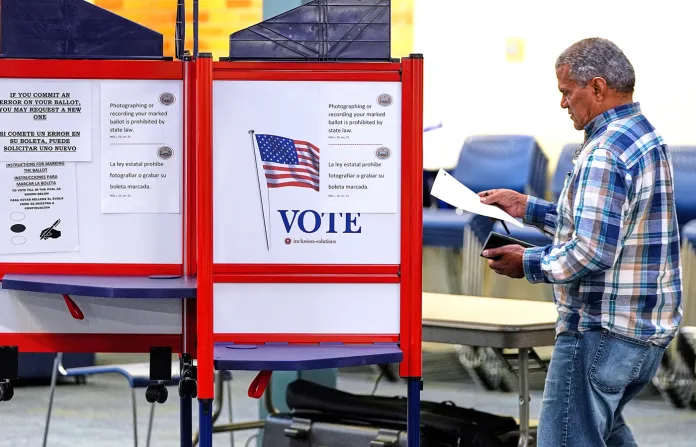
Massachusetts’ Question 3 ballot measure would put every candidate on a single primary ballot, regardless of party affiliation, with the top two vote-getters advancing to the November general election. That is, if the ballot measure passes on Nov 3. (Charles Krupa/AP)
” data-large-file=”https://conservativenewsbriefing.com/wp-content/uploads/2026/10/proposed-massachusetts-voting-change-could-make-gop-candidates-more-competitive.webp” height=”658″ width=”1024″ src=”https://conservativenewsbriefing.com/wp-content/uploads/2026/10/proposed-massachusetts-voting-change-could-make-gop-candidates-more-competitive.webp” alt=”Massachusetts’ Question 3 ballot measure would put every candidate on a single primary ballot, regardless of party affiliation, with the top two vote-getters advancing to the November general election. That is, if the ballot measure passes on Nov 3. (Charles Krupa/AP)” class=”wp-image-4751394″ srcset=”https://conservativenewsbriefing.com/wp-content/uploads/2026/10/proposed-massachusetts-voting-change-could-make-gop-candidates-more-competitive-2.webp 1400w, https://conservativenewsbriefing.com/wp-content/uploads/2026/10/proposed-massachusetts-voting-change-could-make-gop-candidates-more-competitive-2.webp?resize=300,193 300w, https://conservativenewsbriefing.com/wp-content/uploads/2026/10/proposed-massachusetts-voting-change-could-make-gop-candidates-more-competitive-2.webp?resize=768,494 768w, https://conservativenewsbriefing.com/wp-content/uploads/2026/10/proposed-massachusetts-voting-change-could-make-gop-candidates-more-competitive-2.webp?resize=1024,658 1024w, https://conservativenewsbriefing.com/wp-content/uploads/2026/10/proposed-massachusetts-voting-change-could-make-gop-candidates-more-competitive-2.webp?resize=150,96 150w, https://conservativenewsbriefing.com/wp-content/uploads/2026/10/proposed-massachusetts-voting-change-could-make-gop-candidates-more-competitive-2.webp?resize=696,447 696w, https://conservativenewsbriefing.com/wp-content/uploads/2026/10/proposed-massachusetts-voting-change-could-make-gop-candidates-more-competitive-2.webp?resize=1068,687 1068w” sizes=”(max-width: 1024px) 100vw, 1024px”>
“Question 3 would extend this same familiar model to state legislative, statewide, and federal elections — and add more information for voters by listing party registration and endorsements,” says the Yes On 3 campaign website. “It is the system Massachusetts already uses at the local level, applied to state and federal races.
Supporters say the change would shake up a political system they argue has become too comfortable. Too many elections effectively are decided in low-turnout primaries or without meaningful competition, their argument goes.
A spool of stickers rests on a table at a polling station during Massachusetts state primary voting, Sept. 3, 2024, at the Newton Free Library, in Newton, Mass. (AP Photo/Steven Senne)
” data-large-file=”https://conservativenewsbriefing.com/wp-content/uploads/2026/10/proposed-massachusetts-voting-change-could-make-gop-candidates-more-competitive-1.webp” src=”https://conservativenewsbriefing.com/wp-content/uploads/2026/10/proposed-massachusetts-voting-change-could-make-gop-candidates-more-competitive-1.webp” alt=”A spool of "I voted" stickers rests on a table.” class=”wp-image-4746005″ srcset=”https://conservativenewsbriefing.com/wp-content/uploads/2026/10/proposed-massachusetts-voting-change-could-make-gop-candidates-more-competitive-4.webp 1024w, https://conservativenewsbriefing.com/wp-content/uploads/2026/10/proposed-massachusetts-voting-change-could-make-gop-candidates-more-competitive-4.webp?resize=300,200 300w, https://conservativenewsbriefing.com/wp-content/uploads/2026/10/proposed-massachusetts-voting-change-could-make-gop-candidates-more-competitive-4.webp?resize=768,512 768w, https://conservativenewsbriefing.com/wp-content/uploads/2026/10/proposed-massachusetts-voting-change-could-make-gop-candidates-more-competitive-4.webp?resize=150,100 150w, https://conservativenewsbriefing.com/wp-content/uploads/2026/10/proposed-massachusetts-voting-change-could-make-gop-candidates-more-competitive-4.webp?resize=696,464 696w” sizes=”(max-width: 1024px) 100vw, 1024px”>
“Many people in Massachusetts feel that the political system isn’t working,” Jesse Littlewood, campaign manager for the Coalition for Healthy Democracy, the group behind Question 3, told Boston.com. “It’s not representing us because politicians don’t have to listen to us, and that is because of the structure of how they get elected.”
But opponents, including the Massachusetts Democratic Party, Republican Party, AFL-CIO, and other unions, argue the proposal could make campaigns more expensive, weaken party organizations, and increase the influence of wealthy donors and outside groups.
The Massachusetts GOP opposition is notable, since, in practical terms, its candidates stand to gain the most under a top-two system. The last two Republican House members, Peter Blute and Peter Torkildsen, lost reelection in 1996 after four years in office. Over the past 30 years, it’s been a clean sweep for Massachusetts Democrats in House races.
A long-term trend, aided no doubt by gerrymandering of House seats by the Democratic-dominated legislature. In the 2024 election cycle, in 7 of 9 House districts, incumbent Democrats faced no Republican opponents. The closest 2024 Massachusetts House race was in the Cape Cod and South Shore 9th Congressional District, where Rep. Bill Keating (D-MA) beat his Republican opponent 56% to 43%.
If the top-two system were enacted in Massachusetts, Republicans could potentially win seats through savvy political tactics and plain luck. Specifically, Republicans would field two — and only two — candidates in a House district loaded with politically ambitious Democrats. If each GOP candidate could score about 20% in the primary, a multi-candidate Democratic field would divvy up the remaining 60%. Both Republicans would secure general-election ballot spots and notch a GOP pickup no matter which candidate won.
The California test
This isn’t a far-fetched scenario. It’s frequently played out, or has come reasonably close, in California, the most populous Democratic-dominated state.
Voters narrowly approved Proposition 14 in 2010, creating the state’s top-two system. Under the rules, all candidates for voter-nominated state and congressional offices appear on the same primary ballot, and the two highest vote-getters advance to November regardless of party.
The system was intended, among other things, to broaden competition and encourage candidates to reach beyond their traditional partisan bases. But more than a decade later, some Golden State Democrats argue the experiment has produced problems of its own.
California Democratic Party Chairman Rusty Hicks has called the current system a failure that should be “revised or repealed.” The issue was highlighted during this year’s crowded gubernatorial primary, when Democratic vote-splitting raised the possibility that two Republicans could finish first and second and advance to November despite California’s overwhelming Democratic voter registration. That outcome did not materialize. Democrat Xavier Becerra and Republican Steve Hilton advanced to the general election, but the scare helped revive a broader fight over the system.
And Democrats in California have lost elections due to the top-two system. In the June 2012 California primary election, a heavily fragmented Democratic field led to a political disaster for the party in a newly drawn Inland Southern California seat that forced Rep. Pete Aguilar (D-CA) to wait two years to start his congressional career. The then-Redlands Mayor was the top Democratic vote-getter in the House race against several party rivals, with 22.6%. But GOP Rep. Gary Miller, who had represented some of the new district’s territory under the previously used House map, got 26.7% of the vote, while Republican state Sen. Bob Dutton earned 24.9%.
That iced out Aguilar in what was a Democratic-leaning district. Even as President Barack Obama that November, on his way to a second term, won California over Republican rival Mitt Romney 60%-37% — about the same as Kamala Harris’s 2024 win in Massachusetts.
In that blue-leaning congressional district, Miller knew he was living on political borrowed time and retired from Congress after 16 years. Aguilar’s time in top-two purgatory wasn’t long, as he nabbed the open seat in 2014 and has easily won reelection since. He’s also risen to his party’s third-highest leadership position in the minority, House Democratic Caucus chairman.
The point being, though, that if gamed right, a state’s minority party can try to use a top-two election system for its own political advantage. And occasionally win under it.
California Democrats certainly know that. An initiative seeking to repeal California’s top-two primary has been cleared to begin collecting signatures for the 2028 ballot. If it qualifies and passes, California would return to a system in which each party’s top primary candidate advances to the general election.
Political consultant Dave Spencer said California can show that the model is capable of expanding competition and reducing the influence of party insiders, even if it has not solved every problem.
“California hasn’t proven that a top two system is the answer to everything,” Spencer told the Washington Examiner. “But the top two primary isn’t the source of all of California’s political problems either.”
The California experience also complicates the question of whether top-two primaries actually produce the political transformation their supporters promise. A recent CalMatters analysis found that California’s system has not fundamentally eliminated conventional partisan contests. Most races still produce a Democrat-versus-Republican matchup in November, while the system has occasionally produced the unusual prospect of two Democrats or two Republicans facing each other.
Debate over whether Question 3 would boost democracy
This all puts Massachusetts reformers in an awkward position. They are pitching voters on a system that California Democrats increasingly regard as a liability.
Danielle Allen, the coalition’s convening chair and a Harvard University professor, argues that an all-party primary would shift more of the decision-making to November, when turnout is typically much higher. While giving independent and minor-party candidates a chance to compete on the same ballot as Democrats and Republicans.
Jordan Berg Powers, chair of Voter Rights MA, claims that Massachusetts already has an open primary: The state’s large bloc of unenrolled voters can choose either a Democratic or Republican ballot. He worries the proposed system would force candidates to campaign to a much broader electorate, potentially making money and name recognition even more important.
Mike Fahey, a political strategist who has followed primary reform efforts, told the Washington Examiner the debate ultimately comes down to who wields the most influence.
“Question 3 is really a debate over where political power should live: with the smaller group of voters who participate in party primaries, or with the much larger electorate that shows up in November,” Fahey said.
The debate also involves representation.
Tanisha Sullivan, president of the NAACP New England Area Conference and a Question 3 supporter, claims that the current system leaves too many voters, particularly working-class voters and communities of color, with little meaningful say because so many races are effectively settled before November.
“Most of our elections offer no real choice,” Sullivan wrote in a recent defense of Question 3. She pointed to the state’s latest legislative elections, in which only 25 of the 200 lawmakers seeking reelection faced primary challengers.
The question is whether changing the primary system would actually solve that problem or simply create a different set of winners and losers.
Mayors offer a different example
Massachusetts supporters have another case study closer to home.
At least 10 Massachusetts mayors have backed Question 3, arguing that top-two elections already work in municipal races. Boston, for example, uses preliminary elections in which the top two finishers advance to a final contest. Medford Mayor Breanna Lungo-Koehn, Malden Mayor Gary Christenson, and Chicopee Mayor John Vieau are among those who have joined the “Yes on 3” campaign. The group also includes New Bedford Mayor Jon Mitchell and Fitchburg Mayor Samantha Squailia.
Lungo-Koehn said the reform would bring “more competition, broader voter participation, and more accountability” to Massachusetts elections. Westfield Mayor Michael McCabe called it a “practical reform,” arguing that voters in state elections should get the same basic choice they already have in many municipal races.
But Daniel Schlozman, a Johns Hopkins University political scientist, cautions against assuming that what works in a mayoral race will necessarily translate to statewide and federal politics.
“It is very tempting to say this electoral system worked for me, and it is therefore good,” Schlozman said of the mayors. He argued the political dynamics of a small city differ from those of statewide races, where national party identities, presidential politics, and ideological divisions play a much larger role. In a traditional partisan primary, party affiliation gives voters an immediate clue about where a candidate stands. In an all-party primary, voters could face a crowded field of candidates from the same party — or several candidates with different political affiliations competing side by side — and have to do more of the sorting themselves.
CALIFORNIA VOTER ID BALLOT MEASURE COULD BE RARE GOP STATEWIDE WIN
Still, opponents argue that races in California show that campaigns can become more dependent on candidates with the money, connections, or name recognition to introduce themselves to a much larger electorate.
For Massachusetts, that leaves California as both a case study and a cautionary tale.
Barnini Chakraborty (@Barnini) is a senior political reporter at the Washington Examiner.