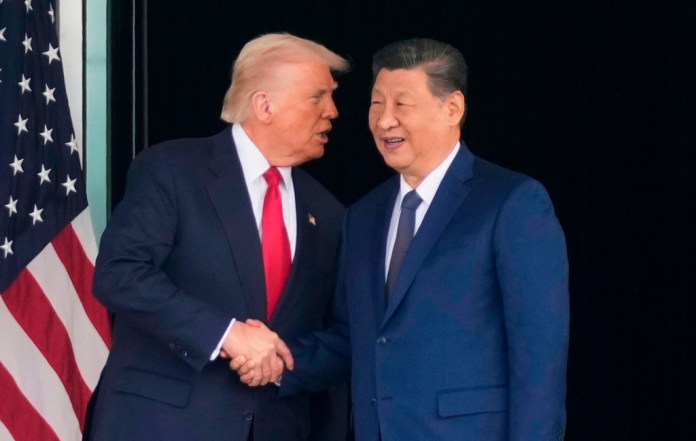
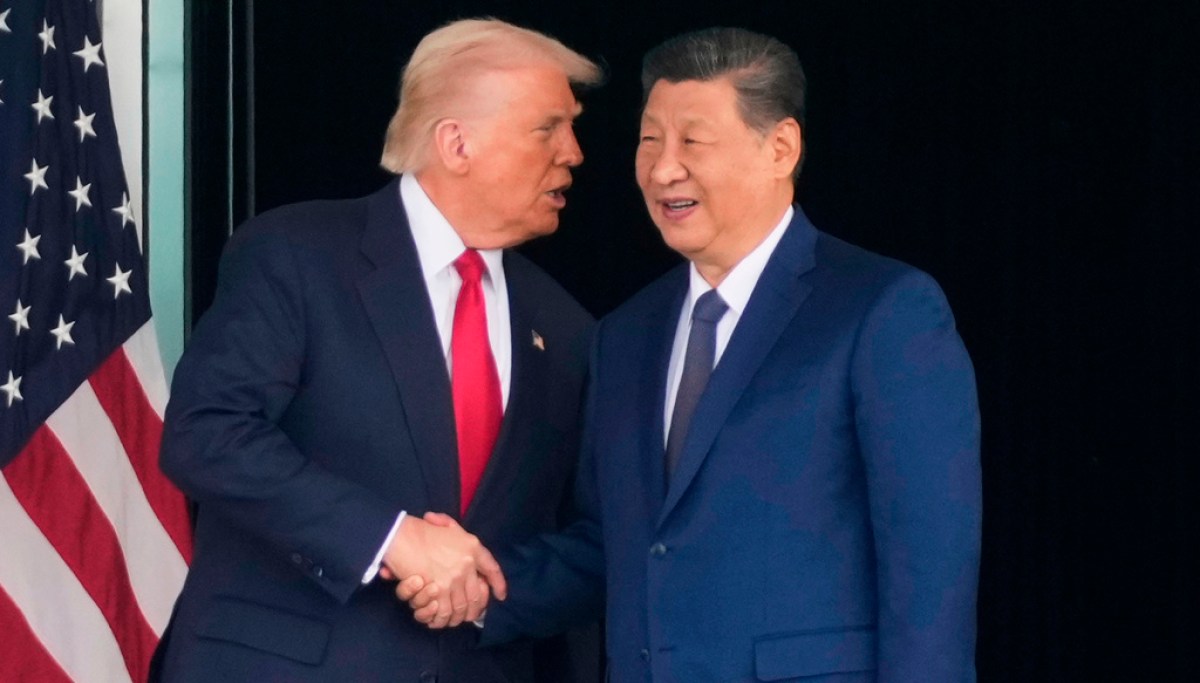
Despite President Donald Trump’s resistance to greenlighting another American arms sale to Taiwan before his highly anticipated trip to Beijing, he will not alter existing American policy regarding the island nation, according to senior administration officials and China policy experts.
A bipartisan group of senators urged the president earlier this week to sign off on the transfer of $14 billion in weapons to Taiwan, aid that has been delayed for months ahead of Trump’s summit with Chinese President Xi Jinping. Headlines and private Washington chatter have suggested that Trump may seek to extend an olive branch to Beijing to gain Chinese assistance in ending the Iranian conflict, not to mention smoothing over the simmering trade war between the two nations.
Though Trump is leaving without rubberstamping the transfer, White House officials say that “there has been no change in U.S. policy with regards to Taiwan.”
John Ullyot, the former chief National Security Council spokesman from Trump’s first term in office, contested the idea that Trump has lost his handle on Iran and said it is unlikely that Xi “will make a direct move for something that’s a major change” in Taiwan policy in exchange for Chinese assistance in the Middle East.
“As much as [Trump] is under pressure, politically, on Iran, he does not need China’s help to finish that,” he said in an interview. “China can be helpful, but he does not need China to resolve the Iran conflict because he holds very strong cards on the kinetic side, as well as on the economic side. President Trump would be giving up a lot just to get President Xi’s help in resolving something he can do on his own. He’s not going to give up something as important as our long-standing relationship with Taiwan and our stance of ambiguity, calculated ambiguity.”
Lyle Goldstein, the director of Defense Priorities’ Asia Program, disputed Trump’s solid footing regarding Iran but added that Chinese officials doubt they can move Trump on Taiwan policy, even if “he’s so inconsistent and prone to follow the last piece of advice that he got.”
“The Chinese know it, of course,” he told the Washington Examiner. “Hope for major movement there probably doesn’t exist in Beijing, so my guess would be that their approach is to kind of just hope for a reiteration of the [former President Joe] Biden-era formula of not supporting Taiwan independence.”
TRUMP’S HORMUZ BLOCKADE UNLIKELY TO DRAW CHINA INTO IRAN CONFLICT
The United States has provided Taiwan defense assistance for the better part of the past 50 years, and Goldstein believes China will not “go to the mat” on pressuring Trump to halt arms sales.
Goldstein did suggest one possible exception to that rule. He told the Washington Examiner that Xi may seek “some kind of gentleman’s agreement” with Trump to exclude ATACMS and other “new missile systems” from future weapons transfers.
“I think that has the Chinese a bit lathered up, the idea that Taiwan would have that kind of offensive capability,” he told the Washington Examiner.
One senior Trump administration official told the Washington Examiner that the concerns from certain members of Congress, including some Republicans, over Taiwan are “nothing more than feckless hand-wringing.”
“President Trump has demonstrated that he’s dedicated to ensuring peace across the globe,” that person said. “Yes, he’s stated that he would rather work with China than against it — and I’d argue the trade dialogue speaks to that — but China simply won’t be allowed to invade Taiwan on his watch. Full stop.”
Trump has certainly evolved his own rhetoric, compared to his first term, when discussing America’s most powerful frenemy.
On Monday, Trump told reporters in the Oval Office that Taiwan will almost certainly be discussed during the summit.
“He’ll bring up Taiwan, I think, more than I will,” the president said, adding that he expected Xi to raise the topic of U.S. arms sales to the island.
TRUMP SAYS HE’S ‘SERIOUSLY CONSIDERING’ MAKING VENEZUELA THE 51ST STATE
Trump also referred to Xi as a “gentleman” who “loves his country” but borrowed language he frequently uses to characterize Russia’s 2022 invasion of Ukraine to send something of a warning on Taiwan to his Chinese counterpart.
“If you have the right president, I don’t think it’ll happen,” he said. “I think we’ll be fine. I have a very good relationship with President Xi. He knows I don’t want that to happen.”