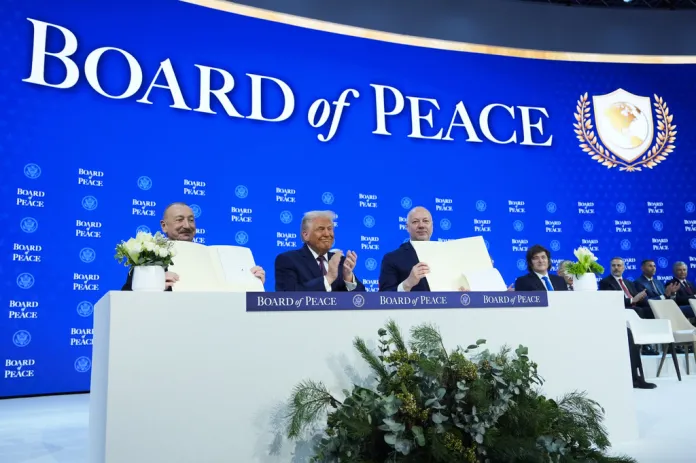
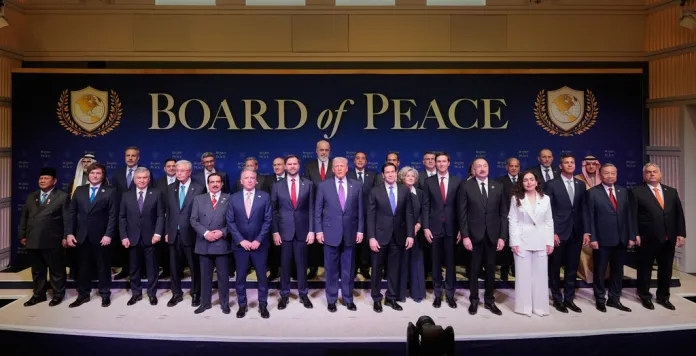
President Donald Trump’s Board of Peace is not hoarding lump-sum payments from member states and collecting on each nation’s pledges bit by bit as required for its projects in Gaza instead.
The international committee, of which Trump is the inaugural and permanent chairman, received pledges of $1 billion from dozens of charter members. However, an official involved with Board of Peace operations told the Washington Examiner that “the goal is not to go around and hoard significant sums of cash,” instead calling up partners for contribution when an immediate need is identified.
“If we had $17,000,000,000, we wouldn’t be able to spend it. It wouldn’t be responsible to collect that amount to do nothing with it. The goal is to collect the funds necessary as the projects are ready to be implemented,” the official told the Washington Examiner.
The official claimed individual nations step in to contribute to projects they deem relevant and asserted that the board has always “received funding in the instances where we’ve sought it.”
“Countries have stepped forward and said, ‘We want to fund this. We want to fund that.’ Saudi Arabia, they want to fund a specific thing — versus Qatar wants to do something else,” the official explained. “And as those things are ready and we present them — how we’re going to spend it and we show them everything that we plan to do — they’ll provide [funding].”
In February, Morocco touted that it had made the “first-ever financial contribution” to the board and committed its police forces to training law enforcement in Gaza. It also pledged to send military officers to help operate the ISF, tackle the process of deradicalization, and open a field hospital for the region.
Leaders in the United Arab Emirates approved a $100 million payment to the international organization earlier this month to help fund training for the new police force in Gaza.
Both of these contributions were announced by the nations themselves, as the Board of Peace seeks to avoid offering a “grand tally” or scrutinized public accounting for different members’ donations.
“We’re not the United Nations,” the official said. “This is a voluntary, good-faith thing. We’re asking for money on an as-needed basis, as projects come online.”
Most financial contributions have been transmitted through the board’s account with J.P. Morgan. The organization also accepts donations through a fund set up by the World Bank, believing that it is a mechanism that some members might see as tested and reliable.
On Wednesday, a Financial Times report characterized the Board of Peace as “stuck in limbo with no money flowing,” citing sources claiming the World Bank fund is empty.
“Zero dollars have been deposited,” a source told the outlet.
The Board of Peace has publicly pushed back on the report, accusing the Financial Times of “[trying] desperately to sow doubt” on the organization’s effectiveness and leaning into a “narrative they wanted to push.” The board acknowledged that the World Bank fund has “not been utilized by the donor community,” but emphasized they are being “funded through other mechanisms” — an apparent reference to the J.P. Morgan account.
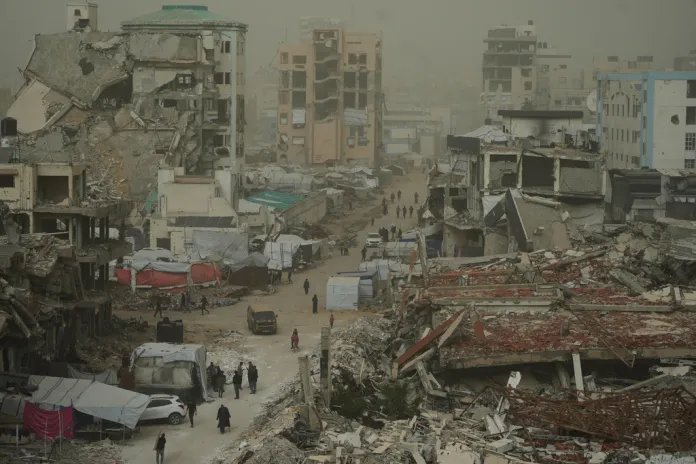
As of now, the Board of Peace has not begun operating in Gaza. A variety of hurdles remain for the organization to undertake its mission in earnest, including the deployment of the National Committee for the Administration of Gaza, the “transitional technocratic governance body” meant to inherit authority over Gaza from Hamas.
The International Stabilization Force, the peace-keeping troops intended to ensure Gaza remains secure and peaceful throughout the transition, has not established a presence either. Personnel for the ISF pledged by Albania, Indonesia, Kazakhstan, Kosovo, and Morocco have not been deployed.
“At this stage, the principal obstacle to full implementation remains Hamas’ refusal to accept verified decommissioning, relinquish coercive control, and permit a genuine civilian transition in Gaza,” the Board of Peace said in a report earlier this month.
Nikolay Mladenov, head of the Board of Peace, is pressing the United Nations Security Council to use “every means at [their] disposal” to pressure Hamas toward disarmament.
“You cannot build a future with armed groups running the streets, hiding in tunnels and stockpiling weapons,” Mladenov said earlier this month. “You cannot deliver reconstruction with militias on every corner.”
Hamas spokesman Hazem Qassem has rejected this characterization, asserting that the U.S. and its allies have not sufficiently held Israel accountable for its violations of the ceasefire.
TRUMP SAYS US WILL CONTRIBUTE $10 BILLION TO BOARD OF PEACE
The conflict with Iran has not helped the implementation of the peace plan, complicating diplomatic relationships and dominating the attention of international partners.
“Because the intensity of the conflict between U.S. and Iranian forces remains very high, the BoP has tended to be left behind,” Indonesian Defense Minister Sjafrie Sjamsoeddin told his nation’s parliament last week. “Since the BoP has been left behind, the ISF has also been left behind.”
Trump will remain the board’s chairman even after the completion of his second term in the Oval Office. This perpetual mandate provides the organization with a timeline for projects divorced from elections or the political developments in any member country.