Civil rights groups are asking a federal court to block the Justice Department immediately from using election materials seized in a January raid of a Fulton County elections facility, warning that the data could be repurposed to build what they described as a “national voter database” of eligible voters.
In a motion filed late Sunday, the NAACP and allied organizations argued that Georgia voters entrusted the state with “sensitive personal information” when registering to vote and that the Jan. 28 seizure of ballots and related records “breached that guarantee, infringed constitutional protections of privacy, and interfered with the right to vote.”

“NAACP members believe there is a substantial risk their sensitive data will … be improperly disclosed to agencies and third parties or misused to create a national voter database, purge eligible voters, or used for other improper purposes, chilling their right to vote, free from intimidation,” the filing states.
The motion asks the court to fast-track the dispute, proposing a full briefing schedule by Feb. 24, and to impose strict limits on how federal investigators may use the materials. Specifically, the groups want a judge to bar the government from using the data for anything beyond the criminal investigation outlined in the search warrant, including voter roll maintenance, election administration, or immigration enforcement.
Civil rights groups seek limits and disclosures
The motion also asks the court to order the government to produce a detailed inventory of everything seized, identify anyone who accessed the records outside the investigative team, disclose whether copies were made, and explain the safeguards in place to secure the information.
The request was filed by the Lawyers’ Committee for Civil Rights Under Law on behalf of the NAACP’s national, Georgia, and Atlanta branches, along with the Georgia Coalition for the People’s Agenda.
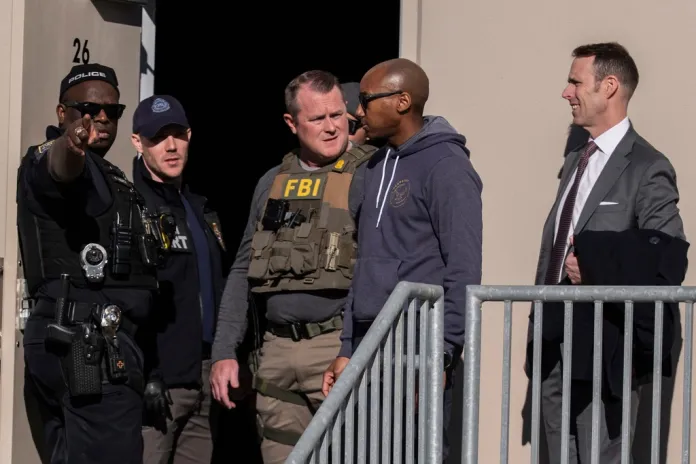
FBI agents executed the warrant at an elections hub just south of Atlanta, seeking documents tied to the 2020 election. According to a copy of the search warrant, investigators collected ballots, scanner tabulator tapes, electronic ballot images generated during counting and recounting, and voter registration rolls.
Fulton County officials separately have moved for the return of the seized materials.
FBI inquiry tied to long-running scrutiny of 2020 election
An FBI affidavit supporting the warrant states the criminal investigation began with a referral from Kurt Olsen, a lawyer who advised President Donald Trump during efforts to challenge his 2020 election loss and who now serves as Trump’s director of election security and integrity.
Trump has repeatedly focused on Fulton County, a Democratic stronghold and Georgia’s most populous jurisdiction, which has been under scrutiny for various election-related errors tied to its handling of the 2020 election.
The bureau’s search was led by Hugh Raymond Evans, who used at least 11 witnesses to support a finding of probable cause to believe that unknown individuals committed election law violations by improperly preserving records and tabulating fictitious ballots.
One glaring deficiency in Fulton County’s data, according to the affidavit, is related to the 2020 election recount results as well as when the final numbers were reported. The county initially reported a total of 511,343 ballots, 17,434 fewer than originally counted. One day later, the county reported that 527,925 total ballots had been recorded in the recount.
Evan wrote that even if the irregularities were not the result of intentional action, “It would be a violation of federal law regardless of whether the failure to retain records or the deprivation of a fair tabulation of a vote was outcome determinative for any particular election or race.”
Fulton County officials wrote in a Tuesday filing that the evidence cited by the FBI was “woefully short” of substantiating probable cause. The county argued that any actions would need to be willful to be crimes, and that no proof has yet been established to purport willful neglect.
Meanwhile, the latest civil rights motion pointed to Trump’s recent public remarks, including comments on former co-Deputy FBI Director Dan Bongino’s new podcast in which the president suggested Republicans “should take over the voting” in multiple states and said the federal government “ought to nationalize the voting.”
The White House later backtracked on Trump’s comments, saying he has been a strong proponent of election integrity measures such as the Safeguarding American Voter Eligibility Act, which is currently making its way through Congress. That legislation would require voter ID for federal elections.
Broader legal clash over voter data access
The civil rights groups’ request places the Fulton County seizure within a wider DOJ push to obtain detailed voter information nationwide. The department has sued at least 23 states and the District of Columbia seeking access to voter data, saying the effort is aimed at strengthening election security. The Trump administration has highlighted failures in Democratic states to maintain up-to-date voter rolls.
Democratic officials and voting-rights advocates, however, argue the requests risk exposing sensitive personal information and could be used for unrelated federal initiatives. Courts in several states have already rejected DOJ attempts to compel the production of certain records.
FULTON COUNTY FBI RAID PROMPTED BY TRUMP 2020 ELECTION LAWYER’S CRIMINAL REFERRAL
“These repeated efforts to access 2020 election records, including by the entity that now has custody of them, heightens concerns about the privacy and security of sensitive voter data and exacerbates the chill on voting rights,” the civil rights motion stated.
The court has not yet ruled on the request for expedited consideration.