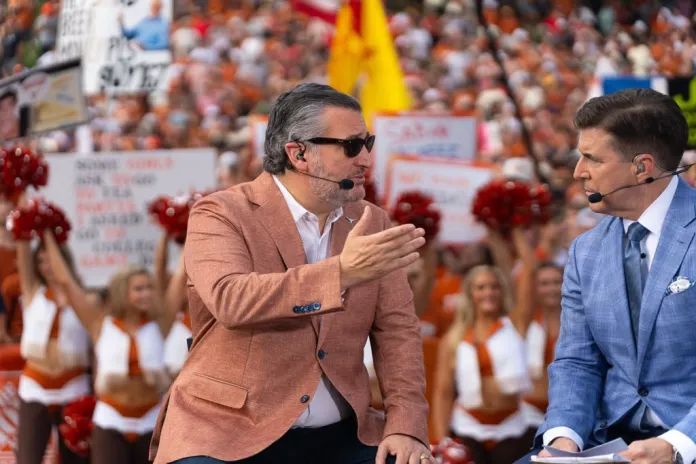
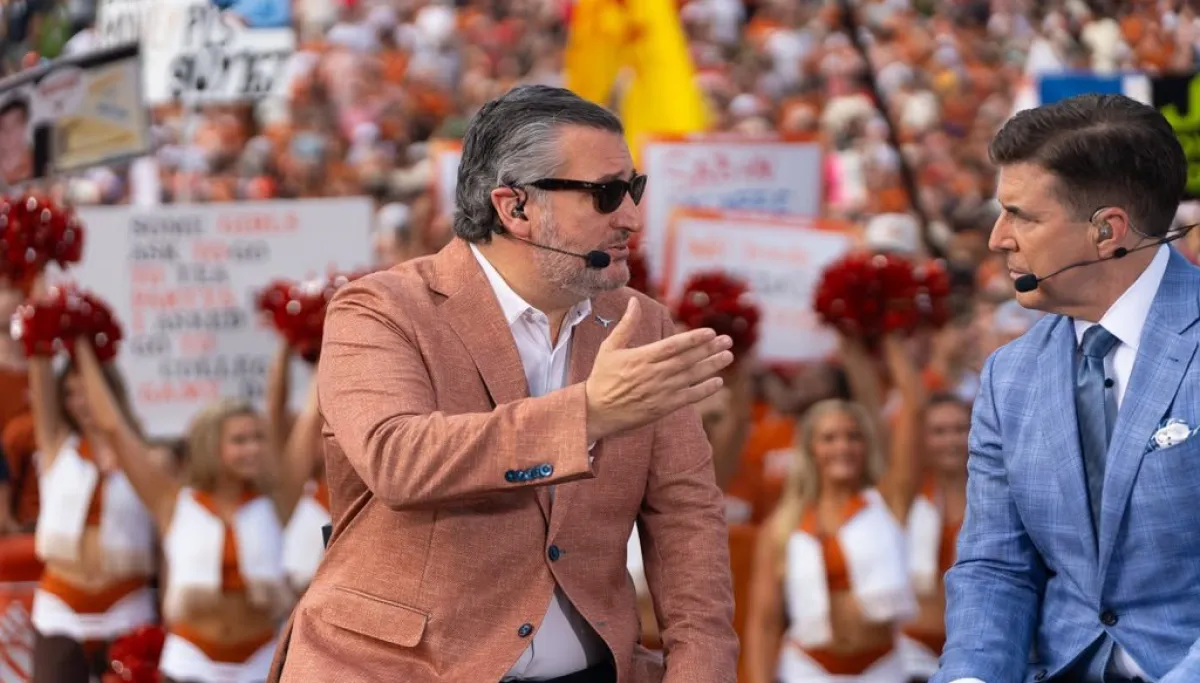
Sen. Ted Cruz (R-TX) faced a raucous gathering at his appearance on ESPN’s College GameDay while pushing for the passage of the Protect College Sports Act, whose closure vote was delayed due to the congressional August recess.
ESPN’s College GameDay hosted Cruz for an interview with Rece Davis, in which Cruz discussed the efforts for a nationalized regulation of collegiate sports standards ahead of Saturday’s University of Texas at Austin’s Week 2 matchup against Ohio State University.
Cruz’s microphone was drowned out by UT Austin students and fans who were heard chanting, “Ted — you — suck,” for 10 minutes, eventually booing the senator off-stage.
Cruz proposed the co-authored Protect College Sports Act with Sen. Maria Cantwell (D-WA) and with the support of Sen. Chris Coons (D-DE) in late May.
“College sports is an amazing institution. It has been an avenue for opportunity for millions of young men and young women,” Cruz said.
“[Student athletes] are producing enormous value at an enormous scale,” Cruz noted, discussing the pay-to-play notion in the Name, Image, Likeness debate of collegiate student-athlete compensation.
“Every single student can still earn name, image, and likeness money,” he said. “What this bill does is prohibit a booster in a back alley showing up with a bag of cash and doing things under the table.”
Texas Democratic Senate candidate James Talarico, whose defense of transgender athletes in girls’ sports has caused backlash, weighed in on the harsh reaction to Cruz’s appearance.
Cruz elaborated in the interview that the Protect College Sports Act also “brings order to chaos; it protects the students and their ability to be compensated … but it also puts reasonable rules in place,” acknowledging the recent legal standoff between LSU and the SEC after a judge cleared the way for a pair of former NFL signees to return for a fifth year of eligibility despite having declared and signed with the professional league.
There are currently 34 states that have collegiate name, image, and likeness-related laws in effect. Texas enacted its NIL law in 2023, followed by a 2023 amendment. Several states have no bill proposed at this time and operate under institution-based and NCAA interim guidelines.
President Donald Trump has urged bipartisan support for the Protect College Sports Act, “to send the bill to my desk, and I will sign it.”
Democrats, hesitant to hand over a win to Republicans ahead of the midterm election season, have pushed back on the legislation’s language. The Congressional Black Caucus and AFL-CIO also came out against it, though amendments dealing with issues that were never part of the bill also started coming up.
Cruz optimistically ended the interview saying, “I think we’re going to get the [60] votes.”
The bipartisan legislation was confirmed by Senate Majority Leader John Thune (R-SD) to be “teed up” for a September vote, leaving the Senate two weeks to hold a vote on the bill after the chamber reconvenes on Sept. 14 from the August recess.
THE 10 SENATE SEATS MOST LIKELY TO FLIP IN 2026
“College sports is something that needs to be fixed; [Cruz and Cantwell] have a good solution,” said Thune.
If the bill passes the Senate, it still faces a steep climb in the House, which is more narrowly divided and has tried for months to bring the less athlete-friendly SCORE Act to a vote and failed repeatedly.