Democrats’ brief victory on government funding could be short-lived as Republicans bring their own demands, including a crackdown on “sanctuary” cities and states, to a fight over Immigration and Customs Enforcement conduct.
A White House-brokered deal to reopen the government, poised to clear Congress early next week, gave Democrats what they wanted to negotiate over immigration enforcement, namely a two-week extension on funding for the Department of Homeland Security.
Republicans have demonstrated openness to codifying some of their reforms, which come after two U.S. citizens were fatally shot in Minneapolis this month. For any deal to be signed into law, however, will require a give-and-take that Democrats might find difficult to swallow.
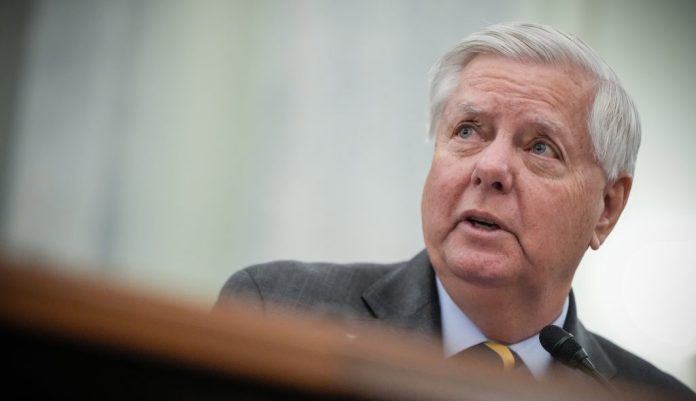
Sen. Lindsey Graham (R-SC) wants to penalize Democratic jurisdictions that refuse to cooperate with the federal government on immigration, a demand being echoed in the House. And Republicans believe that some of the demands from Democrats go too far, signaling early resistance to a ban on the face masks agents wear to shield their identity.
The impasse raises the distinct possibility of a protracted fight over the DHS funding bill. Democrats see the threat of DHS shuttering in two weeks as leverage in negotiations, given that the department also oversees the Coast Guard and emergency response to natural disasters. Yet, DHS also represents a small share of the federal budget, and immigration enforcement will continue regardless of a deal.
“I could see DHS shut down for a long, long, long time,” said Sen. John Kennedy (R-LA), a member of the Appropriations Committee.
For days, the Senate has been consumed by how to avert a prolonged government shutdown and on Friday sent six spending bills, including the DHS funding patch, to the House with President Donald Trump’s support.
But the early posturing has already begun over an ICE compromise that Republicans say won’t happen without concessions. Graham, in particular, has been on a war path over the negotiations, accusing Republicans of not fighting hard enough to reclaim the narrative on immigration after the death of Alex Pretti last weekend.
“I’m doing it now because we’re off the rails, both parties, quite frankly,” Graham said.
He’s asking for a vote on his bill to impose criminal penalties on state officials who “wilfully interfere” with immigration enforcement. Other Republicans are framing the reforms proposed by Democrats as a bad-faith effort to provide de facto amnesty to illegal immigrants.
In a Friday floor speech, Sen. Eric Schmitt (R-MO) claimed the demands would make the job of immigration officers “personally dangerous and professionally impossible.”
The rhetoric is a sign of how challenging it will be to get any deal done after similar efforts at bipartisanship have fallen apart. Most recently, negotiators walked away empty-handed after a long-shot push to extend enhanced Obamacare subsidies that were at the center of the last government shutdown.
Kennedy expressed openness to building on modest reforms that already passed the House, chiefly more money for body cameras and de-escalation training. But the Louisiana Republican expressed skepticism that anything meaningful can be done given how polarizing ICE has become since Trump returned to the White House.
“In my opinion, it’s not the details that matter here,” Kennedy said. “This has nothing to do with whether we want to make ICE a more efficient organization, or whether we want to make it look like an eighth-grade car wash. This has to do with, the Democrats cannot afford to appear to like ICE, and so, that’s why we are where we are.”
That skepticism runs both ways, particularly when it comes to the Trump administration. Democrats don’t believe the president is serious about reining in some of the more aggressive tactics by ICE, even as he deployed border czar Tom Homan, viewed in Washington as a steadier hand, to take over immigration operations in Minneapolis.
As a sign of goodwill, the White House also ended its expanded operation in Maine, following outreach from Senate Appropriations Chairwoman Susan Collins (R-ME). Those steps and others like it are ringing hollow with the more progressive members of the Senate who want to see a larger pullback.
“I mean, Tom Homan is not an avatar for responsible immigration policy, and I have no idea what they’re doing in Maine,” said Sen. Chris Murphy (D-CT), the top Democratic appropriator for DHS spending.
“I was just in Texas, a state 20 times as big as Maine, and they are involved in gross illegality every single day in the state of Texas,” he said, “and that is representative of what’s happening all around the country.”
For that reason, Democrats are demanding that any compromise be codified into law, and so far, Republicans are entertaining the conversation. Earlier this week, Senate Majority Leader John Thune (R-SD) judged that “there’s a path to consider some of those things and negotiate that out.”
His remark came after Democrats united behind a list of “legislative objectives” that includes tightening warrant requirements and instituting use-of-force rules akin to those adopted by local police departments.
In the meantime, Republicans are bringing their own ideas to the table, with Sen. Thom Tillis (R-NC) proposing a monthly reporting requirement on immigration raids. Tillis billed it as a way to rebuild public trust.
But Republicans are simultaneously reluctant to embrace the full set of reforms proposed by Democrats and believe that any deal must also advance their priorities.
Sen. Katie Britt (R-AL), the top appropriator on DHS funding, told reporters to expect Republicans to voice their “really strong stance” on law enforcement and push to end sanctuary city policies that bar cooperation with federal authorities.
“I think Democrats are going to have to be really honest about that, and we’re going to have a lot of debate,” she said.
Like Graham, Tillis has a piece of legislation that allows legal action for families “harmed when sanctuary jurisdictions put public safety in danger.”
When asked about the sanctuary legislation, Murphy told the Washington Examiner he would not be negotiating in public.
“I’m not interested in negotiating out loud,” Murphy said. “I think they know where we are, and let’s sit down and get in the room and start talking about a path forward.”
Reaching a compromise will be even harder in the House, where rabble-rousing conservatives have already threatened to hold up floor business over illegal immigration.
DEMOCRATS PUSH TO BLACKLIST ICE OFFICERS FROM FUTURE GOVERNMENT JOBS
Rep. Chip Roy (R-TX), who is running for attorney general of Texas, warned Wednesday that he had his own “list” of demands on DHS if Democrats get theirs.
Also this week, House Minority Leader Hakeem Jeffries (D-NY) began to draw red lines, telling reporters on Friday that Democrats “will not walk away from” their demand that ICE obtain judicial warrants before entering homes. He also called for an “explicit prohibition” on the deportation of U.S. citizens.
Rachel Schilke contributed to this report.