The United States’s efforts to permanently neutralize the Iranian threat are getting tangled by disagreements between allies who, theoretically, should be cheering on the regime’s collapse.
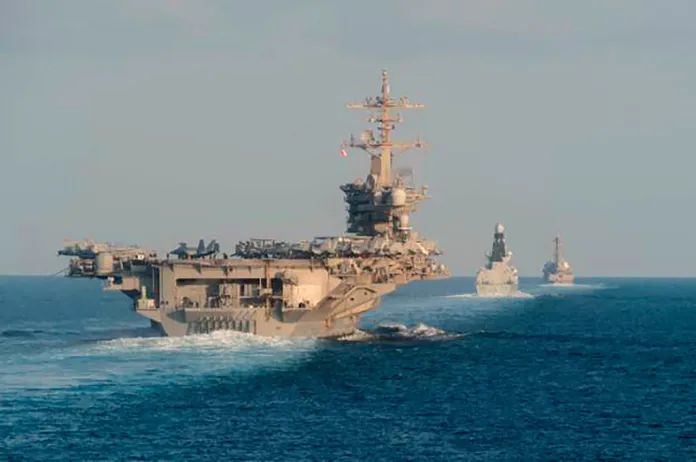
President Donald Trump has ordered a second aircraft carrier to join military patrols in the Strait of Hormuz. U.S. envoys are meeting with increasingly desperate Iranian counterparts with the goal of negotiating an end to the Islamic Republic’s nuclear program. Yet in ally Saudi Arabia, more ink is being spilled over the United Arab Emirates and Israel.
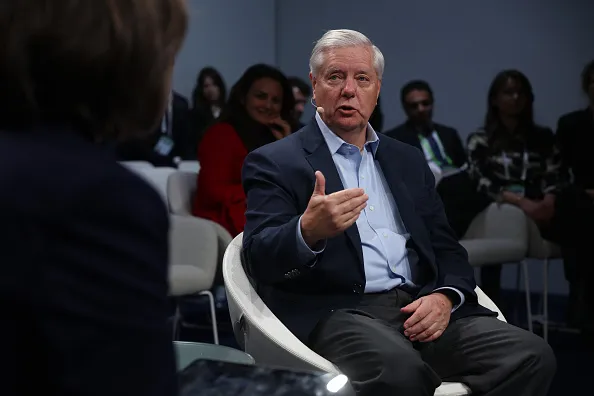
Sen. Lindsey Graham (R-SC), widely considered the Senate’s supreme warhawk toward the Islamic Republic, had a hard time controlling his anger at the Munich Security Conference on Friday as he lambasted the Middle East leaders he believes are holding back an anti-Iran coalition with petty feuds.
“As to [Saudi Crown Prince Mohammed bin Salman] and [UAE President Mohamed bin Zayed Al Nahyan] — knock it off. … I’m tired of this crap,” he shouted from the stage, warning that “any leader in the region that doesn’t understand you’re on the verge of history — history will judge you poorly.”
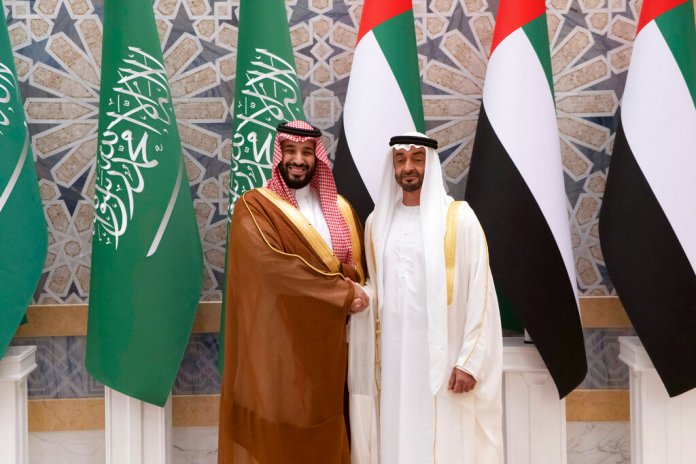
The Saudis and Emiratis have escalated their rhetoric against one another in recent weeks, focusing more public statements on each other’s perceived duplicity than on the Shia dictatorship that is under threat of collapse.
The sour relations emerged in December 2025, ostensibly over conflicting visions for leadership in Yemen and Sudan. That complicated dispute has quickly mutated into tit-for-tat insults using Israel as a wedge.
Saudi media outlets and sermons delivered by state-sanctioned clerics have renewed campaigns characterizing Israel as “Zionist aggressors” and decrying the Jewish state’s treatment of muslims’ “downtrodden brothers in Palestine.” The Saudis have used this narrative as a cudgel to hammer the UAE, which maintains a close relationship with Israel, as a “Zionist Trojan Horse” and “proxy” being used to “divide Arab states.”
The UAE has been accused of lobbying American advocacy groups to brand Saudi Arabia as “antisemitic” in response.
Graham, exasperated in Munich on Friday, urged Salman to abandon his line of attack on the UAE and focus on the Iranian regime — a Shia extremist government despised by both the Saudis and Emiratis.
“MBS is not a Zionist, and you’re emboldening Iran by having this conflict,” Graham pleaded. “Now I know they have differences in Yemen and differences in Sudan, but we’ve got to think big picture.”
He added: “Sunni Islam will go, if it were up to the ayatollah [Ali Khamenei]. They want to destroy Islam, and they want to kill us. We’ve got a lot in common here.”
The Saudi government has been mercurial in its public statements about possible further U.S. and Israeli intervention in the Islamic Republic, fluctuating between tacit support and refusal to cooperate.
Saudi Defense Minister Prince Khalid bin Salman reportedly warned U.S. officials late last month that failing to follow through on Trump’s early threats of military action would “only embolden the regime.”
But the U.S. and Israel should not expect any help from Riyadh. Salman has barred U.S. and Israeli forces from using any part of his territory to stage such an attack.
Jacob Olidort, chief research officer and director of American security at the America First Policy Institute, told the Washington Examiner that the Saudis’ refusal to be entangled with U.S. operations is not based on diverging visions about Iran, but instead concerns about how a conflict with Tehran could spill over into their own borders.
“Any public expressions of concern on the part of Saudi Arabia vis-a-vis military action towards Iran are a reflection of their concerns about being on the receiving end of any Iranian response,” Olidort said, adding that there appears to be a “consensus between Saudi Arabia and Israel on the need to eliminate threats from the Iranian regime, which is the view of the United States as well.”
Olidort added, “Whether this is ultimately achieved diplomatically or militarily, the outcome will likely encourage greater cooperation between Israel and its neighbors.”
Edmund Fitton-Brown, former British ambassador to Yemen and a senior fellow at the Foundation for Defense of Democracies, speculates that the reduction of Iranian influence caused by U.S.-Israeli military operations has counterintuitively given Saudi Arabia less reason to work with its Sunni rivals.
“They’re very conscious of their national security — both who is threatening them and also how do they avoid having unnecessary fallings out with dangerous neighbors or partners or interlocutors,” Fitton-Brown told the Washington Examiner.
He continued, “By making Iran look a lot less scary, which is what Israel did last year with U.S. involvement as well, that has changed the calculation for a number of countries in the region who are now less afraid of Iran than they were. And I think that’s true of Saudi Arabia.”
The State Department believes that despite the current bickering, efforts to reduce Iranian influence can only have a positive effect on the region.
“We do not share the premise that efforts to counter the Iranian regime’s malign activities undermine regional integration,” a spokesperson for the State Department told the Washington Examiner. “On the contrary, reducing the Iranian regime’s destabilizing activities creates conditions for broader stability and long-term cooperation.”
Abraham Accords optimism
The State Department is optimistic about the future of the Abraham Accords, the 2020 diplomatic framework crafted by the first Trump administration to normalize relations between Israel and its surrounding Arab neighbors.
The United Arab Emirates was the first Arab nation to sign on, followed by Bahrain, Sudan, and Morocco in the following years — all Sunni nations concerned with the existential threat of growing Iranian influence.
The U.S. believes the Abraham Accords remain a valuable mechanism for stabilizing the region and still sees them as an option on the table to bring Saudi Arabia closer in alignment with the West.
“The Abraham Accords have already delivered tangible security and economic benefits,” the State Department spokesperson told the Washington Examiner. “The United States remains committed to building on those gains in consultation with regional partners.”
The spokesperson added, “Expanding the Abraham Accords strengthens regional security, economic integration, and deterrence against malign actors.”
Since the Oct. 7, 2023, attacks by Hamas reignited Israel’s war in Gaza, Saudi Arabia has maintained that while it is interested in signing onto the accords, recognition of a Palestinian state and defense agreements with the U.S. are a precondition for normalizing its relationship with Israel.
“We want to be part of the Abraham Accords, but we want also to be sure that we secure a clear path to a two-state solution,” the Saudi crown prince said in November 2025. “We had a healthy discussion with Mr. President that we’re going to work on that to be sure that we can prepare the right situation as soon as possible.”
This position has been a cornerstone of Saudi Arabia’s efforts to maintain its status as an independent power with its feet firmly planted in the Islamic world, even as it modernizes and cooperates with Western powers such as the U.S. and Israel.
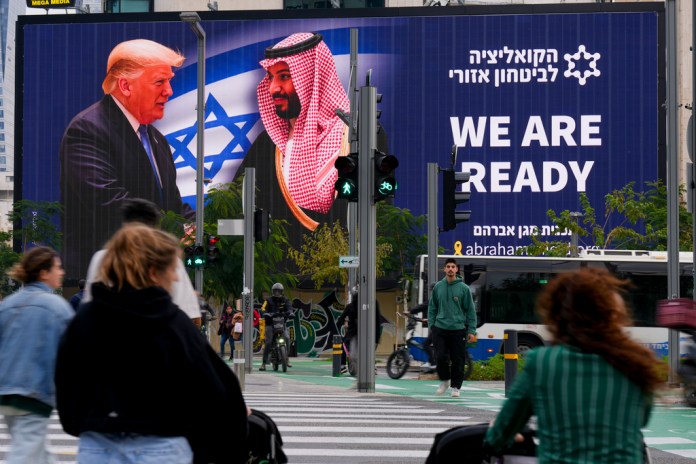
“Publicly, Saudi Arabia has not changed its stance on these positions — whether because doing so could expose it to new risks amid changing regional dynamics or frustrate its deepening ties with other regional actors,” Olidort told the Washington Examiner.
He continued, “Regardless, insofar as both of these demands are informed by Saudi Arabia’s need to create diplomatic and military buffers against Iran and its proxies, presumably the neutralization of threats from the Iranian regime could remove the sense of urgency of needing either or both, creating a new opportunity to work towards normalization of ties with Israel.”
Fitton-Brown believes the Saudis’ conditions for joining the Abraham Accords are ultimately a self-sabotaging position, leaving too much power in the hands of foreign actors who can willfully reset the board to keep the two countries from normalizing.
“If you set too many conditions — if you say that every star has to align before you can ever join the Abraham Accords — you’re actually effectively giving a veto to wreckers who don’t want it to happen,” he said. “And that was definitely one of the things that was in Hamas’s mind when they attacked Israel nearly two and a half years ago.”
“Is it really consistent with the dignity of Saudi Arabia that they give Hamas a veto?” he asked.
Israeli policies and military actions following its launch of the war in Gaza have cost it considerably when it comes to goodwill from its regional neighbors.
PENTAGON LOOKING TO REPLACE MASSIVE BOMBS USED IN IRAN ATTACK
Expansion of settlements into Palestinian territory, incursions into Syria following the fall of President Bashar Assad, and its unilateral strikes on Iranian military infrastructure have all contributed to diplomatic fatigue from Arab neighbors.
A pan-Arab survey conducted by the Arab Center Washington DC found that an overwhelming majority of respondents, 87%, opposed the idea of normalizing relations with Israel.