Taiwan’s conservative opposition leader has a very unusual problem. She needs to get close to the communist dictator threatening to conquer her country — but not so close that the voting public starts thinking they’re actually friends.
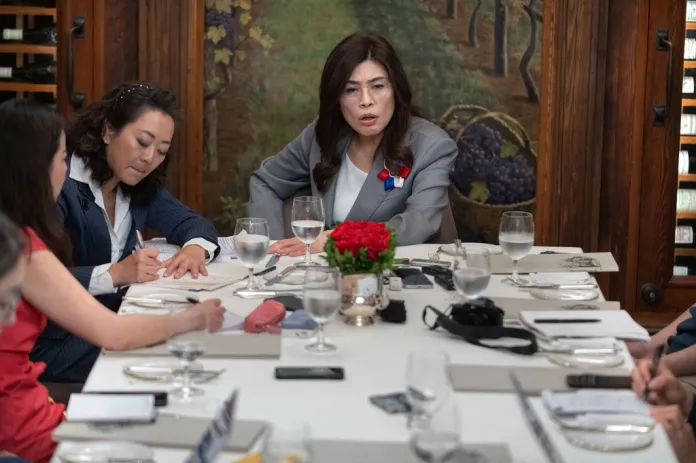
Kuomintang Chairwoman Cheng Li-wun sat down with American reporters on Friday at the Jefferson Hotel in Washington, D.C., where she reflected on her two-week tour of the United States. She has visited world-class universities such as Harvard and Columbia, met with congressional members from both chambers, and spoken with some of President Donald Trump’s closest allies.
One of her goals on this trip was to advocate against her own island’s sovereignty, characterizing self-declared independence as a frivolous and illegitimate provocation that could drag American soldiers into a war with Beijing. Her other goal was to convey to U.S. leaders that, despite that stance — and whatever her opponents might tell them behind her back — she is not some kind of crypto-communist.
“Some of [the people I met with] chose to tell me voluntarily that there were rumors about me before my arrival in D.C. … to deter my meeting with them,” Cheng told the reporters. “Even so, they decided to still meet with me in person and to try to clarify those rumors.”
“I’m really honest and candid and real and very sincere, and they can tell it. They can tell when they meet me in person,” Cheng said with a smile. “So, maybe some of them were so surprised that I’m like this and the KMT is not like what [opponents] portray.”
Cheng and the KMT are socially conservative Chinese nationalists. The party founded Taiwan as a Chinese government-in-exile after fleeing the mainland during the Communist Revolution.
They agree with Chinese paramount leader Xi Jinping that there is only one China and Taiwan is part of it. This is not a new or novel position. In fact, it was the codified consensus between China and Taiwan beginning in 1992. That agreement allowed cross-strait relations between the feuding governments to thaw, bonded as they were by shared Chinese identity. But that consensus began to fall apart after Beijing’s “one country, two systems” arrangement with Hong Kong resulted in a 2019 martial law crackdown and total subjugation.
The Taiwanese public began favoring total independence in response, and the Democratic Progressive Party — which has been in power for over a decade — has adopted the rhetoric that Taiwan is already a sovereign country independent from the mainland. Beijing does not approve, and the saber-rattling has reached deafening levels.
“The DPP was not very responsible in servicing the so-called ‘two-state theory,’ which caused the disruption of cross-strait dialogues and communication,” Cheng said of the rival party. “We saw a deterioration of the cross-strait relations, and without communications and dialogues, the war can happen at any moment.”
The war she was referencing is the theoretical endpoint of all Taiwanese politics — the hypothetical day the People’s Liberation Army calls to collect on Chinese sovereignty over the island. Taiwan has invested heavily in security infrastructure, defensive technology, and munitions in preparation for that day, which everybody hopes will never come.
Trump, seeking to avoid the U.S. being dragged into such a conflict with a near-peer adversary, said after meeting with Xi in Beijing last month that he is “not looking to have somebody go independent,” in reference to Taiwan. He said both sides needed to “cool down.”
And that’s just what Cheng aims to do. She accepted her own invitation to meet with Xi in April during a multiday trip to the mainland. That goodwill summit was the first of its kind in over a decade, and it was deeply divisive for the Taiwanese public.
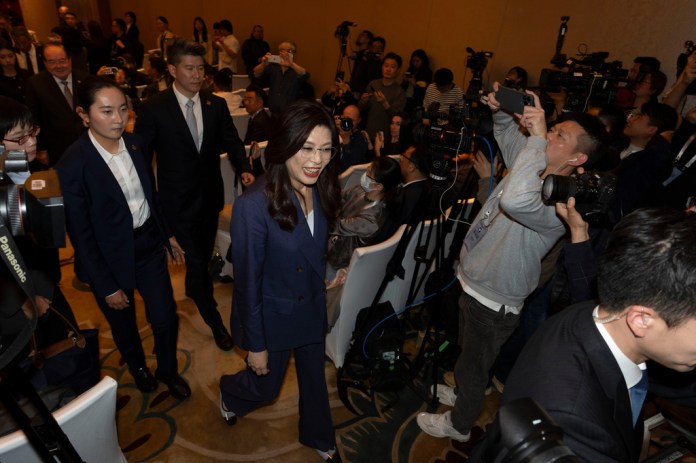
According to a study from the Brookings Institution, 46.6% of Taiwanese voters said they had a “negative” to “very negative” feeling about Cheng meeting Xi. Approximately 34.6% said they had a “positive” to “very positive” feeling about it, and 18.8% said they weren’t sure.
If critics were put off by the optics of Cheng chumming it up with the communist who would like to capture their island, they certainly would not appreciate the KMT leader’s assessment of Xi’s character.
“He’s been very gentle and very nice and very real during the meeting with me,” she told the American reporters on Friday. “He really wants to deal with cross-strait relations with peaceful means and avoid war.”
“For him, it’s crucially important that we accept — we recognize — we belong to the same, great Chinese family in a cultural-historical way,” she explained.
HEGSETH STRIKES SOFTER TONE ON CHINA AND STAYS QUIET ON TAIWAN AT SINGAPORE SUMMIT
Taiwanese politics has always been defined by the question of how the island relates to the mainland. Cheng is not offering anything new on the topic. She’s actually suggesting something old — the almost quaint idea that both sides of the strait can go back to coexisting peacefully under a convenient mythology of reuniting one day.
Beijing says there’s only one China. The KMT agrees. It would just like a very, very long time frame for actually deciding how they’ll make it work.