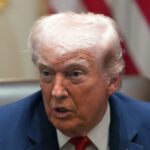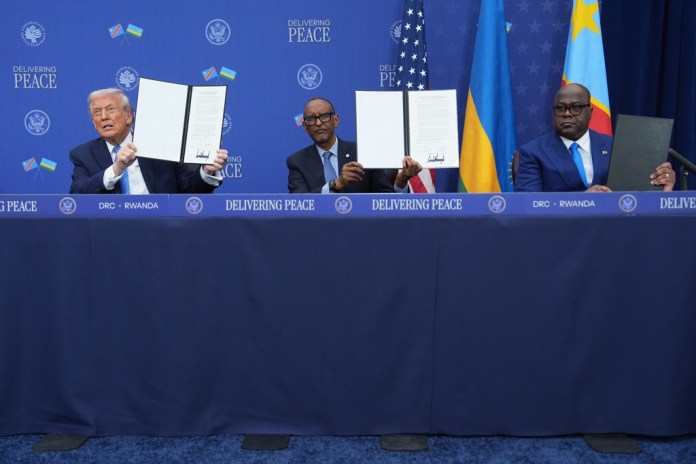
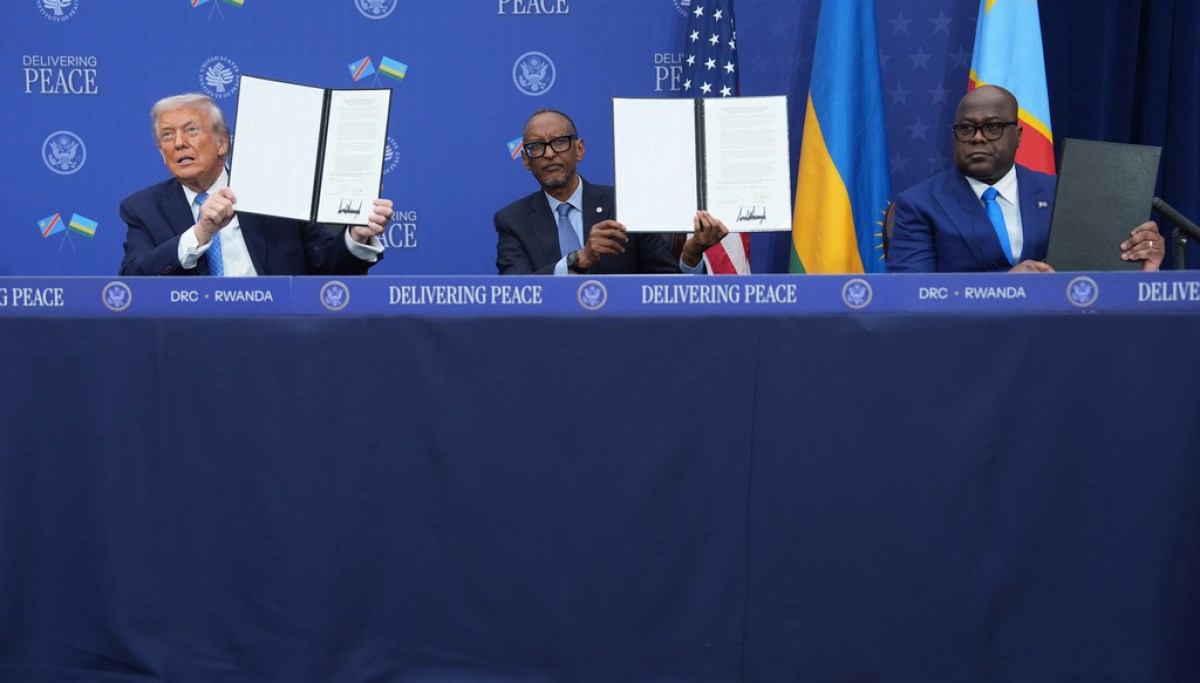
During the same week that President Donald Trump repeatedly denigrated Somali immigrants as “garbage,” he also welcomed a group of African leaders to Washington to champion a peace deal between the Democratic Republic of Congo and Rwanda, ending their decadeslong bitter conflict.
The contrast between Trump’s disgust at the Somali immigrants in Minnesota and his eagerness to champion the money to be made from access to critical minerals in Congo represents the different approaches Trump is taking when it comes to dealing with the African continent.
Flanked by Congolese President Felix Tshisekedi and Rwandan President Paul Kagame, Trump also bragged about a separate critical minerals deal that provides the United States with easier access to the mineral-rich region as it attempts to counter China’s dominance of rare earth minerals amid an escalating trade war.
Trump joked that “everybody’s going to make a lot of money” during his comments on Thursday at the newly renamed Donald J. Trump Institute of Peace, formerly the U.S. Institute of Peace.
But experts warned that Trump’s tactics in handling African nations may not be enough to counter China’s influence.
TRUMP TOUTS CONGO-RWANDA PEACE DEAL IN PUSH TO END YEARSLONG CONFLICT
“The only reason he is interested at this point is that the U.S. is so far behind China on critical minerals,” said Mathew Burrows, counselor in the executive office at the Stimson Center, with a prior decadeslong career at the State Department and the Central Intelligence Agency. “And he has done this all over the world. Countries who want his attention also seem to find critical minerals on their territory to offer him.”
Trump’s efforts to dismantle the U.S. Agency for International Development and cut 83% of its programs have led to a devastating impact on sub-Saharan Africa, including funding for the President’s Emergency Plan for AIDS Relief program. Researchers estimate 14 million lives could be lost by 2030 if the USAID cuts continue.
Cameron Hudson, a former senior fellow in the Africa Program at the Center for Strategic and International Studies, claimed that with the dismantling of USAID, “the administration appears to have adopted a burn-the-boats mentality in pursuit of a ‘trade, not aid’ model to Africa in a way that previous U.S. administrations, since the Clinton administration, have discussed but never aggressively pursued.”
“Intentionally or not, this approach has the power to reset Washington’s overall relationship with Africa in ways that are both disruptive but also contradictory,” he added.
Burrows claimed that the dismantling of USAID also represents Trump’s “lack of knowledge on most, not all, of the developing world, and also lack of real interest in helping.”
The administration rolled out the first of a series of “America First” global health deals with Kenyan President William Ruto on Thursday to replace some of the funding that USAID provided. Other African nations are expected to sign these agreements with the U.S. before the end of the year.
Africa not being treated as a monolith
Yet Trump’s approach to dealing with African nations also represents that he is not taking a monolithic strategy for the continent, former U.S. Ambassador to Ethiopia and Guinea Tibor Nagy told the Washington Examiner.
“Just like people would not expect the United States to deal with all of Europe, the same way, given the huge differences, it’s finally that Africa is also being looked at in parcels, instead of one policy towards the whole continent, which I think is great,” Nagy said.
Nagy also said he has “been so encouraged because President Trump has really shown a willingness to do his best to end conflicts which have been burdening Africa for a long time.”
Secretary of State Marco Rubio announced this week that a new policy under the Immigration and Nationality Act, the State Department will restrict visas for those who have orchestrated religious violence in the aftermath of harm against Christians in Nigeria.
“The United States is taking decisive action in response to the mass killings and violence against Christians by radical Islamic terrorists, Fulani ethnic militias, and other violent actors in Nigeria and beyond,” Rubio said in a statement.
The move comes after Trump claimed last month that he was “really angry” about the anti-Christian violence in Nigeria and ordered armed forces leaders to prepare for action in the West African nation to tackle Islamist militant groups. Officials in Nigeria said they welcome the military help but pushed back against claims of Christian genocide, claiming all groups of faith are targets for violence.
In contrast, Trump has taken a hard-line stance with other African nations. The president did not invite South Africa to participate in the G20 summit next year in Florida and paused foreign aid after the U.S. boycotted the summit hosted by President Cyril Ramaphosa in Johannesburg.
Ramaphosa spokesman Vincent Magwenya joked that the nation “will take a commercial break” from the G20 while Trump is leading it.
Part of Trump’s disapproval with South Africa stems from his accusations of racial discrimination against minority white Afrikaner farmers in the southernmost African country. In an extraordinary moment in May, Trump confronted Ramaphosa with video footage of alleged burial sites of white farmers when he visited the White House.
Trump is also actively working to bring an end to the three-year conflict in Sudan that has led to a severe humanitarian crisis, according to Rubio.
“The president has taken on this issue of Sudan personally, not sent out deputies to do it,” Rubio said during the final Cabinet meeting of the year on Tuesday. The secretary also claimed that Trump was “the only leader in the world” who could bring the conflict to an end.
Trump’s efforts to resolve peace on the African continent are striking, given his harsh attacks this week on Somali immigrants accused of defrauding multiple government social services programs of at least $1 billion.
He said Somalia was “barely a country,” went on a diatribe against Rep. Ilhan Omar (D-MN), who immigrated to the U.S. from Somalia, and slammed immigrants as ungrateful to the U.S. for taking them in.
“These aren’t people that work,” Trump said Tuesday. “These aren’t people that say, ‘Let’s go, come on. Let’s make this place great.’ These are people that do nothing but complain.”
Trump’s anger at Somalia likely stems from his actions during his first administration, when he withdrew roughly 700 U.S. troops from Somalia in 2020.
“He was already getting less and less enamored of Somalia,” Nagy said. “Somalia costs the United States about a billion dollars a year, give or take several hundred million. And I think President Trump was already starting to get really, really annoyed at that.”
The recent news that federal prosecutors alleged $1 billion in taxpayer money was stolen in three separate fraud schemes, with the majority of the accusers being Somali immigrants, likely added fuel to Trump’s ire.
Nagy claimed that the U.S. “would probably do better with Somaliland, which is right next door, and it’s democratic, it’s it pays for itself. It doesn’t get aid from other people.”
Trump’s feuds with some African nations, the gutting of USAID, and the implementation of punishing “Liberation Day” tariffs likely help China continue its dominance on the continent.
“They show a lot more interest in the U.S. has and over a longer time,” said Burrows, who counseled that the U.S. could regain some of its soft power by reinstating USAID.
“The foreign aid was important because China doesn’t do foreign aid, and given that a lot of the foreign aid was health, I mean, the best thing he could do would be to turn it back on,” he said.