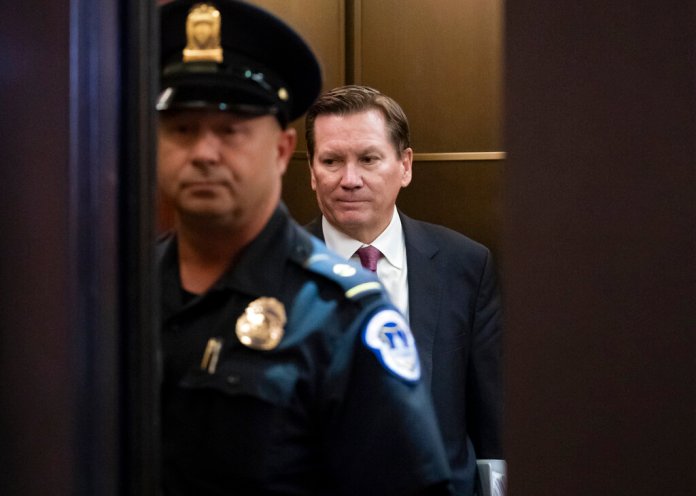
Newly declassified transcripts from the Intelligence Community’s then-inspector general show that the whistleblower whose complaint triggered President Donald Trump’s first impeachment had prior contact with congressional Democrats before filing the allegation, a newly-surfaced and damning detail that was not disclosed in the official complaint form.
The records, released Monday following declassification by Director of National Intelligence Tulsi Gabbard and the House Intelligence Committee, shed new light on the origins of the August 2019 complaint centered on Trump’s July 25, 2019, phone call with Ukrainian President Volodymyr Zelensky. That phone call centered on Trump requesting that Zelensky look into the business dealings of Hunter Biden in Ukraine.
During a closed-door deposition on Oct. 4, 2019, then-Rep. John Ratcliffe (R-TX) pressed Intelligence Community Inspector General Michael Atkinson on the timeline between Trump’s phone call and the filing of the complaint roughly 18 days later. Ratcliffe asked whether the whistleblower had disclosed prior contact with the House Permanent Select Committee on Intelligence.
“The answer to that is yes,” Atkinson replied, according to the transcript.
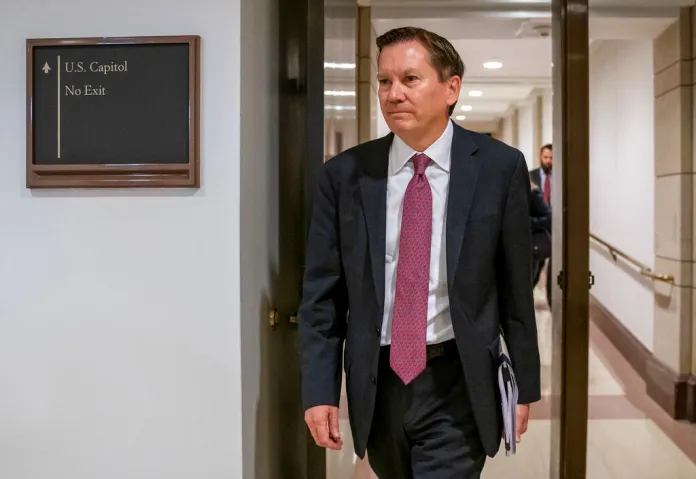
Atkinson went on to explain that the initial whistleblower, whose identity was never confirmed by the government, did not disclose his contact with Democrats on the form he submitted to the inspector general’s office, despite the form containing a question on whether the complaint had been reported to Congress first.
“On the urgent disclosure form, there’s a question that the complainant is asked about who they have reported the violation to … and one of the boxes is the congressional intelligence committees,” Atkinson said. “The complainant did not check that box.”
The revelation adds a new layer to longstanding Republican concerns about coordination between the whistleblower and Democratic lawmakers during the beginning of the impeachment inquiry, which was led at the time by then-House Intelligence Committee Chairman Adam Schiff (D-CA).
The whistleblower’s complaint, filed Aug. 12, 2019, alleged that Trump sought foreign assistance to influence the 2020 election by urging Zelensky to investigate former Vice President Joe Biden and his son Hunter Biden. The complaint ultimately prompted a formal impeachment inquiry in the House, which was at the time controlled by Democrats, culminating in Trump’s impeachment in December 2019 and subsequent acquittal by the Senate.
Atkinson testified that his office determined within a 14-day review period that the complaint met the statutory definition of an “urgent concern” and appeared credible. That determination was based on interviews with the complainant, the complainant’s supervisors, and at least one additional witness with access to a written record of the Trump-Zelensky call.
According to the October 2019 transcript, Atkinson said his office relied in part on information from a witness who had reviewed official records of the call and corroborated key elements of the whistleblower’s account. He emphasized that the complaint included both firsthand and secondhand information and was not dismissed solely on hearsay grounds.
At the same time, Atkinson acknowledged under questioning that the whistleblower disclosed being a registered Democrat and having prior professional contact with a Democratic presidential candidate, though he said supervisors still viewed the individual as credible and not politically biased.
Still, the newly disclosed testimony underscored that the whistleblower had engaged with congressional Democrats before initiating the formal complaint process through the inspector general’s office, a sequence that was not disclosed in the original complaint’s filing itself.
That omission raised significant questions about the political origins of the complaint and the integrity of the process that led to Trump’s first impeachment.
Atkinson also testified that his office did not independently investigate the whistleblower’s contacts with congressional staff prior to making its credibility determination, focusing instead on corroborating the underlying allegations tied to the July 2019 call between Trump and Zelensky.
House Intelligence Committee Chairman Rick Crawford (R-AR) said in a statement on Monday accompanying the release of the transcripts that the information in them had been withheld from the public for far too long.
“There have been many questions and concerns about these Atkinson transcripts, which have been withheld from the American public for far too long,” Crawford said. “I hope that the release of these transcripts allows the American people to make their own determinations about their content.”
Crawford also thanked Gabbard for moving quickly to declassify the materials, adding that the committee remains committed to balancing transparency with the protection of sensitive national security information.
Atkinson had previously told lawmakers in a separate Sept. 19, 2019, briefing that he determined within days that the complaint constituted a “credible urgent concern,” a finding that triggered a dispute with the acting director of national intelligence and the Justice Department over whether it had to be transmitted to Congress. The complaint was initially withheld from lawmakers amid that disagreement before Atkinson moved to alert the committee himself. At the time, the Justice Department concluded that the Office of the Director of National Intelligence lacked jurisdiction over allegations involving a president’s private conversations with a fellow head of state.
GRAND CONSPIRACY INVESTIGATION INTO OBAMA-ERA OFFICIALS GAINS STEAM IN SOUTH FLORIDA
Atkinson testified that he believed the complaint met the statutory threshold and should have been forwarded, while the DOJ’s Office of Legal Counsel concluded at the time that it did not fall within ODNI’s jurisdiction.
That disagreement led to a temporary standoff, with the acting DNI initially declining to transmit the complaint to Congress before Atkinson notified lawmakers himself.