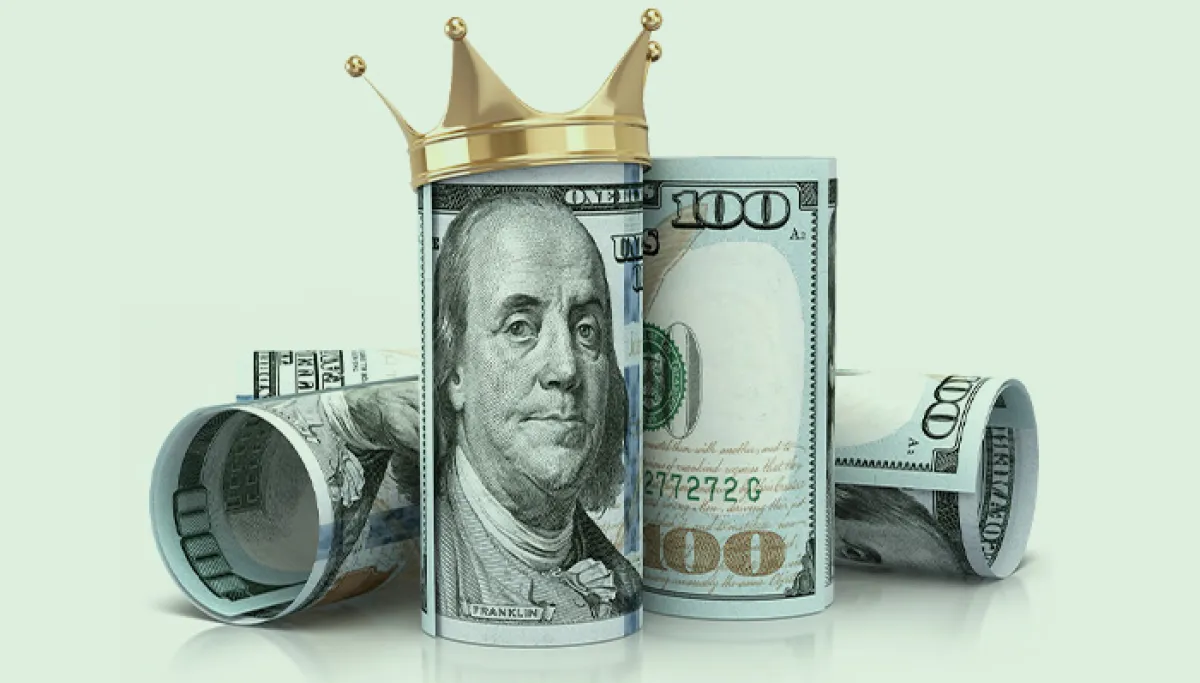
For years, monetary doves have challenged hawks worried about the dominance of the U.S. dollar as the world’s reserve currency, with a very good question: What sovereign currency could replace it?
As it turns out, the answer is none of the above. But that doesn’t mean the greenback isn’t being replaced. After the single-worst year of performance for King Dollar in nearly a decade, the USD has continued to collapse. The U.S. Dollar Index has fallen by over 3% in less than a fortnight since President Donald Trump escalated his war on the Federal Reserve‘s independence — an effort supercharged by the Justice Department’s unprecedented criminal investigation into Fed Chairman Jerome Powell and the president’s since-revoked tariff threat in his gambit to get Greenland.
But the USD and U.S. Treasurys are not being challenged by Europe, where the economy is stagnating, or by China, which is stuck in a demographic and deflationary doom spiral. Instead, a sovereign currency isn’t dethroning King Dollar — it’s gold and silver.
Gold prices have more than doubled in the past year to an earth-shattering record of nearly $5,500 per ounce. Silver prices have nearly quadrupled, including a 66% increase in the past month to over $115 per ounce. A boom in precious metals valuation and a bust in Treasurys resulted from the dual fracas of the Powell subpoena and the Greenland tariff tease. So, gold holdings at current market prices have unseated Treasurys as the top reserve asset for the world’s central banks.
When asked about the dollar’s decline during his Jan. 27 not-a-campaign-visit to Iowa, Trump insisted on optimism, saying, “The dollar’s doing great.”
The same way that former President Joe Biden’s delusional insistence that near-double-digit inflation simply entrenched higher inflation expectations, worsening the crisis of Bidenomics, the dollar interpreted Trump’s optimism as tolerance for a weaker greenback. And the dollar fell a full 1.3% on Jan. 27, in its worst daily tumble since shortly after “Liberation Day,” when Trump announced his tariff regime.
Cue the perennially besieged Scott Bessent, the treasury secretary who may have an even more taxing job than “Secretary of Everything” Marco Rubio.
The morning after Trump’s greenback gaffe, Bessent reiterated the administration’s support for a “strong dollar policy.” Directly contradicting Trump’s complaint that Japan “devalues” the yen, making it “hard to compete,” Bessent maintained that the U.S. would not intervene in the Japanese currency market. That contradicted reports the week prior that indicated the U.S. would effectively weaken the dollar to prop up the yen. The greenback slightly rallied in relief after Bessent’s remarks, but global markets are still correctly seeing mixed signals within the White House.
As has been true throughout the second administration, Bessent understands that King Dollar is the backbone of the nation’s ability to finance a $38.5 trillion national debt. Along with our consumer-driven economic growth, a historically low and stable inflation rate, attractiveness for international investments, and sanctions leverage in foreign policy.
Bessent has been stuck fighting the autarkic mercantilist faction that would rather artificially juice the 10% of our economy made up of our exports by sacrificing the rest of the 90% that depends on U.S. dollar dominance. And although Bessent has ultimately won every existential fight the D-list of the administration has thrown his way, markets are still making contingency plans. The International Monetary Fund is preparing for a total sell-off of greenback-denominated assets, while BlackRock says it no longer regards long-term Treasurys as the haven of global finance.
DOJ INVESTIGATION COULD PUSH POWELL TO HOLD ON TO HIS SEAT AT FED
The good news for Trump is that the dollar still has the leeway to course correct. If only because the rest of the world is even more hostile to finance. Although the USD has fallen from its near 70% share of global currency reserves at the start of the century, it still comprises a majority of both foreign exchange reserves and international banking transactions recorded by SWIFT. The revanchist, third-world experiment that is BRICs continues to prove a communist failure, and Europe remains so suicidally opposed to growth that it cannot fill an American vacuum.
So, the Trump administration would be wise to return to principles that undergirded the USD’s gold standard era, the time when we became the world’s reserve currency in the first place. If our trade deficit creates the flows of foreign investment that allow us to borrow indefinitely, our trade deficit is a strength, not a weakness. When supply-side economics focuses on stability for the consumer, not protectionism for the producer, a rising tide of economic growth lifts all boats. For America to lead the world, King Dollar must not cede the throne.
Tiana Lowe Doescher (@TianaTheFirst) is an economics columnist for the Washington Examiner.