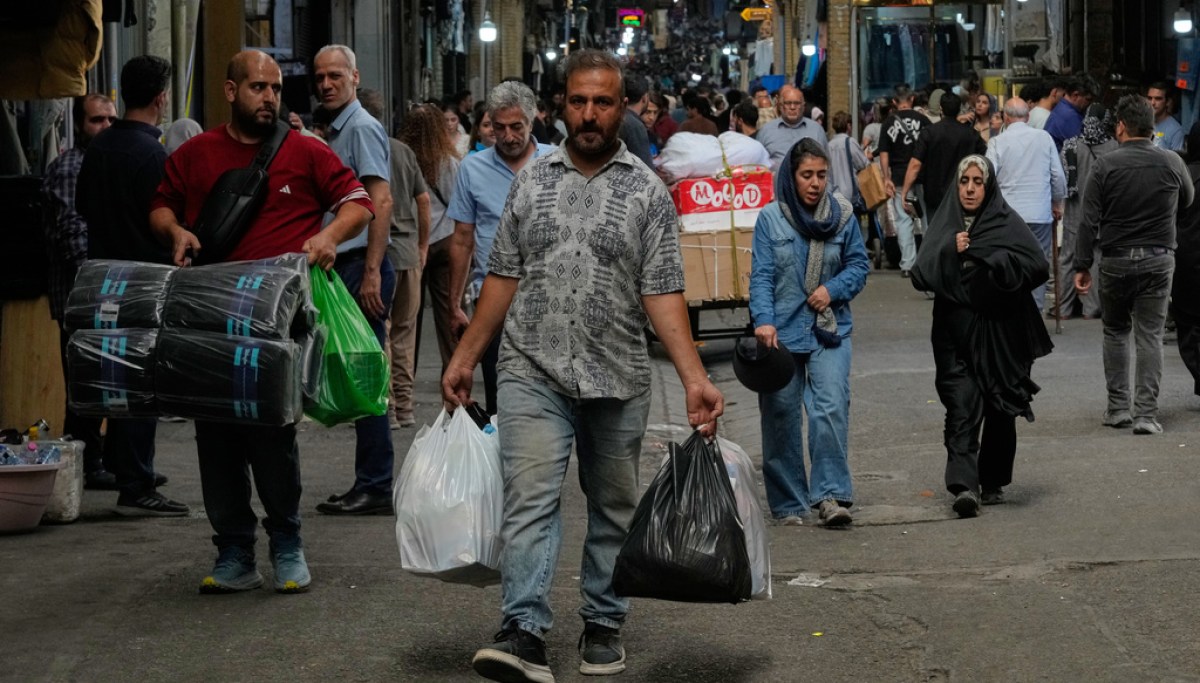
Iran’s rial hit a new record low compared to the U.S. dollar on Tuesday, as the embattled country’s economy continues to reach new lows.
Iran was already experiencing an economic collapse well before the launch of Operation Epic Fury, leading to the deteriorating living conditions that triggered the largest protests in Iran since the 1979 Islamic Revolution in December. Those in turn led to the brutal January crackdown that killed tens of thousands, one of the impetuses for the U.S.-Israeli war. The most intensive bombing campaign since the Gulf War, a renewed sanctioning blitz, and the U.S. naval blockade supercharged Iran’s economic decline, sending its currency tumbling to its worst position yet on Tuesday.
Pashizi, a tracker for free-market exchange rates of Iran’s currency, put the closing value of the rial at 2.548 million rials per one U.S. dollar.
This marks a massive fall in the Iranian currency’s value since the Memorandum of Understanding collapsed in mid-July, when the rial stood at about 1.79 million rials per one U.S. dollar.
Iranian free-market exchange rate trackers show good news for the Trump administration — the new economic pressure valves appear to be working.
One of the trackers, Alanchand, showed the rial remaining roughly stable throughout the intensive bombing phase of the war, even increasing to 1.664 million rials per one U.S. dollar on March 1. The sudden appreciation of the rial at the time was noted as odd by the Hudson Institute’s Research Fellow and Middle East expert Zineb Riboua, who told the Washington Examiner in mid-March that it indicated the central bank was drawing down reserves or mobilizing assets through back channels.
The first noticeable hits to the currency happened at the end of April when the U.S. blockade took effect, sending the rial’s value down to 1.913 million rials per dollar on May 2. News of the MOU sent the rial to a higher valuation of 1.535 million rials per dollar on June 15, then the currency lowered to hover around 1.8-1.9 million for most of July and August.
Finally, a noticeable change occurred on Aug. 20, when the Rial began a sustained fall. The trend coincides exactly with President Donald Trump’s announcement of “economic D-Day,” otherwise known as Operation Outcast, on Aug. 19. Treasury Secretary Scott Bessent revealed the details of the plan on Aug. 24, which included a rigorous crackdown on illicit Iranian financial and smuggling networks, along with the imposition of secondary sanctions.
Bessent said the objective of the “economic onslaught against Iran’s financial connections around the globe” was to “sever every economic lifeline that sustains this tyrannical regime until Tehran stands alone.”
Alanchand put the rial’s Sept. 29, 2025, exchange rate at 1.139 million per one U.S. dollar, meaning it has lost 55.3% of its value in one year. Since. Aug. 20, it has lost 25.4% of its value.
The degradation of Iran’s currency comes from the dual pincers of more rigidly enforced sanctions and the fruits of the U.S. blockade, which was reimposed on July 14. Analysts noted the drastic effects of the blockade as early as Sept. 1, Reuters reported. Iran has now gone nearly two and a half months without any new oil tankers reaching Chinese ports, its last main oil customer, stripping it of much-needed export revenue.
Even Iran’s rosiest economic figures, which authorities are willing to admit, are dire. Iran Central Bank Gov. Abdolnaser Hemmati put year-on-year inflation in September at 83.8%, down from 84.4% in August.
Iranians speaking with Reuters spoke of the abysmal conditions in Iran, detailing having to sell valuable belongings to afford basic necessities and life-saving medication. U.S., Middle Eastern, and Iranian sources told the outlet that Tehran’s sudden, renewed burst of diplomacy last week was triggered by the worsening economic crisis.
The situation has given rise to new hopefulness from the Trump administration, which has begun to speak of the war in more optimistic terms after a bad month of PR in August. Secretary of State Marco Rubio triumphantly proclaimed in a Monday appearance on Fox News that Iran was facing an economic “cataclysm.”
IRAN READY FOR ‘DOOMSDAY WAR’ AFTER TRUMP REJECTS CEASEFIRE, FOREIGN MINISTER SAYS
“And so when you’re denying them money through oil sales and sanctions, you’re not just punishing them,” Rubio said. “You are preventing them from getting access to money that they will use to try and kill Americans and others around the world and their own people and build weapons and threaten the world and ultimately break out to a nuclear weapons program.”
Iran has countered with its standard defiance, with Iranian Foreign Minister Abbas Araghchi declaring in a Sunday appearance on NBC News’s Meet the Press that Iran was ready for a “doomsday war” if need be.