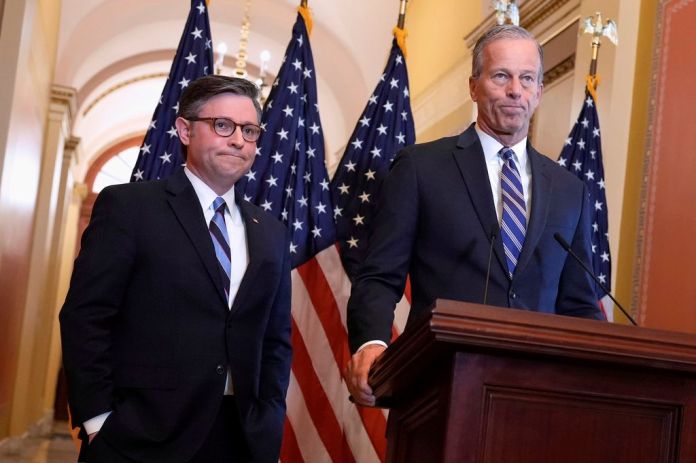
The House and Senate reconvene this week after a weeklong Memorial Day recess with a lot on their plate as the November election looms.
Immediately upon returning, the Senate will take up a postponed vote on a $70 billion party-line immigration bill after an uproar from Republicans over the Trump administration’s “anti-weaponization” fund and money for White House security upgrades.
The scheduling shift came despite a June 1 deadline from President Donald Trump to get the legislation across the finish line.
While there were enough reservations to hold off voting in the Senate, House GOP lawmakers were just as concerned about the fund. Rep. Kevin Kiley (I-CA), who caucuses with Republicans, told the Washington Examiner he did not want to see the fund move forward. Rep. Don Bacon (R-NE) said the fund was “not right.”
LAUREN BOEBERT BRUSHES OFF TRUMP’S ATTACKS CALLING HER ‘DUMB’
While both chambers will be working quickly to get the party-line bill to the president’s desk, there is another deadline quickly approaching: the Foreign Intelligence Surveillance Act. Both FISA and the funding bill have widened the split between the House and Senate.
The House passed the Senate’s 45-day clean extension of FISA last month. Yet, negotiations are ongoing for what a longer extension would entail.
This week, the House is also likely to bring up a war powers resolution to force President Donald Trump to end hostilities with Iran. A vote was expected to take place before the break, but GOP leadership punted because of absences. The measure has a good chance of passing for the first time after two prior war powers resolutions came down to Rep. Jared Golden (D-ME), who was the only Democratic “no” vote. But last month, Golden signaled he would support limiting Trump’s authority to wage war when the vote came up again.
On top of all those bills, Democrats and centrist Republicans are planning to force tough votes on Ukraine funding and labor regulations using discharge petitions. The parliamentary procedure bypasses the committee process and forces legislation directly to the floor for a vote after receiving support from 218 lawmakers.
MASSIE GOES ON FISHING TRIP WITH MTG AFTER LOSING KENTUCKY PRIMARY ELECTION
One discharge petition will force a vote on sending $1.3 billion in aid to Ukraine and instituting new sanctions on Russia.
The second discharge petition would force a vote on the Faster Labor Contracts Act. The bill requires employers to bargain within 10 days of union certification in an effort to prevent employers from stalling first-time union contracts.