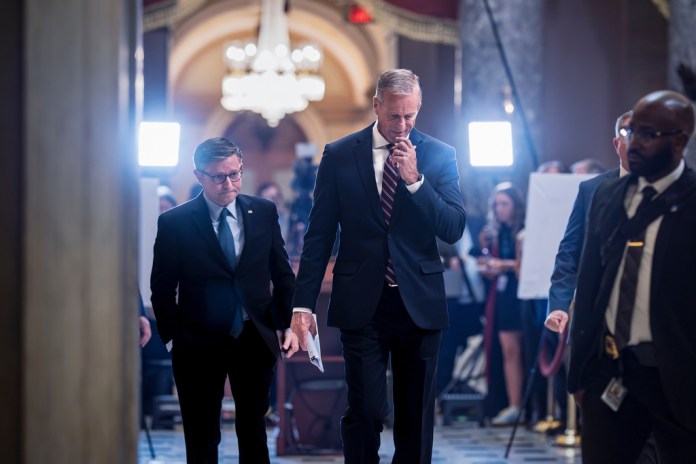
Weeks of bruising cross-chamber policy fights have blemished what has otherwise been a cordial and remarkably effective relationship between Senate Majority Leader John Thune (R-SD) and House Speaker Mike Johnson (R-LA).
Thune and Johnson have navigated razor-thin margins to pass major components of President Donald Trump’s second-term agenda. But they’ll need to quickly iron out the wrinkles in their relationship if they’re to return later this month from recess and shepherd through another party-line reconciliation bill to fund their immigration enforcement priorities ahead of the midterm elections.
“He has to do what he has to do,” Thune said of Johnson to the Washington Examiner. “I know that, and he knows … the challenges we face over here.”
Johnson, reflecting on a chaotic House week filled with GOP infighting that still included major policy wins, conceded that “sometimes the process around here is cumbersome.”
“They often analogize legislating to making sausage,” Johnson told reporters. “You don’t want to see it made. Sometimes it’s an ugly process. Sometimes it’s a long process.”
The House ultimately passed the Senate’s versions of DHS funding and a 45-day extension of Section 702 of the Foreign Intelligence Surveillance Act, conclusions that House Republicans say are the latest cases of them being forced to “cave” to the upper chamber. The Senate’s 60-vote filibuster is often to thank for that repetitive theme, but mounting frustrations in the House have more recently centered on accusations that Thune is capitulating to Democrats.
Thune, Johnson, and their staffs still have weekly policy meetings to talk strategy. However, Senate leaders and staffers have become incensed by the airing of dirty laundry from their House counterparts on policy disagreements, particularly the public trashing of the DHS funding bill Johnson once called a “crap sandwich.” The House passed it on Thursday, more than a month after the Senate did in late March. The measure funds most of the department except for immigration agencies. Republicans plan to fund those through the reconciliation process, which can bypass a Democratic filibuster.
The day after a gunman allegedly targeted Trump and senior administration officials at the White House Correspondents’ Association dinner, some in MAGAworld even pinned the blame on Thune for undermining national security.
In the eyes of senior Senate GOP aides, what was initially a shutdown caused by a Democratic filibuster to protest Trump’s immigration enforcement agenda became a Republican “self-own” at the hands of the House. An aide granted anonymity to discuss behind-the-scenes tensions urged the party to trade in the “short-sighted intraparty scuffles” for unity to defeat Democrats in November.
“Republicans battling Republicans is exactly what Democrats want,” a senior GOP aide said. “House and Senate Republicans are on the same team, and the sooner we can get back to playing team ball, the better it will be for the party, our voters, and the rest of the American people.”
The mild-mannered Thune has, at times in recent months, traded his usual diplomatic reserve for more blunt rhetoric to counter criticism both from the House and what he has deemed an online “paid influencer ecosystem.” He has referred to himself as the “clear-eyed realist” against calls from Trump and House Republicans to nuke the filibuster for the SAVE Act. Thune further called Johnson’s push to include a central bank digital currency provision in FISA reauthorization a “poison bill” that was “dead on arrival” in the Senate. The majority leader has also repeatedly pushed the House to stomach its concerns over the DHS shutdown and vote to reopen the department.
Johnson qualified the weeks of inaction on DHS funding as a way of forcing urgency to pass the blueprint for the GOP’s party-line immigration funding, which the House greenlighted last week. He told reporters that “you heard me trash” the DHS bill after it was “haphazardly drafted” by the Senate and initially passed in the middle of the night.
Thune held his tongue Thursday following the House clearing the DHS funding by voice vote, a method of unanimous consent that House leaders previously condemned the Senate for using on the same bill more than a month earlier.
“Yeah,” Thune said with a pause. “I probably shouldn’t.”
Sen. Josh Hawley (R-MO), also reacting to the news from across the Capitol, called it a “miracle.”
DHS SHUTDOWN STRESS-TESTS JOHN THUNE’S RELATIONSHIP WITH MIKE JOHNSON
Just as Thune has his own challenges managing expectations with a 53-47 majority in a chamber that requires 60 votes to achieve nearly anything, Johnson must wrangle a conference more than four times the size and with only a one-seat margin, depending on absences. After all, Johnson’s predecessor, former Rep. Kevin McCarthy, lasted in the role less than nine months before being forced out by some of the same conservative hard-liners who act as a thorn in Johnson’s side.
“We’re very unhappy with the Senate. That’s what today was about, and that’s the macro theme,” said Rep. Warren Davidson (R-OH), lamenting Thune’s handling of DHS funding and FISA reauthorization after they passed the House. “Unfortunately, Leader Thune has allowed the Democrats to have way too much voice in the Senate.”
Lauren Green and Hailey Bullis contributed to this report.