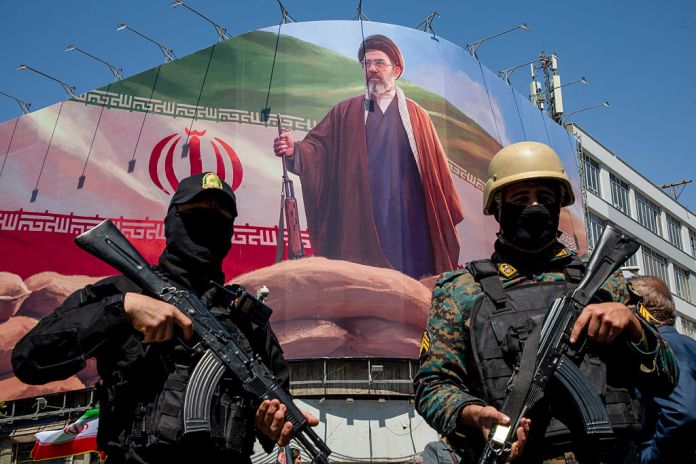
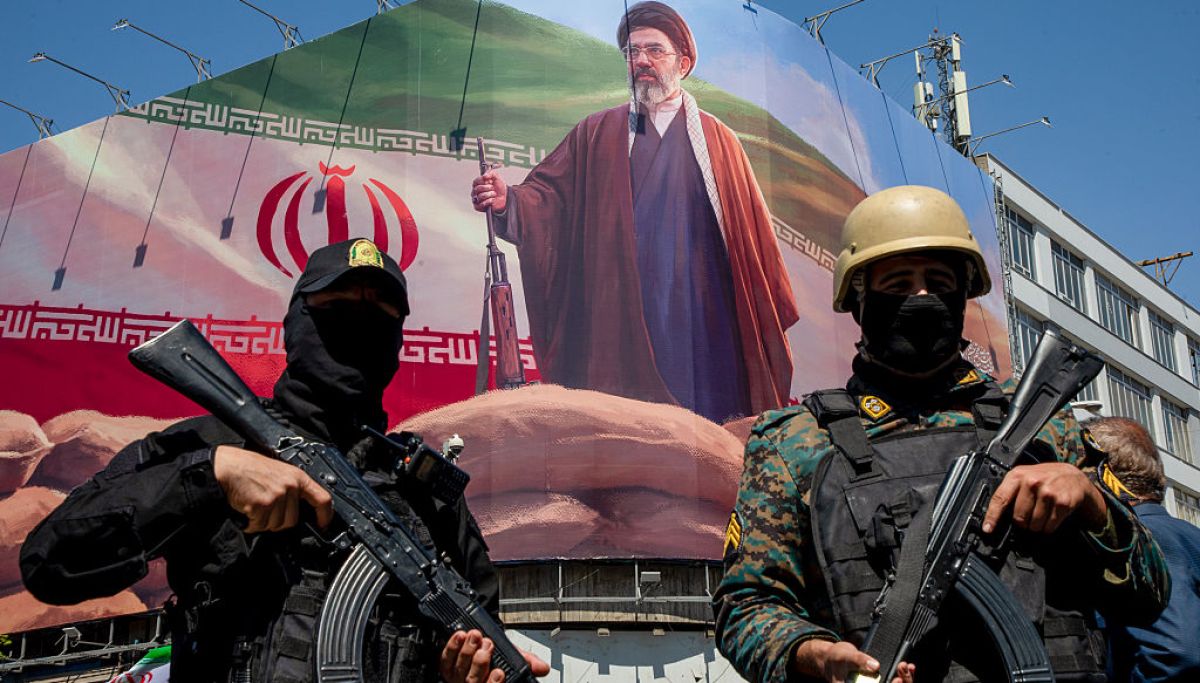
Iranian supreme leader Mojtaba Khamenei said the United States’s only place in the Persian Gulf region was “at the bottom of its waters,” in a defiant message pledging not to give up Iran’s ballistic missile and nuclear programs.
In a rare statement released by the reclusive leader in honor of National Persian Gulf Day, Khamenei signaled defiance to the U.S. as the prospect of successful negotiations grows ever distant. He began by defending Iran’s ballistic missile and nuclear programs, comments that make negotiations with the U.S. even more difficult due to the mutually exclusive positions.
“Ninety million proud and honorable Iranians inside and outside the country regard all of Iran’s identity-based, spiritual, human, scientific, industrial and technological capacities — from nanotechnology and biotechnology to nuclear and missile capabilities — as national assets, and will protect them just as they protect the country’s waters, land and airspace,” Khamenei said in written remarks published by state media.
He then said the U.S. would soon be made to depart the Persian Gulf, extending an olive branch to the U.S.’s Gulf allies in the process.
“By God’s help and power, the bright future of the Persian Gulf region will be a future without America, one serving the progress, comfort, and prosperity of its people,” Khamenei said.
“We and our neighbors across the waters of the Persian Gulf and the [Gulf] of Oman share a common destiny. Foreigners who come from thousands of kilometers away to act with greed and malice there have no place in it — except at the bottom of its waters,” he added.
The unseen leader then vowed to secure the Persian Gulf and eliminate “the enemy’s abuses of the waterway,” referring to the U.S.’s naval blockade of the Strait of Hormuz.
His maximalist rhetoric comes despite the heavily lopsided losses suffered in the war. The U.S. and Israel killed thousands of Iranian troops and leaders and vastly degraded its ballistic missile and drone capabilities, along with the degradation of its defense industrial base. The U.S. sank Iran’s entire conventional navy, while Tehran failed to sink a single U.S. ship.
Despite the written statement being released in state media, Khamenei still hasn’t been seen in any capacity since he was reportedly wounded in the same Feb. 28 airstrike that killed his father. His disappearance has fed speculation that he was severely wounded and is now either disfigured or comatose. He’s widely viewed as only the symbolic head of Iran, with the Islamic Revolutionary Guard Corps wielding the true power.
HOW IRAN TRANSFORMED FROM AN ISLAMIC REPUBLIC TO A MILITARY DICTATORSHIP
Rumors of war have grown this week after U.S. and Iranian negotiators ended their talks in Islamabad, Pakistan. The U.S. has continued its massive airlift of military supplies to the Middle East, similar to that which led up to the beginning of Operation Epic Fury.
In the meantime, the U.S. has blockaded the Strait of Hormuz, strangling the Iranian economy. The impact was felt worse this week, as the Iranian Student News Agency said that the Iranian Rial fell roughly 15% in two days, dropping to 1,810,000 Rials to every U.S. dollar by Wednesday. Gholamhossein Mohammadi, an official at Iran’s Labor and Social-Affairs ministry, said that 1 million Iranians have been put directly out of work since the war began, and another 1 million have been put out of work indirectly.