The outbreak of war across the Middle East following Oct. 7, 2023, has drawn in the three major power blocs of the region — Israel, the Gulf countries, and Iran — but the fourth, Turkey, has stood back and bided its time.
Though the country has received less attention as it has largely stayed out of the recent chaos, Turkey’s strategic position continues to play a fundamental role in shaping the trajectory of the Middle East. The government of President Recep Tayyip Erdogan has overhauled the country’s foreign policy and maneuvered to establish it as a great regional power. The degradation of Iran, its centuries-old foe, is set to be just the latest strike of good fortune.
Turkey most recently flexed its muscles behind the scenes; media reports alleged that Erdogan personally called President Donald Trump to warn against an alleged plan to send a heavily armed Kurdish force into Iran, an intervention that caused the plan to be scrapped.
The past 20 years have seen Turkey reassert itself to an extent not seen since its predecessor, the Ottoman Empire, dominated the entire Middle East. It combined its strong military, impressive defense industry, willingness to deploy its forces abroad, and growing soft power to help shape the modern Middle East.
“What seems to be different now is that having developed its own defense industry to complement its strong army … and having shown a willingness to engage in a number of areas, like North Africa, the Horn of Africa, the Gulf … Turkey is more aware, more cognizant of its own power, and more willing to use that influence beyond its borders,” Bulent Aliriza, director of the Turkey Project at the Center for Strategic and International Studies, told the Washington Examiner.
Shaped by history
Discussions around Turkey’s strategic posture are indelibly shaped by its near and distant future, with Turkish elites battling over where the country should look to define itself. Since Mustafa Kemal Ataturk’s war of independence against the First World War Triple Entente and its allies concluded with the creation of the modern Republic of Turkey in 1923, most Turkish leaders have aggressively guarded the majority-Muslim nation’s status as a modern, secular, western-facing republic.
This changed for the first time in 2003, when Recep Tayyip Erdogan, a conservative Sunni Muslim, became prime minister. No figure has been as influential in the country since Ataturk, Turkish political scientist Soner Cagaptay wrote in his 2019 book, Erdogan’s Empire, and his rule has seen the country’s power grow relative to the Middle East.
Sinan Ciddi, head of the Turkey Project at the Foundation for the Defense of Democracies, told the Washington Examiner that Turkey’s rise to become a predominant regional power occurred under Erdogan, especially over the past ten years. The weakening of Iran in the past three years has also played a significant role in this ascendance, despite Turkey’s neutrality in the war with Iran.
Turkey’s politics remain heavily polarized, with the country largely being arrayed half for Erdogan and his Justice and Development (AKP) party and half against them, the former of whom have narrowly eked out major electoral victories to grow Erdogan’s power. Much to the disdain of the elite, more sympathetic to Ataturk’s vision of a secular republic, Erdogan has steered Turkey’s politics in a decidedly Islamist direction, forging ties with the Muslim Brotherhood and positioning itself as a central power player in the Muslim world.
“What has happened with the advent of the AKP is that Turkey is more willing to stress Islamic solidarity or closeness to fellow Muslim states than before,” Aliriza said.
He stressed that engagement with the Islamic world through appeals to a common faith predates Erdogan, pointing to the country’s founding membership in the Organization of Islamic Cooperation in 1969.
Ankara’s newfound Islamism has shifted its attention more towards the Muslim world, however, and shaped its alliances. Turkey’s closer ties with the Muslim Brotherhood have also put it at odds with Muslim countries hostile to the group, like Egypt and the United Arab Emirates. It’s likewise forged a strong bond with Qatar, its closest friend in the region.
Reaping the benefits of NATO’s second-largest army
Turkey’s rise as a major regional power since the early 2000s can be partially credited to its economic growth and the expansion of the country’s soft power through foreign aid and entertainment products. In 2002, the year before Erdogan took power, Turkey’s Gross Domestic Product was $238 billion. It has exploded to become $1.6 trillion in 2025, according to the World Bank, a growth reflected in Turkey’s growing business interests worldwide.
Despite the role of Turkish business and economic interests in its rise, however, nothing has played such a central role as the wielding of its powerful military.
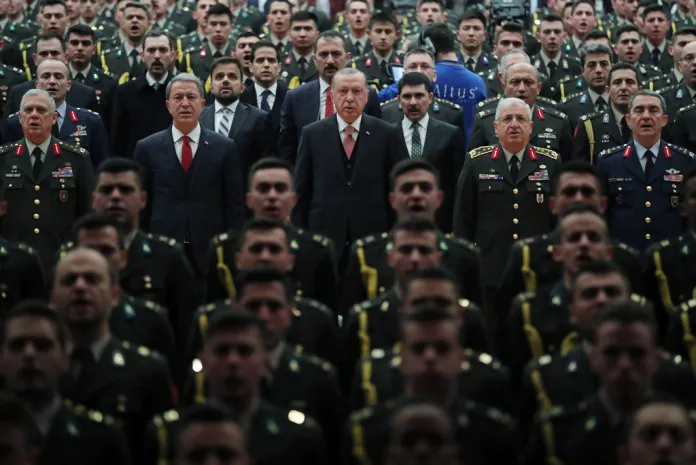
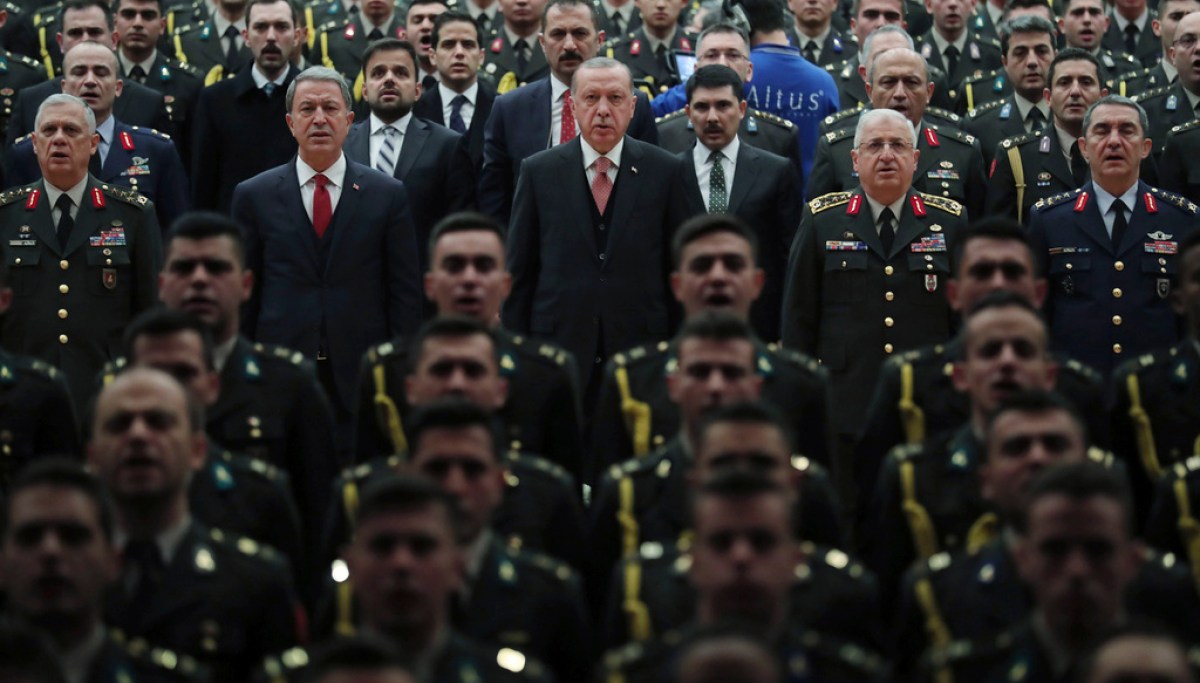
Turkey’s military has long been a regional behemoth, the second largest in NATO behind the U.S., but larger than the militaries of all European Union countries combined. The powerful status of Ankara’s military was solidified during the Cold War as a way to keep communism and political Islam in check, but the force was largely confined to combating domestic troubles until Erdogan took power.
Beginning with Operation Euphrates Shield in 2016, Turkey has launched four major interventions into Syria and several incursions into Iraq, mostly to combat Kurdish militants. It provided armed support for Azerbaijan in the Second Nagorno-Karabakh War against Armenia in 2020, intervened in Libya in 2020, and deployed troops to Qatar and Somalia to boost each government.
Most notable in its interventions has been the remarkable success it has seen; every intervention has been a moderate or decisive success, giving the Turkish military one of the most successful combat records of the 21st century.
Part of this success has been through its early investment in its lucrative drone industry, which has emerged as one of the best in the world. Turkey’s drone companies, such as Bayraktar, have found eager customers in the Middle East, Africa, Asia, and Europe, most notably in Ukraine.
Aliriza noted a pattern in many of Ankara’s foreign deployments and influence operations.
“If you have an integrated strategy in which you develop a good relationship with a country, you sell them arms, which in many cases you help finance in the initial purchase, and then you also send troops and support that government against insurgents or external enemies, as has happened in Qatar, Libya, and Azerbaijan, then that’s an influence multiplier,” he said.
Its deployments have helped put Syria firmly under its wing, while wielding significant influence in Iraq, the Caucasus, Libya, and the Horn of Africa.
A bridge between East and West
Turkey’s greatest card to play is its cultural and physical position as the gateway between east and west. It occupies some of the most valuable strategic real estate on Earth, occupying both sides of the Bosphorus Strait, which controls access to the Black Sea. It has increasingly leaned into this role as a bridge between East and West in its growth as a regional power.
“Turkey is maximizing the advantages of its geography and history, and its links to the Middle East alongside its treaty relationship with the West to underline its status as a regional middle power,” Aliriza said.
Ataturk’s plan to turn Turkey into a modern, Western country paid dividends over the latter half of the 20th century, especially after his successor, President Ismet Inonu, firmly embraced the United States after World War II. Notably, the cornerstone of the U.S. Cold War policy, the Truman Doctrine, was issued in 1947 in response to communist and Soviet pressure against Turkey and Greece. Turkey joined NATO five years later, an alliance that would greatly expand its military capabilities and state capacity, giving it a major advantage in comparison to the dysfunctional Arab states.
Turkey’s strategic position and capable military also give it far more flexibility and leverage than other NATO members, often getting away with moves that would jeopardize the membership of a lesser member. Complaints about Turkey’s independence and moves contrary to U.S. interests, such as its growing rivalry with Israel, have fallen on deaf ears in Washington.
While Erdogan has steered Turkey away from Ataturk and Inonu’s vision, positioning it as more independent and Eastern-focused, he has continued to embrace the importance of NATO. He has even pitched his eastward shift as a move of possible benefit to the U.S. and the West, a view accepted by many U.S. policymakers.
“What [Turkey is] saying to its Western partners is, ‘Look, I am a major power in the region, at the same time I’m an ally, and I enhance the influence and force projection of NATO and the West in the Middle East,’” Aliriza explained. “Turkey is maximizing the advantages of its geography and history, and its links to the Middle East alongside its treaty relationship with the West to underline its status as a regional middle power.”
Former Presidents Bill Clinton, George W. Bush, and Barack Obama have all “specifically referred to Turkey’s regional influence as something that was an advantage to the United States,” Aliriza said, but this view has reached new heights under President Donald Trump, who has made this feeling “even more explicit.”
Perhaps the best showcase of the growing prominence of Turkish influence is the prominence that Tom Barack, the U.S. ambassador to Turkey, has played in shaping Washington’s Middle East policy. Barack has been made special envoy to the Middle East, directly coordinating policies between Syria, Iraq, and Turkey. His Turkophilia hasn’t been subtle, publicly positioning Turkey as the best partner to ensure the stability of Syria post-Assad.
Barack helped push the preference for the Turkish position in Syria over that of the U.S.’s Kurdish allies and even Israel.
The Turkish deputy
Barack’s policy views reflects that of some pro-Turkish thinkers in Washington who argue that Ankara could be a perfect conduit for U.S. interests in the Muslim world. As the argument goes, Turkey could be effectively deputized and empowered to dominate the Middle East in line with U.S. interests.
Despite the argument’s popularity among some in the Trump administration, it has plenty of skeptics.
Ciddi argued that the scheme is unviable.
“Offloading the Middle East concerns to Turkey may sound like an interesting idea, but again, there are so many regional actors that are allies of the United States that wouldn’t be necessarily thrilled about that,” Ciddi said. “The Israelis being the obvious one … the United Arab Emirates, I don’t think the Saudis and the Egyptians would be too jazzed either.”
Turkey’s identity as a non-Arab power also poses a problem, as “they’ve never been perceived as essentially a leader of the Arab world, or the Muslim world since the days of the Ottoman Empire.”
Ciddi also doubted that Ankara had the financial resources required to take on such a role, as it would require extensive investment in economic and trade infrastructure throughout the region.
“Turkey may have a vision, but in order for those visions to essentially come to fruition, it’s going to have to collaborate and not necessarily dictate terms to the rest of the region … so offloading all the Middle East problems onto Turkey is not necessarily a viable solution,” he said.
Turkey’s aim for what it calls strategic autonomy also brings into question its alignment with the U.S. While pitched as an arrangement of mutual benefit, Ciddi argued that Ankara was looking to become largely independent of the U.S.’s orbit altogether, and may only be using its position to reap the benefits of the West while acting against it.
A NATO ALLY’S INFORMATION WAR: UNMASKING TURKEY’S GLOBAL MEDIA STRATEGY
“What people tend to miss is Erdogan is doing this to become independent of the West,” he said.
Turkey, Ciddi argued, is “maintaining these relationships with the West, not to augment the capabilities of the NATO alliance and NATO priorities and concerns, but really to use that as a springboard to drive forward his own agenda of expansionism and revisionism in that part of the world.”