Over 350 officials from the Spanish National Police and other law enforcement agencies on Sunday forcefully cleared an illegal migrant encampment in Ceuta located at the Guano esplanade.
The post Ceuta Clears Illegal Migrant Beachfront Camp Hours Before King Felipe Visit appeared first on Breitbart.
Over 350 officials from the Spanish National Police and other law enforcement agencies on Sunday forcefully cleared an illegal migrant encampment in Ceuta located at the Guano esplanade.
The encampment at the Guano esplanade was the last mayor illegal migrant shanty town that remained erected in Ceuta after a similar operation took place earlier this month to clear the one assembled by invading migrants at the Trampolín beach, one of the areas most affected by the massive invasion of the Spanish North African exclave.
Sunday’s operation occurred just about 48 hours before the highly anticipated arrival of King Felipe VI and Queen Letizia, the first official visit by a Spanish monarch to the North African exclave in almost two decades.
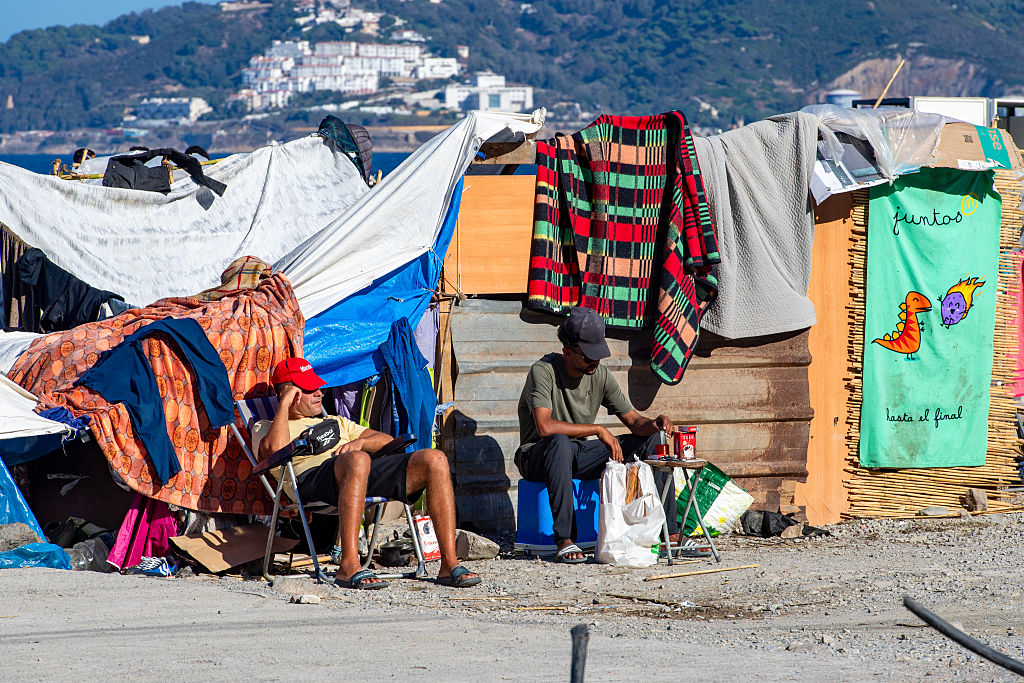
Migrants rest at a squalid temporary beachfront camp – since dispersed – where illegal migrants remain waiting to be transferred to reception facilities in Spain’s north African enclave of Ceuta on October 7, 2026. (Antonio Sempere / AFP via Getty Images)
The Spanish royals will visit Ceuta on Tuesday and are expected to spend the night there, which will also mark the first time that a Spanish monarch stays in Ceuta overnight in almost a century. King Felipe and Queen Letizia will travel to Melilla on Wednesday.
The Spanish newspaper La Vanguardia reports that the operation began on Sunday morning, and involved the joint efforts of hundreds of members of the Spanish National Police, Civil Guard, local Ceuta police, and Armed Forces, removing about 500 illegal migrants from the esplanade.
RELATED: Lefty Jayapal Praises Socialist Spain for Allowing Illegal Immigrant Invasion of Ceuta
Much like during the operation at the Trampolín beach, law enforcement agents gave the illegal migrants two choices — either voluntary return to Morocco, or be transported to a Temporary Foreigners’ Assistance Center (CATE) to be rehoused in government facilities.
La Vanguardia noted that it was not able to determine how many chose to return to Morocco. An unnamed local resident who witnessed the operation affirmed that “there was no one left by 10:00a.m.”
The unnamed resident, however, lamented that the Guano beach “will never be the same again.
“It will take a long time to recover, right now there’s nothing but trash, and we can’t swim in this water because it’s so dirty,” the person stated to La Vanguardia.
Footage of the operation was published by the local outlet El Faro de Ceuta.
[embedded content]
El Faro reported that as of Sunday night, Ceuta’s Department of the Environment, Urban Services, and Housing had removed 105 metric tons of waste from the Guano area left by the invading migrants over the past weeks.
The recent operations to clear the encampments set up by illegal migrants in Ceuta does not, in itself, resolve the invasion of the Spanish North African Exclave.
Local residents and representatives of neighborhood associations expressed to El Mundo on Monday that they still live under a constant state of fear and that the city is far from recovering the normalcy it had prior to the invasion.
The Ceuta locals stressed that it is still highly common to come across makeshift tents across the streets of their neighborhoods — with an “entire camp” still present at the central square of Poblado de Regulares.
“At night there’s noise all the time, there are fights, it’s a terrible situation,” an 80 year-old woman identified as “Mina,” told El Mundo.
“I don’t go out at all, I’m afraid,” she confided, and detailed that it has been weeks since she has left her house outside walking a few steps “to stretch my legs” out of fear of her personal safety.
The elderly woman explained that she has lived her entire life in a residence originally built to house soldiers from a nearby barracks. She presently lives with one of her sons, as the rest of her children have long since left Ceuta.