The oil-producing nations of the Persian Gulf are stepping up their efforts to divert shipping away from the Strait of Hormuz, where Iran has been launching terror strikes on civilian vessels.
The post Gulf Nations Accelerate Efforts to Bypass Iran and Strait of Hormuz appeared first on Breitbart.
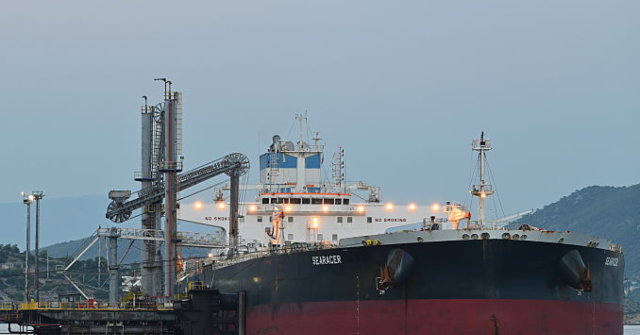
The oil-producing nations of the Persian Gulf are stepping up their efforts to divert shipping away from the Strait of Hormuz, where Iran has been launching terror strikes on civilian vessels.
The Associated Press (AP) noted on Thursday that “at least seven major pipeline projects are under construction, in the planning stage, or being discussed as possibilities.”
Work on all of these projects accelerated after Iran delivered a “wake-up call for Gulf oil producers” by shuttering the Strait of Hormuz twice so far this year.
The goal is to build and expand pipeline networks that would allow countries like Saudi Arabia, the United Arab Emirates (UAE), and Iraq to bypass the traditional seaborne route from their Persian Gulf ports through the Strait of Hormuz and on to buyers across Asia.
One of those alternate routes has now come under threat: the Red Sea, where Iran’s terrorist proxies in Yemen, the Houthis, are attacking oil tankers and proclaiming a “maritime ban” on Saudi Arabia.
The Saudis already had a decades-old pipeline they could use to divert their oil to a Red Sea port, while the Emiratis have a port called Fujairah that theoretically allows them to bypass the Strait of Hormuz, although Iran has directly attacked Fujairah — and the gas processing facility in the city at the other end of the pipeline, Habshan — to keep the UAE’s energy industry on edge.
The UAE is building another pipeline to Fujairah, putting a rush order on the $3 billion project to bring it online by mid-2027. This expansion to the existing Habshan-Fujairah pipeline was conceived before the Iran war began, at a time when the UAE was preparing to depart from OPEC and increase its oil production. The UAE announced it would accelerate the project in May, after Iran’s first round of disruptions to shipping in the Strait of Hormuz.
Iraq is working with American companies on pipelines that would take its products from the oil terminal in Basra to ports in Turkey and Syria, and is considering a third pipeline that would send Basra’s oil to the port of Aqaba in Jordan.
The U.S. State Department is reportedly particularly enthusiastic about the Iraq-Syria project, which will refurbish and expand a long-disused pipeline that was built in the early 1950s. The line was damaged in 2003 during the U.S.-Iraq war, and restoring it became a much more attractive prospect after the Assad dictatorship was overthrown in Syria in 2024.
Iraq is now eager to rebuild the pipeline to establish an oil shipment route through the Mediterranean, Syria wants the project for regional prestige and income, the U.S. hopes it will stabilize both Iraq and Syria, and everyone wants to make the Strait of Hormuz less important.
The State Department hailed the Iraq-Syria pipeline as a “priority infrastructure project of bilateral and regional strategic significance,” a “critical energy corridor,” and a “groundbreaking project” when Baghdad and Damascus signed a memorandum of understanding (MOU) last week.
“The commitment of both countries to work jointly to rehabilitate and operate the pipeline, create a legal framework, and engage constructively with the consortium advances security and stability through prosperity, made possible by the vision and leadership of President Donald J. Trump,” the State Department said.
Analysts told the AP that if all of these pipeline projects come to fruition in a timely manner, it could divert almost 60 percent of the oil that used to flow through the Strait of Hormuz, greatly reducing Iran’s leverage. It might also be helpful if the oil-producing nations use some smaller ships instead of the titanic two-million-barrel Very Large Crude Carriers (VLCCs) they currently rely on, because smaller ships could make it through the Suez Canal.
Iran might try to keep its leverage by attacking the pipelines and oil production facilities to discourage the Hormuz bypass. Also, the situation with liquified natural gas (LNG) remains dire, as Qatar produces a great deal of it and has no good alternative to shipping it through Hormuz.
A final hitch in the scramble to work around Iran’s blockade of Hormuz is that some Gulf nations have no real prospect of building the kind of pipelines the UAE, Saudi Arabia, and Iraq are working on because they lack either the resources or favorable geography. Kuwait and Bahrain are in much the same pickle as Qatar.
Kuwait is exploring the possibility of patching into the Saudi and Emirati pipeline networks, according to Sheikh Nawaf al-Sabah, chief executive of the state-owned KPC energy corporation.
Nawaf told the Atlantic Council Global Energy Forum in June that the Gulf Cooperation Council (GCC) long ago created the legal framework for members to export each others’ oil in emergency situations, but currently “nobody has that capacity.” He said KPC was looking at a few places where it could link up with pipelines in Saudi Arabia and the UAE, but provided no details, possibly in the interests of security.
“You’ve seen how Iran has targeted both the Saudi and Emirati pipelines, and how those have been effective to a certain degree,” he said, specifically mentioning Iran’s five attacks on Fujairah.
According to Nawaf, Kuwait’s oil production has been ramped down to about 25 percent of its prewar levels and the country is exporting virtually zero oil due to the Hormuz crisis. He said that if the crisis ends, or Kuwait finds a way around the strait, it could return to 80 percent production in a matter of weeks. The final 20 percent would be the “hardest” to restore, and could take “three or four months.”
Bahrain has no firm plans at present to bypass the Strait of Hormuz, but it has been working with Oman — the country on the other side of the strait from Iran — to secure a “corridor for safe passage” of its ships. Iran’s terrorist Islamic Revolutionary Guard Corps (IRGC) has demonstrated its willingness to attack ships in Oman’s territorial waters.