Iran's remaining living regime officials flooded the pages of their state media outlets on Tuesday with outraged statements rejecting any negotiation with the United States and threatening "decisive, definitive, and immediate" attacks.
The post Iran Escalates Trash Talk as Ceasefire Deadline Looms appeared first on Breitbart.
Iran’s remaining living regime officials flooded the pages of their state media outlets on Tuesday with outraged statements rejecting any negotiation with the United States and threatening “decisive, definitive, and immediate” attacks.
The commentary arrives shortly before a reported Wednesday deadline for the two-week ceasefire between America and Iran which President Donald Trump announced in early April. Widespread reports anticipate that top American officials, including Vice President JD Vance, are en route to Islamabad, Pakistan, for further negotiations with Iran to cement a more prolonged peace.
Among the topics of conversation expected are limiting Iran’s illicit nuclear development, addressing its widespread funding and other support for jihadist terrorism, and potentially lifting American sanctions on the Iranian economy. Both Iran and America are also deeply invested in resolving the situation in the Strait of Hormuz, where Iran has repeatedly attempted to fully blockade commercial shipping — hurting allies such as China — while President Trump recently announced a blockade of Iran-linked ships in the region in response to the initial closures. President Trump claimed on Friday that Iran had agreed to fully open the Strait indefinitely, but Iranian officials denied this on Saturday. The U.S. military confirmed that it had intercepted two ships in the ensuing days, including one late on Monday.
President Trump on Monday teased a “FAR BETTER” nuclear agreement with Iran in the near future to replace the Joint Comprehensive Plan of Action (JCPOA), the 2015 agreement brokered by President Barack Obama.
“It will be something that the entire World will be proud of, instead of the years of Embarrassment and Humiliation that we have been forced to suffer due to incompetent and cowardly leadership!” he wrote on his website, Truth Social.
An anonymous official from Pakistan, which has been working as a mediator for communication between Washington and Tehran, told Reuters on Monday that Iran had sent “a positive signal” to Pakistan regarding further negotiations, though adding that “things are fluid” regarding exactly when the talks would happen and what they would cover.
Iranian state media offered a strident tone in contrast with the optimism of the other parties involved. The state-run Islamic Republic News Agency (IRNA), for example, published remarks on Tuesday by the commander of the Khatam al-Anbiya Headquarters, an arm of the Iranian military, threatening more attacks against America and Israel. Major General Ali Abdollahi falsely claimed that Iran had “driven the Israeli enemy and terrorist U.S. to desperation and exhaustion with devastating missile and drone strikes” — strikes that mostly hit Iran’s Gulf state neighbors rather than targeting the named countries.
“The brave Iranian armed forces, together with the government and people, united and in full compliance with the directives of the Leader of the Islamic Revolution, are ready to deliver decisive, definitive, and immediate responses to enemy threats,” Abdollahi claimed.
The “Leader of the Islamic Revolution” is technically Mojtaba Khamenei, the son of longtime dictator Ali Khamenei, who was killed on the first day of America’s “Operation Epic Fury” in February. Mojtaba Khamenei has not been seen in public since declared the “supreme leader,” nor has he published any audio messages or offered any signs of life to the public.
“With the upper hand, the Armed Forces will prevent the deceitful and delusional U.S. president from exploiting or creating false accounts of the battlefield situation during the military silence,” Abdollahi continued, “particularly concerning the management and control of the Strait of Hormuz and will respond appropriately to any violation of commitments.”
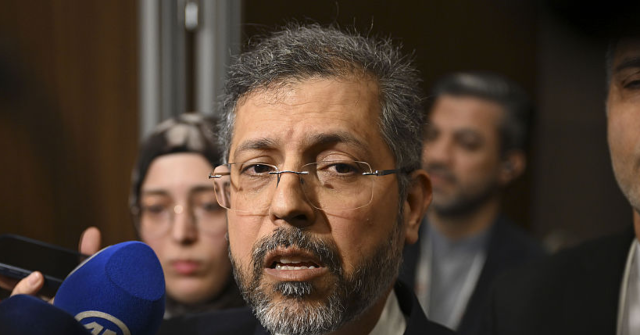
On the civilian side of the regime, Deputy Foreign Minister Saeed Khatibzadeh declared on Monday that his country would not negotiate with the United States unless the White House dropped its allegedly “excessive demands,” suggesting that Tehran would not be participating in any imminent peace talks.
“We will continue our strong resistance to protect the high interests of this country and its people, and we fear no threat,” he claimed.
Like similar Iranian regime comments, however, Khatibzadeh’s remarks, offered on Turkish television, gave no specifics regarding whether Iran would participate in this week’s expected talks or not, or a pathway to resume negotiations beyond America’s complete surrender.
IRNA separately reported that its own anonymous “diplomatic source in Pakistan” could confirm that Iran had not sent any delegates to the expected negotiations in Islamabad, but added that this had not happened “so far.”
“The source clarified that neither official nor unofficial information has been received regarding any Iranian involvement in the negotiations in Islamabad,” the state outlet shared.
In a commentary on the talks, the Iranian state-linked Mehr News Agency also indicated that Iran was not seeking to resolve the crisis anytime soon, claiming that the jihadist regime uses “strategic patience” to exasperate opponents into submission and intends to do so in this situation, as well.
“A country with a history spanning several millennia, which has navigated through numerous external crises and pressures, is not easily swayed by short-term ultimatums,” Mehr claimed. “Within this framework, the more impatient the opposing side becomes, the more it is perceived as a sign of success, not weakness.”
The outlet’s commentary also bizarrely added that, while “in Washington, success is often measured by demonstrable achievements: a formal agreement, a historic signing, or a joint statement… the definition of success can be entirely different” in Iran.
The article offers no indication of what would bring Iran back to the negotiating table or how to resolve the crisis, only dismissing the idea of pressure on the Iranian regime as ineffective.
The pressure nonetheless resumed on Monday as the U.S. military confirmed a second ship seizure apparently linked to Iran.
The ship in question was described as a “stateless” vessel that had already been under American sanctions and was traveling in the Indo-Pacific region, suggesting it was not in the Strait of Hormuz when captured. The sanctions in question are those intended to limit Iran’s ability to sell oil in international markets.
Iran responded by claiming on Tuesday that one of its ships had successfully avoided the U.S. blockade and navigated through the Strait of Hormuz.