Iranian Parliament Speaker Mohammad Bagher Ghalibaf, one of several Iranian politicians vying for influence following the elimination of "supreme leader" Ali Khamenei, disparaged American Secretary of War Pete Hegseth as a "failed TV host" in commentary on Friday following a successful visit by President Donald Trump to Iranian ally China.
The post Iran, Rattled by Trump-Xi Lovefest, Knocks Pete Hegseth as ‘Failed TV Host’ appeared first on Breitbart.
Iranian Parliament Speaker Mohammad Bagher Ghalibaf, one of several Iranian politicians vying for influence following the elimination of “supreme leader” Ali Khamenei, disparaged American Secretary of War Pete Hegseth as a “failed TV host” in commentary on Friday following a successful visit by President Donald Trump to Iranian ally China.
The comments – apparently intended for an American audience given the use of terms such as “cosplay” and “LARP” – also occur as Iranian Foreign Minister Abbas Araghchi attends a summit of BRICS ministers in India. BRICS is an anti-American coalition named for its top countries – Brazil, Russia, India, China, and South Africa – largely believed to be led by China. Iran, a member of the coalition, has significantly strained the alliance after bombing fellow brings member United Arab Emirates (UAE). Araghchi reportedly used his position at the summit to accuse of the UAE of inciting hostilities against Iran, fraying an already weakened coalition.
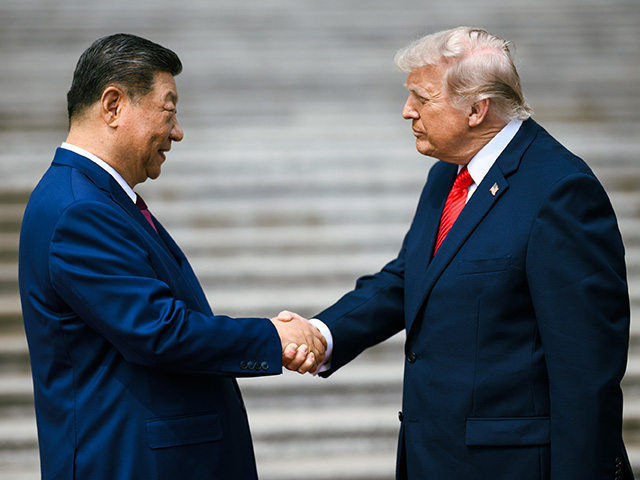
President Donald J. Trump participates in a welcome ceremony with President Xi Jinping of the People’s Republic of China, Thursday, May 14, 2026, at the Great Hall of the People in Beijing, China. (Official White House Photo by Daniel Torok)
Outside of antagonizing a key BRICS ally, Iran has faced over months of increasingly frustrated comments out of the Chinese Foreign Ministry and from dictator Xi Jinping himself demanding free transit for commercial ships in the Strait of Hormuz. As a result of the conflict between Iran and America, Iran’s terrorist Islamic Revolutionary Guard Corps (IRGC) has blocked commercial shipping in the Strait for weeks, to which America retaliated by imposing its own blockade only on Iranian ships.
China is one the largest destination countries for shipments from the Strait and the world’s largest crude oil customer, making it among the most vulnerable countries in the face of such disruptions. President Trump suggested following his visit to China that he and Xi had come to some agreements on how to handle the situation with Iran, news that appears to have prompted the new wave of vitriol from Tehran.
WATCH — “It’s Very Interesting…” Trump Says China Agrees with Him on Iran:
Ghalibaf shared his commentary on Twitter, which was then reproduced by the state-run Islamic Republic News Agency (IRNA), in response to a report in the Financial Times about America selling bonds. According to the Financial Times, the U.S. government sold “30-year debt at a 5 per cent yield for the first time since 2007” on Wednesday. The report suggested that increases in inflation and, especially, fuel prices around the globe linked to Iranian blockages in the Strait of Hormuz were to blame for the need for selling such debt.
“So you’re funding Hegseth the failed TV host at rates unheard of since 2007, so he can cosplay as Secretary of War in our backyard in Hormuz?” Ghalibaf wrote on social media. “You know what’s crazier than $39 trillion in debt? Paying a pre-GFC premium to fund a LARP and all you’ll get is a brand new GFC”.
“LARP” is an internet term for “live-action role play,” typically used in the context of “cosplay,” or the detailed dressing up by adults to appear like illustrated or animated characters. It is used derisively to refer to someone faking or incapable of realistically achieving something.
Ghalibaf failed to note, of course, that Iran’s threats to commercial shipping in the Strait of Hormuz, and not the American campaign to prevent Iran from threatening its neighbors, is responsible for the higher oil prices. Iran has repeatedly denied, despite the clear evidence, that it is preventing all civilian commercial shipping from safely transiting through the Strait. The American military attacks on Iran stopped in April after President Trump announced a ceasefire of indefinite length to allow for negotiations, ideally resulting in a long-term peace deal that prevents Iran from obtaining a nuclear weapon.
Abroad, Foreign Minister Abbas Araghchi addressed the conflict at the BRICS summit, calling the ceasefire “very unstable” and rejecting talks with America.
“We are interested in negotiations, but only if our counterpart is serious,” he told reporters, according to IRNA. “Therefore, the most important issue right now is trust. We cannot trust the Americans at all.”
Araghchi also insisted the Strait of Hormuz was open, “as far as we are concerned,” but added that “all ships can transit, except for those belonging to countries that have been at war against us and are fighting us.” This would presumably include the UAE, which Iran has repeatedly bombed, and which sells substantial amounts of oil to China.
WATCH — President Trump Meets with President Xi of China:
Araghchi also extended kind words to China, noting that the Chinese Communist Party played a significant role in the normalization of relations between Iran and Saudi Arabia.
“They are partners in establishing relations between countries, and China has good intentions. Therefore, any action taken by them to help diplomacy will be welcomed by the Islamic Republic of Iran,” Araghchi reportedly said.
Reports suggest that, elsewhere in the summit, Iran was a source of discord for BRICS rather than unity. Speaking to reporters on the sidelines, Araghchi noted that he did not use his BRICS statement to condemn Israeli and American ally UAE, also a BRICS member, “but the truth is that the UAE was directly involved in the aggression against my country. When the attacks started, they didn’t even issue a condemnation.”
“We must live side by side in peace, and this requires peaceful relations and complete understanding between the two countries,” Araghchi added.
Officials in the UAE did not initially condemn “Operation Epic Fury” as Iran’s immediate response was to launch a missile and drone campaign against its neighbors, including the UAE. Abu Dhabi was quick to condemn explosions against its neighbors.
The Chinese Foreign Ministry on Friday, following Trump’s departure from Beijing, indicated that Trump and Xi found common ground on the issue of Iran, news that is unlikely to please Tehran.
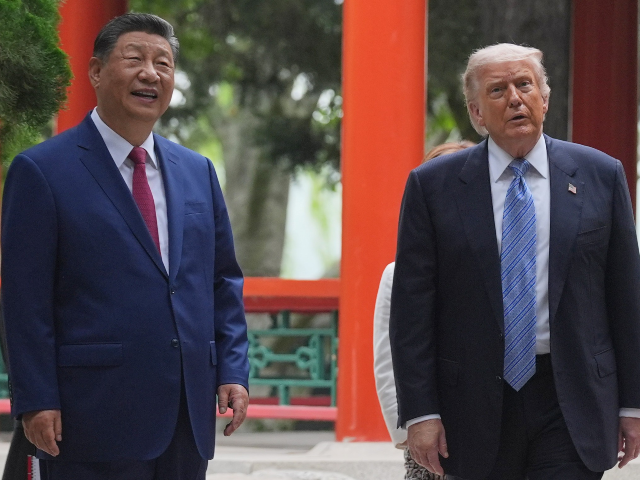
President Donald Trump talks with China’s President Xi Jinping at the Zhongnanhai leadership compound, Friday, May 15, 2026, in Beijing. (AP Photo/Mark Schiefelbein)
“It is important to reopen the shipping lanes as soon as possible to respond to the call of the international community and jointly keep the global supply chains stable and unimpeded,” Foreign Ministry spokesman Guo Jiakun told reporters, referring to the Strait of Hormuz. “It is important to reach a comprehensive and lasting ceasefire as soon as possible, enable peace and stability to return to the Middle East and Gulf region at an early date, and lay the foundation for building a sustainable security architecture for the region.”
“There is no point in continuing this conflict which should not have happened in the first place. To find an early way to resolve the situation is in the interest of not only the U.S. and Iran, but also regional countries and the rest of the world,” Guo stated.
Shortly after the first conversations in Beijing, the White House revealed that Xi had “made clear China’s opposition to the militarization of the Strait and any effort to charge a toll for its use” to Trump and agreed that “Iran can never have a nuclear weapon.”