Multiple top Iranian regime officials, including missing "supreme leader" Mojtaba Khamenei, issued statements on Thursday and Friday declaring that they are all entirely in agreement with how to move forward on the current crisis with the United States, denying the existence of political dissent.
The post Iran’s Leaders Try to Show Unity After Trump Mocks Power Struggle in Tehran appeared first on Breitbart.
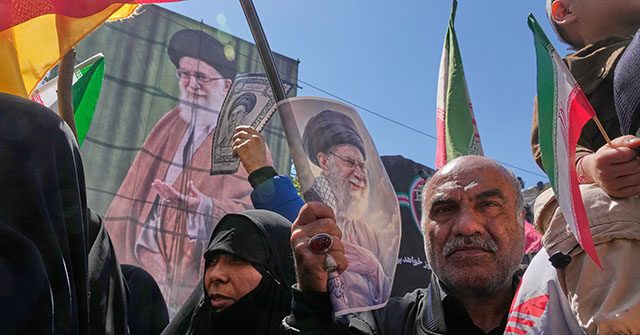
Multiple top Iranian regime officials, including missing “supreme leader” Mojtaba Khamenei, issued statements on Thursday and Friday declaring that they are all entirely in agreement with how to move forward on the current crisis with the United States, denying the existence of political dissent.
The statements followed a week in which President Donald Trump repeatedly remarked on his website that a significant obstacle to negotiating with Tehran is that the few remining living members of the regime so stridently disagree on how to approach talks with America. Trump announced that planned talks between representatives of both states in Pakistan were postponed, and a two-week ceasefire that expired on Tuesday was extended indefinitely, in recognition of the chaotic state of the Iranian Islamic regime.
Pakistan is attempting to mediate talks toward peace between the two countries after the Pentagon launched an expansive military operation on February 28 to destroy much of Iran’s terrorist capability, particularly its prodigious missile and drone arsenals. As part of that operation, nicknamed “Epic Fury,” and Israel Defense Forces (IDF) missions taken in tandem, dozens of senior Iranian leaders have been killed, including longtime dictator Supreme Leader Ayatollah Ali Khamenei and commanders of the Islamic Revolutionary Guard Corps (IRGC).
Of those in place prior to the operations, President Masoud Pezeshkian and Foreign Minister Abbas Araghchi have emerged the most publicly visible and vocal figures in leadership, but both are subservient to the “supreme leader.” Following Khamenei’s death, son Mojtaba was officially proclaimed his successor, but he has made no public appearances and has issued only pre-written statements, leaving it unclear how powerful a figure he truly is.
Mojtaba Khamenei issued another of his written statements on Thursday declaring that the Trump administration was the one experiencing division, contrary to reports of division among Iranian leaders between a faction of pro-dialogue “moderates” and “hardliners.”
“Due to the strange unity created among compatriots, a fracture has occurred in the enemy,” the entity claiming to be Khamenei proclaimed in his written statement, according to the state-run Islamic Republic News Agency (IRNA).
“The enemy’s media operations, by targeting the minds and psyches of the people, intend to undermine national unity and security; may our negligence not allow this sinister intent to come to fruition,” the written statement continued.
Araghchi and Pezeshkian issued similar statements proclaiming ideological unity, including Parliament speaker Mohammad Bagher Ghalibaf, who is rumored to have resigned from his position in disagreement with other factions of the government. All reflected similar language dismissing reports of alleged discord but not directly identifying President Trump as the source of the allegations.
“Iranians are all united, more than ever before,” Araghchi declared in a post on social media.
“The failure of Israel’s terrorist killings is reflected in how Iran’s state institutions continue to act with unity, purpose, and discipline,” his comment claimed.
Similarly, President Pezeshkian published a statement reading, “in Iran, there are no ‘hardliners’ or ‘moderates,’” contrary to decades of understanding of Iranian politics – and Iran’s own false claims to tolerating dissenting viewpoints.
“We are all Iranians and revolutionaries. With ironclad unity of nation and state and obedience to the Supreme Leader, we will make the aggressor regret,” Pezeshkian claimed. “One God, one nation, one leader, one path; victory for Iran, dearer than life.”
Ghalibaf published an almost identical statement.
“In Iran, there are no radicals or moderates; we are all ‘Iranian’ and ‘revolutionary,’ and with the iron unity of the nation and government,” his social media accounts posted, “with complete obedience to the Supreme Leader of the Revolution, we will make the aggressor criminal regret his actions.”
President Trump began hinting at reasons to believe that the Iranian regime was significantly divided on Tuesday, when he announced an extension to the two-week ceasefire that ended that day.
“Based on the fact that the Government of Iran is seriously fractured, not unexpectedly so and, upon the request of Field Marshal Asim Munir, and Prime Minister Shehbaz Sharif, of Pakistan,” Trump wrote on Truth Social, “we have been asked to hold our Attack on the Country of Iran until such time as their leaders and representatives can come up with a unified proposal.”
Trump stated that he had chosen to answer the request positively.
On Thursday, Trump again stated that Iran was difficult to negotiate with because they could not agree internally on their positions.
“Iran is having a very hard time figuring out who their leader is! They just don’t know!” Trump wrote. “The infighting is between the ‘Hardliners,’ who have been losing BADLY on the battlefield, and the ‘Moderates,’ who are not very moderate at all (but gaining respect!), is CRAZY!”
Shortly after the announcement of the ceasefire, reports surfaced appearing to corroborate Trump’s claims. The independent outlet Iran International reported on Thursday that, as Trump had suggested, part of the reason for the delay in negotiations on Tuesday was that the Iranian team could not organize itself in time to meet in Islamabad on Tuesday.
“Divisions within Iran’s leadership prevented a negotiating team from traveling to Islamabad for talks with the US,” anonymous “sources familiar” with the situation told Iran International, specifically defining the divide in the government between Pezeshkian’s wing of the government and “figures close to Supreme Leader Mojtaba Khamenei.”
“According to the sources familiar with the matter, the delegation was ready to leave when a message from Khamenei’s inner circle ruled out discussing nuclear issues and reprimanded the foreign ministry team over earlier negotiations,” Iran International added. Frustrated, Araghchi allegedly suggested calling it off.
Reports on Friday indicated that Araghchi arrived in Islamabad on Friday and the White House has also deployed a team to the Pakistani capital; whether the two will meet remains unclear at press time.