Fulton Sheen’s beatification today marks the last step before his official canonization as a Catholic saint. When that day comes, he should be designated the patron saint of anti-communism.
The post Pinkerton: Fulton Sheen Should Be the Patron Saint of Anti-Communism appeared first on Breitbart.
Archbishop Fulton Sheen is now, in the eyes of the Catholic Church, Blessed Fulton Sheen. His beatification mass today in St. Louis, Missouri, marks the last step before official canonization as a Catholic saint. And in this layperson’s opinion, when that day comes, Fulton Sheen should be designated the patron saint of anti-communism.
Indeed, as we look around the world today, the red tide rising, we see the urgent need for Sheen-style moral armament.
In his own mind, first and foremost, Sheen (1895-1979) was a man of God. Ordained as a priest in 1919, he served his church for the next 60 years in a variety of parochial and administrative roles, including as Bishop of Rochester, NY.
Still, Sheen’s greatest gift was as a communicator. Possessed of movie-star looks, a rich voice, and a theatrical mien—some joshingly compared him to such high-cheek-boned movie players as Christopher Lee, Christopher Plummer, and Peter Cushing—Sheen was, as they say, born for the boards. And for the camera, and the microphone.
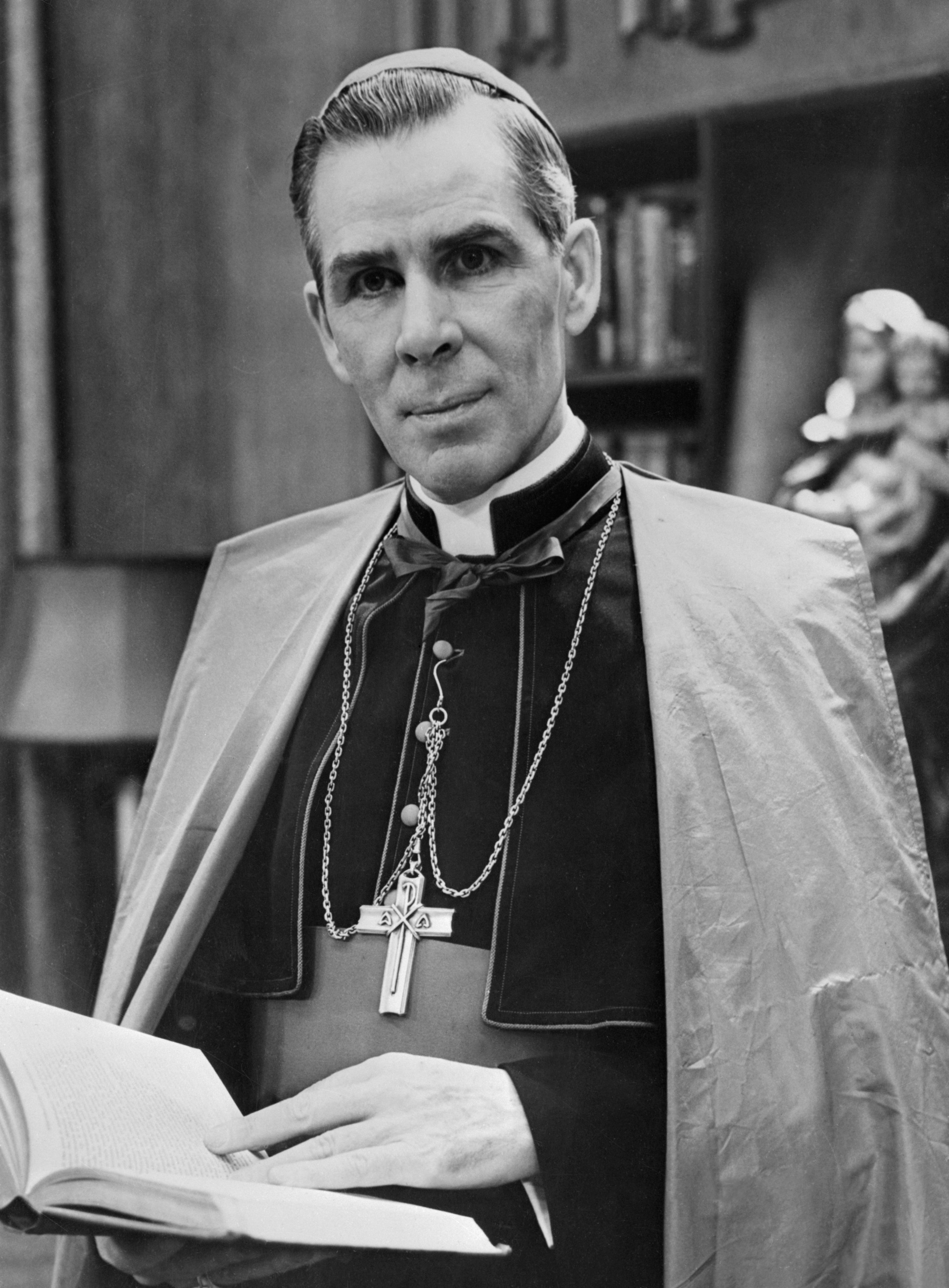
Original Caption: Intelligence, simplicity, spirituality, humor are all expressed in the features of Bishop Fulton Sheen, once described as a “priestly-looking Tyrone Power.” (Getty Images)
Most importantly, Sheen had something important to say; his religious schooling, from Washington, D.C. to Belgium to Rome, was put to good use. Beginning in the 1930s, Sheen had a regular radio show in New York City. In the 1950s, he moved to primetime network television, going head to head with the likes of Milton Berle and Frank Sinatra. At its peak, his Emmy-award winning show, called Life Is Worth Living, reached 30 million Americans every week, making him the most successful televangelist of all time. When he won his Emmy, he famously gave all the credit to his writers — “Matthew, Mark, Luke, and John.”
Sheen’s stardom faded by the late 1960s, and yet happily—miraculously, some might say—half a century after his death, we have myriad video clips, and many whole shows, online.
Sheen was not afraid to be topical, albeit in ways theological. In the midst of the protests and riots of the 60s, Sheen lambasted nihilism: “Our nation is too full with those who are crying ‘down.’ ‘Down with churches.’ ‘Down with the police.’ ‘Down with government.’ Can you build anything down? You cannot.” That’s the voice of a careful institutionalist: Yes, make things better, but operate within proper godly and human channels.
And here’s Sheen on crime: “False compassion is a pity shown not to the family of the murdered, but to the murderer.” There’s plenty of room for forgiveness in this worldview, and yet first the criminal must repent. And in the meantime, at all times, the social order, including innocent life, must be protected.
Sheen’s lifelong point was that political activism must never be used to excuse personal shortcomings; we meet our Maker as a single soul, not as a party or a bureaucracy. In Sheen’s incisive formulation, “Sometimes we can cover our want of individual justice with social justice.” In other words, hypocritical posturing and evading may work in this world, but in the next, God will have none of it.
Interestingly, during his life, Sheen was seen as a political liberal. But of course, back then, liberals included Harry Truman and John F. Kennedy, two God-fearers who supported the police and the military—both men, in fact, volunteered for combat duty. So today, the 33rd and 35th president would be seen as conservatives; there was nothing woke about either of those old-guard Democrats, and millions more of their generations.
For his part, Sheen also wrote longer than soundbites. He published some 73 books in his life, as well as innumerable columns, articles, and scripts. In 1943, he produced a prayer book for soldiers, distributed free to interested GIs.
He dedicated that opus to to the Queen of Heaven, and then moved to a clever patriotic invocation, anathematizing both the rising-sun-iconography of Imperial Japan and the twisted-cross swastika of Nazi Germany:
To Mary, Mother Immaculate, gracious protectress of the United States, in humble petition that thy land, which was violated on the eve of thy great feast, may be victorious and inviolate again on that same feast day, when the false god of a rising sun sets, and the double cross untwists itself, and we, who fought to make others free, are ourselves made free with the glorious liberty of the children of God.
(Faith was, for sure, a major aspect of the American victory in World War Two. Here, for example, is a mass on Iwo Jima; the chaplain and the Marine communicants are literally on the beach, vulnerable to Japanese fire, but important things can’t wait.)
Yet opposition to communism was peak Sheen. Even before Karl Marx, left-wing radicals had identified, correctly, religion as their greatest obstacle. That’s why the French revolutionaries of the 18th and 19th century were in such a rush to torture and execute priests, nuns, and higher clerics, even the archbishop of Paris.
Of course, it wasn’t just Catholics who got in the way of the communists, it was also Protestants, the Orthodox, and other believers. Sheen stood up for all of them in opposing Godless Bolshevism and spinoff communisms.
In the late 1930s, when communists in Spain made made a special point of murdering clerics, destroying churches and shrines, and even defiling the holy dead, Sheen went to work, rallying the faithful, as recalled by biographer Thomas C. Reeves:
In an October 1936 article for The Tablet, a conservative Brooklyn diocesan paper, he displayed a detailed knowledge of the crisis in Spain and documented Soviet efforts, in part from the Russian press itself, to turn the nation into a communist state. In November of the following year, Sheen recited gruesome statistics on atrocities against Catholics in Spain and lashed out at liberal intellectuals . . . who were backing [communists].
In fact, behind the scenes during those years, Sheen was even willing to confront President Franklin D. Roosevelt, whose administration harbored more than a few reds, even outright Stalinist spies.
In the 1940s, Sheen called communist Russia “the most anti-Christ nation on the face of the earth.” It was fitting, in Sheen’s view, that the Soviet “saint” was “a rotted corpse, the body of Lenin—a perfect symbol of that to which all communism must lead us all, unto dust, unto dissolution, unto death.” Death without redemption and salvation—that’s what Sheen most opposed.
So yes, God bless Blessed Fulton Sheen, as the Catholic Church’s articulate and persistent critic of communism.
For sure, we need his guiding spirit today, as communism is surging around the world, from New York City to Seattle to Berlin to some inner precincts of the Democratic Party.
There are many arguments to make against communism, and we will need them all. To name just three heroes of the past century, Friedrich Hayek, Ludwig von Mises, and Milton Friedman each made strong pitches on the basis of personal liberty and sound economics. Others spoke of geopolitical strategy, including Charles De Gaulle, Margaret Thatcher, and Ronald Reagan.
Still others, including Aleksandr Solzhenitsyn and Pope John Paul II, couched their anti-communist arguments in more spiritual terms. And of course, back in 2014, John Paul was canonized as a saint. So some might say, we already have a patron saint of anti-communism.
To which we can say, it would be great to have another one, focused perhaps, on the United States. When fighting off Reds, we Americans need all the spiritual armor we can get. This will be a long twilight struggle.