Senior Iranian officials are reportedly growing increasingly concerned about the health of the country’s unseen Supreme Leader Mojtaba Khamenei, with one source close to Iranian President Masoud Pezeshkian’s government saying officials “would not be surprised” to soon hear news of his death.
The post Report: Iranian Leaders Fear Mojtaba Khamenei’s Decline — Officials ‘Would Not Be Surprised’ by His Martyrdom appeared first on Breitbart.
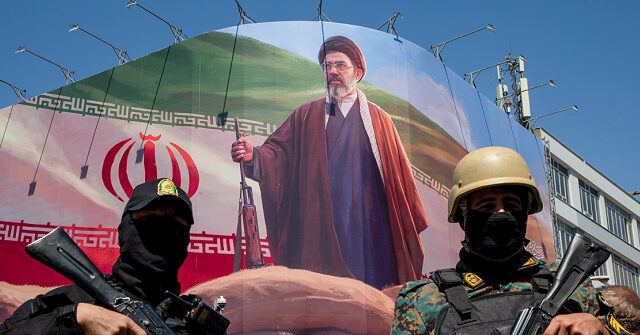
Senior Iranian officials are reportedly growing increasingly concerned about the health of the country’s unseen Supreme Leader Mojtaba Khamenei, with one source close to Iranian President Masoud Pezeshkian’s government saying officials “would not be surprised” to soon hear news of his death.
IranWire reported Thursday, citing two sources close to Pezeshkian’s government, that rumors Khamenei is in “extremely critical condition” and could die at any moment are circulating widely within the highest levels of the Iranian regime.
One source close to Pezeshkian’s cabinet told the opposition outlet that Khamenei’s physical condition is poor.
“We would not be surprised if we heard news of his martyrdom soon,” the source said.
The two sources also said Khamenei has not met with any members of Pezeshkian’s cabinet since the February 28 U.S.-Israeli strikes that launched Operation Epic Fury, killing his father and predecessor, Ayatollah Ali Khamenei, along with other members of his family.
The claims have not been independently verified, and Iranian authorities have not announced that Khamenei is critically ill.
They nevertheless add to mounting questions surrounding the condition of Iran’s elusive supreme leader, who was reportedly wounded in the February 28 attack and has not been seen or heard publicly since succeeding his father.
Khamenei has made no public appearances or televised speeches since taking power, and no video or audio of him has been released. His communications with the Iranian public have instead consisted entirely of written statements attributed to him by state media. He also notably did not appear at his father’s public funeral ceremonies last month, further fueling speculation over his condition and whereabouts.
Accounts have differed significantly over the extent of the injuries Khamenei reportedly suffered in the attack, fueling months of speculation over his physical condition and ability to govern.
Earlier this week, the Tehran Municipality-affiliated Iranian newspaper Al-Mashhari reported that authorities were withholding audio recordings of Khamenei over concerns that foreign intelligence agencies could analyze them to determine his location.
The newspaper said acoustic signatures, background equipment noise and other characteristics of a recording could potentially reveal information about Khamenei’s surroundings or condition — an explanation offered for why even the supreme leader’s voice has not been publicly released.
Pezeshkian himself acknowledged Wednesday that communicating with Khamenei is currently “very difficult.”
“It is very difficult to communicate with him at the moment, but in any case, his presence is a very great source of strength for us so that we can continue,” Pezeshkian said in an interview aired on Iranian state television.
The Iranian president nevertheless defended Khamenei during the interview, describing his interactions with the supreme leader as productive and saying he had encountered “kindness and very sound logic.”
The public acknowledgment came amid separate reporting raising questions over how much access even Iran’s president has had to the Islamic Republic’s supreme leader.
Iran International reported this week, citing anonymous sources, that Pezeshkian was granted only one meeting with Khamenei after repeatedly seeking access to him — an encounter allegedly conducted under circumstances that left the president uncertain whether he had actually met the supreme leader.
According to the outlet, Pezeshkian was taken to a secret location in Tehran and allowed only minutes inside a dark vehicle with tinted windows, with a man presented to him as Khamenei.
“Pezeshkian could not see the man beside him and later asked whether the voice he had heard had really belonged to the supreme leader,” Iran International reported, citing its sources.
The account appeared to conflict with Iranian state media reports this year describing a lengthy in-person meeting between the two men. Pezeshkian said in May that he had held a “direct” and “frank” conversation with Khamenei, while state media reported that the meeting lasted roughly two and a half hours.
The Wall Street Journal reported Thursday that Iranian officials pushing for negotiations have also struggled to gain access to Khamenei, who has never appeared publicly since assuming the Islamic Republic’s most powerful position.
Pezeshkian threatened to resign in order to secure a meeting with Khamenei and warn him that Iran’s economic situation had become so dire that reaching a diplomatic understanding was urgent, according to Arab diplomats and an adviser to the Islamic Revolutionary Guard Corps cited by the outlet.
The renewed questions surrounding Khamenei’s condition come at a particularly consequential moment for Tehran, as Iranian officials consider a temporary framework negotiated with Oman governing commercial navigation through the Strait of Hormuz.
An Iranian parliamentary official said Friday that the “general framework” of the arrangement had been finalized but remained subject to final approval at the country’s “highest decision-making levels.”
Axios separately reported Friday, citing a diplomat from one of the mediating countries, that Iran was awaiting approval from its Supreme National Security Council and expected a decision shortly.
Under the emerging 60-day framework, ships entering the Persian Gulf would use a route along the Iranian side of the strait while outbound traffic would travel along the Omani side, as the parties work toward a longer-term arrangement over the strategic waterway and potentially a broader diplomatic track over Iran’s nuclear program.
The United States has insisted that any temporary routes permit unrestricted commercial navigation without Iranian tolls, fees, approvals or permissions.
Khamenei retains ultimate authority over Iran’s most consequential diplomatic and national security decisions, leaving renewed questions about his health and accessibility hanging over Tehran as it weighs an agreement that could determine the immediate course of the nearly six-month war.
Joshua Klein is a reporter for Breitbart News. Email him at [email protected]. Follow him on Twitter @JoshuaKlein.