President Donald Trump warned Tuesday that Iran could be “totally wiped out as a country” if it continued its attacks on U.S. forces, as Tehran launched a new ballistic missile barrage targeting American military facilities in Jordan following a wave of U.S. strikes on Iran.
The post Trump: Iran Could Be ‘Totally Wiped Out’ — Tehran Launches Missile Attack on U.S. Bases in Jordan appeared first on Breitbart.
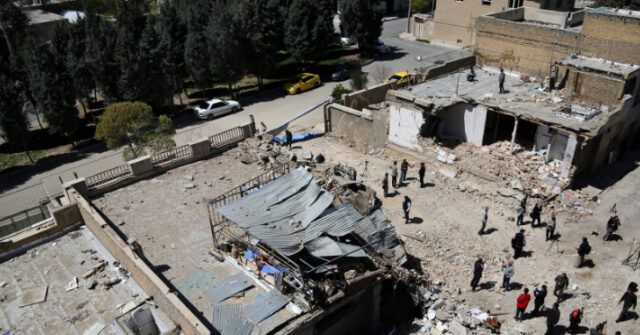
President Donald Trump warned Tuesday that Iran could be “totally wiped out as a country” if it continued its attacks on U.S. forces, as Tehran launched a new ballistic missile barrage targeting American military facilities in Jordan following a wave of U.S. strikes on Iran.
Trump issued the warning during a phone call with Fox News chief foreign correspondent Trey Yingst as U.S. forces carried out a new round of strikes across southern Iran, which Washington said were retaliation for Iranian threats to shipping in the Strait of Hormuz and an earlier missile attack against American forces in Jordan.
“If they do respond, they’ll be hit much harder,” Trump said. “This is a very big hit today. If it goes a third time, they’re going to be totally wiped out as a country.”
Iran subsequently launched another ballistic missile attack targeting U.S. military facilities in Jordan, where the Jordanian Armed Forces said the kingdom had been “targeted by a missile attack that originated from Iranian territory.”
Jordanian air defenses engaged 13 ballistic missiles that entered the kingdom’s airspace, intercepting and destroying 10, according to the military. The remaining three fell in remote areas away from population centers, with no injuries or deaths reported.
A U.S. official separately told ABC News that American forces shot down Iranian missiles during the attack. Two U.S. officials told Reuters that no American casualties had been reported, while a U.S. source told Al Jazeera that an Iranian attack targeting Camp Titin, a U.S. military facility near Aqaba, caused no injuries or major damage.
The Islamic Revolutionary Guard Corps (IRGC) nevertheless claimed its Aerospace Force had carried out a “heavy ballistic missile attack” against Camp Titin, alleging that numerous American personnel were killed and several facilities and attack helicopters destroyed. Those claims were not corroborated by U.S. or Jordanian authorities and stood in contrast to the initial casualty assessments from American officials.
Jordan said its surveillance and air-defense systems remained on high alert as its military continued monitoring the unfolding attacks.
Tuesday’s barrage marked the second Iranian missile attack involving U.S. forces in Jordan in three days — and came after Trump specifically cited the first attack as justification for the latest American strikes.
U.S. Central Command (CENTCOM) struck two IRGC launchers on Iran’s Larak Island on Sunday after saying Iranian forces were preparing rockets carrying sea mines for launch into the Strait of Hormuz. Iran responded by firing ballistic missiles toward U.S. forces in Jordan, where Jordanian defenses intercepted eight missiles.
CENTCOM said U.S. forces began a new round of strikes against IRGC targets at noon ET Tuesday, citing recent attempted attacks against commercial shipping in the Strait of Hormuz and American service members deployed in the region. The command announced Tuesday evening that the wave of strikes had been successfully completed.
Following CENTCOM’s announcement of the strikes earlier Tuesday, Trump said in a Truth Social post that the operation was retaliation both for Iran’s attempted deployment of sea mines and its earlier missile attack against the U.S. base in Jordan. He warned that another Iranian response would bring strikes at a “much harder and higher level,” with an even larger attack “waiting in the wings.”
Trump also disclosed new details about Tuesday’s targets, telling Yingst the United States had struck “a lot of radar” after deliberately allowing Iran to nearly finish rebuilding systems destroyed in earlier attacks.
“They tried to rebuild their radar because they can’t see anything,” Trump said. “We waited until it was almost built and then we hit it.”
The account provided a real-time example of a strategy U.S. officials had described to Axios ahead of Tuesday’s operation: periodically striking Iranian radar, air-defense and anti-ship missile capabilities as Tehran attempts to reconstitute them around the Strait of Hormuz. One U.S. official characterized the approach as “mowing the lawn,” aimed at reducing the threat to commercial shipping and American forces operating around the strategic waterway.
Trump underscored the threat of further American action by pointing to the USS George Washington, the aircraft carrier that arrived in the region last week.
“The [USS] George Washington is loaded to the gills,” Trump told Yingst. “We’re loaded up.”
CENTCOM subsequently confirmed that U.S. forces had struck IRGC air-defense sites, radar systems, maritime assets and facilities, mine-laying capabilities, and communications sites during the operation.
Iranian media reported strikes across a broad stretch of southern Iran, including Bandar Abbas, Qeshm Island, Chabahar, Konarak, Jask and Sirik. Tasnim later reported that a U.S. missile attack also struck the outskirts of Ahvaz in southwestern Iran, where a provincial security official said authorities were assessing the damage.
Iranian authorities, meanwhile, claimed four people, including a child, were killed and more than 50 wounded when a residential home hosting a wedding near Sirik was struck during the U.S. operation. Iran’s Foreign Ministry also accused the United States of carrying out the strike, while the IRGC cited the alleged attack in announcing what it called a second wave of retaliation against American forces.
The Iranian response widened across the region Tuesday evening, with officials in Kuwait and Bahrain reporting that their air defenses had been activated against incoming Iranian drone attacks. Kuwait’s military said its defenses were responding to “hostile drones” linked to Iranian aggression, while there were no immediate reports of injuries or damage in either country.
Iran’s army separately said its drones were targeting radar installations and areas housing U.S. forces at Sheikh Isa Air Base in Bahrain as part of its response to the American strikes.
As Iran’s regional response continued to unfold Tuesday evening, CENTCOM said more than 50,000 American service members operating across the Middle East remained “vigilant, lethal, and prepared to continue executing operations directed by the Commander in Chief.”
The widening exchange came only hours after Iranian President Masoud Pezeshkian said Tehran was prepared to return to the June ceasefire framework if Washington resumed what Iran considers its commitments under the agreement.
Trump offered a markedly different assessment hours later.
“I think an agreement with them isn’t worth the paper it’s written on,” he told Fox News. “We gave them a lot of chances.”
Joshua Klein is a reporter for Breitbart News. Email him at [email protected]. Follow him on Twitter @JoshuaKlein.