USTR Jamieson Greer announced “tariffs on 60 economies for their failure to impose and effectively enforce a prohibition" on forced labor.
The post U.S. Tariffs 60 Trading Partners, Including Europe and China, for Slave Labor Product Imports appeared first on Breitbart.
United States Trade Representative (USTR) Jamieson Greer on Thursday announced “tariffs on 60 economies for their failure to impose and effectively enforce a prohibition on the importation of goods produced with forced labor.”
“President Trump recognizes that decades of moral suasion have not eradicated forced labor from global supply chains,” Greer said. “The United States has had a forced labor import ban for nearly a century, and rigorously enforces it; it’s well past time for our trading partners to do the same.”
“Today’s action will begin to correct what is both a human rights abuse and distortive trade practice to improve the welfare of workers everywhere. I am encouraged by the trading partners who have moved quickly to adopt forced labor import prohibitions, and look forward to ensuring their effective enforcement,” he said.
While no universally recognized definition exists in international law for slavery, the United Nations treats forced labor as a form of modern slavery, alongside human trafficking, sex slavery, and situations such as forced marriages.
Under the heading “What is Modern Slavery?” the State Department defines forced labor as a form of slavery:
Forced labor, sometimes also referred to as labor trafficking, encompasses the range of activities – recruiting, harboring, transporting, providing, or obtaining – involved when a person uses force or physical threats, psychological coercion, abuse of the legal process, deception, or other coercive means to compel someone to work.
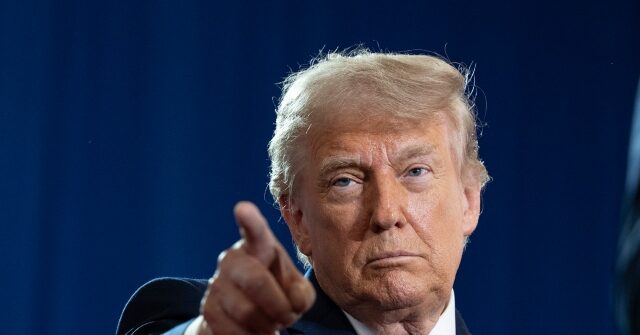
Greer said the tariff action was taken at President Donald Trump’s direction after extensive investigations, two rounds of public hearings, and “engagement with our trading partners to remedy these longstanding concerns.”
The punitive tariffs are at least ten percent on a range of goods from the listed countries, rising to 12 percent in some cases. Those affected include the United Kingdom, Canada, Mexico, and the European Union in addition to China, arguably the world’s worst offender at using slavery to export products at cut-rate prices. The USTR said the affected countries supply 99.4 percent of America’s imports.
Sky News noted that the slavery tariffs will “effectively replace the 10% global duty that Donald Trump imposed in February, following a Supreme Court ruling that declared his previous levies illegal.” The United States has paid out roughly $81 billion in tariff refunds since that ruling.
The forced labor tariff potentially has a more bulletproof legal foundation, as Greer invoked Section 301 of the 1974 Trade Act, which provides the USTR with a range of tools to address certain unfair trade practices by foreign nations.
Until now, Section 301 has mostly been invoked to file cases with the World Trade Organization (WTO), including complaints about slavery and excess industrial capacity. However, Section 301 explicitly allows the USTR to impose tariffs, and forced labor is one of the unfair trade practices covered by the law.
Greer said there would be exemptions to the tariffs, primarily in cases where they could lead to a critical shortage of goods, and domestic manufacturing could not pick up the slack. The USTR also gave some warning-shot exemptions to “encourage” them to “fulfill commitments regarding labor import prohibitions” before punitive measures might take effect.
The United Kingdom was evidently in this group, as a UK government spokesperson told Sky News: “There is no change to the tariff rate facing UK businesses as a result of this announcement.”
“We take forced labor very seriously and ensure that in global supply chains UK businesses are not complicit in forced labor and human rights violations,” the spokesperson said. “The U.S. has recognized the steps the UK is taking, which is why there are no additional tariffs for the UK under this announcement.”
The response from some other countries was not as constructive as the USTR might have hoped. Australian Trade Minister Don Farrell said the tariffs are “completely unjustified, and we will continue to lobby the United States Trade Representative to remove all tariffs on Australian goods.”
New Zealand Prime Minister Christopher Luxon likewise called the USTR action “extremely disappointing” and “unjustified.”
“Tariffs are not the way — they drive up costs and uncertainty for businesses,” he said.
European Union (EU) foreign policy director Kaja Kallas oddly argued that Europe has more generous labor policies than the United States, so it could not possibly be accused of using forced labor from any source.
“If you compare our labor laws to the ones of the United States, I mean we have, people have paid vacations, we have very good conditions, labor conditions for our employees, so it’s not really grounded,” she said.
USTR Greer said the EU was penalized because it “failed to effectively enforce a prohibition on the importation of goods produced with forced labor,” not for actually using slave labor itself.
Japanese Chief Cabinet Secretary Kihara Minoru called the tariffs “regrettable” at a press conference in Tokyo, insisting that Japan’s practices are “in accordance with international rules.”
As with the United Kingdom, Kihara said Japan’s understanding was that tariff rates already settled in negotiations in July with the U.S. would not be increased. The agreement imposed limits on U.S. tariffs in exchange for a $550 billion investment package from Japan.
Mexico’s Economy Minister Marcelo Ebrard anticipated “no change in the effective tariff that Mexico pays,” because the forced labor tariff simply replaces the rate Mexico had already been assessed.
France and South Korea had similar reactions to the USTR announcement. Thailand was slightly disappointed by the increased tariff of 12.5 percent leveled against it, but noted that roughly half of its exports have been exempted.
The socialist Brazilian government was furious, vowing to fight the tariffs at the WTO.
“Lacking a legal basis under domestic law to support its protectionist trade policy, the U.S. Trade Representative chose to manipulate an issue of great importance to human rights and workers’ rights movement,” Brazil said.
Leftist Canadian Prime Minister Mark Carney threatened reciprocal action if the forced labor tariffs take effect, while China slammed the Trump administration for fighting an unreasonable “trade war,” even though the tariffs announced on Thursday were much lower than what it paid last year.
“China’s position on China-U.S. economic and trade issues is consistent and clear. We oppose all forms of unilateral tariffs. Tariff wars and trade wars serve no one’s interests,” sniffed Chinese Foreign Ministry spokesman Lin Jian at a press conference on Friday.
A few of the responses were upbeat and cooperative, such as Malaysian Prime Minister Anwar Ibrahim saying he was “relieved” to get a 10-percent tariff, which is lower than what some neighboring countries will pay. He nevertheless said he would continue negotiations with the United States to reduce or remove the tariffs.
“We will continue to value our strategic relationship with the U.S., especially in ensuring that our trade remains intact, resilient, and stable,” said Philippine Trade Minister Cristina Roque.
“This is especially true since Philippine exports to the United States, particularly in electronics, semiconductors, and key agricultural products, support U.S. supply‑chain stability,” Roque added, hinting that while Manila was not responding with anger, it would prefer to see the tariffs gone.
Generally speaking, few countries were willing to concede they had an actionable problem with slave-made imports, but many seemed prepared to indulge the USTR announcement as the latest effort by President Trump to find a way to impose tariffs that will survive court challenges, and the rates were mostly lower than what Trump imposed during his “Liberation Day” tariff declaration in April 2025.