White House officials said the U.S. signed an Iran MOU reopening Hormuz and lifting the blockade, but sanctions relief and frozen assets will be tied to Iran’s performance.
The post White House: U.S. Signs Iran Memorandum of Understanding, Reopens Hormuz, Says No Frozen Assets Released Yet appeared first on Breitbart.
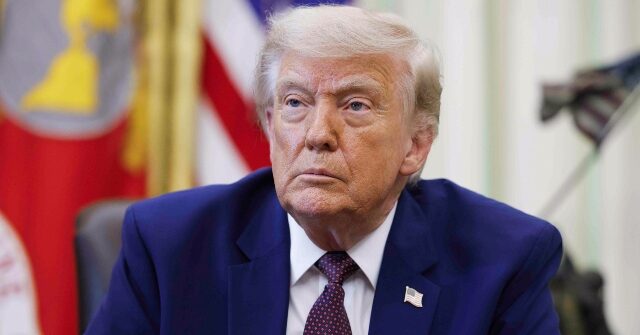
The White House said Monday that the United States has signed a memorandum of understanding (MOU) with Iran that provides for reopening the Strait of Hormuz, lifting the United States naval blockade, and beginning a new phase of negotiations over Tehran’s nuclear program, sanctions relief, frozen assets, and regional security.
A senior American official said, “We have now signed a memorandum of understanding with Iran,” adding that President Donald Trump, Vice President JD Vance, and Iranian Parliament Speaker Mohammad-Bagher Ghalibaf signed the document. The official said the agreement creates “a structure for how our negotiation, our relationship will operate in the future” and ties Iran being “welcomed into the world economy” to cooperation on its nuclear program, verification that it is not building a nuclear weapon, and “not funding radicalism and terrorism in the region.”
The official described the framework as a “two-way street,” saying, “If they’re willing to behave like a normal country, then we’re willing to treat them like a normal country.” The same official said the arrangement could benefit “the people of Iran, of the Gulf region and the United States,” while emphasizing that there is “still a lot of work to do.”
The memorandum also provides for the “immediate opening of the Strait of Hormuz” and the “combined lifting of the naval blockade,” though the official said “immediate” would still take time because there are mines in the strait, ships “have different risk tolerances,” and some crews want to see “a little bit more stability.” The official said a significant increase in traffic through the strait is “actually starting already” and is expected to ramp up over time, while noting that “we probably won’t return to normal in two weeks.”
Trump announced Sunday that the Iran deal was “now complete” and said, “Ships of the World, start your engines. Let the oil flow!” according to the background material provided. Pakistani Prime Minister Shehbaz Sharif also said, “The Peace Deal between the United States of America and Islamic Republic of Iran has been REACHED,” with a formal signing ceremony scheduled for Friday, June 19, in Switzerland.
A senior official said a signing ceremony for the MOU is planned for Friday and credited the negotiating team, including Vance, Jared Kushner, and Steve Witkoff, with establishing “a direct relationship with a number of people at the highest levels of the Iranian government.” The official said that “really hasn’t happened in 47 years” and argued it helped Washington understand “where they’re willing to give” and where there is still “wood to chop.”
Another senior U.S. official said the negotiations had been helped by Iran’s weakened economy, damage from the war to its “industrial base” and “military,” and internal tension between people who “want to stay with the same pathway” and others who “want to change.” He said talks included “front channel conversations with the Pakistanis” and “back channel conversations with the Qataris,” and that officials would know “over the next two to three weeks” whether current understandings would turn into a mutual agreement.
Asked whether any frozen assets had been released to Iran upon signing, one senior U.S. official answered, “Zero,” adding that “$0 of unfrozen assets have been released by the United States or any other country.” Another official said the United States is “prepared to release frozen funds” and offer sanctions relief in phases, but only if Iran takes “verifiable and hopefully irreversible steps.”
A senior U.S. official said the MOU “will be released publicly” and that “there’ll be no side deals,” while stressing that any sanctions relief, access to frozen funds, or support for investments — including the possibility of a “big $300 billion fund to rebuild their country” — would be “tied to performance.”
Asked whether the agreement would lead to a visible drawdown of U.S. forces in the region, a senior official said, “We’re not doing that yet,” explaining that any “reduction” would come only after a final deal in which “the Iranians make some concessions.”
Officials said Washington’s top priority is ensuring Iran does not rebuild its nuclear program, while sanctions relief would depend more broadly on Tehran “behaving more appropriately,” including by “not funding terrorism” or being “a source of instability in the region.”
A senior administration official said Trump encouraged Vance to get “involved directly” in the negotiations, which the official described as “an opportunity to make a difference.” Another senior administration official said negotiators felt “really, really lucky to have the vice president leading this team,” saying his role showed “the President’s commitment” to the talks.
A senior official said the agreement does not require Israel to withdraw from Lebanon because “their withdrawal is not a condition of the deal.” The official said the arrangement is a ceasefire but “will not be a one-way ceasefire,” meaning Israel would retain the right to defend itself and respond if Iran cannot control Hezbollah or if Hezbollah attacks Israeli positions or towns.