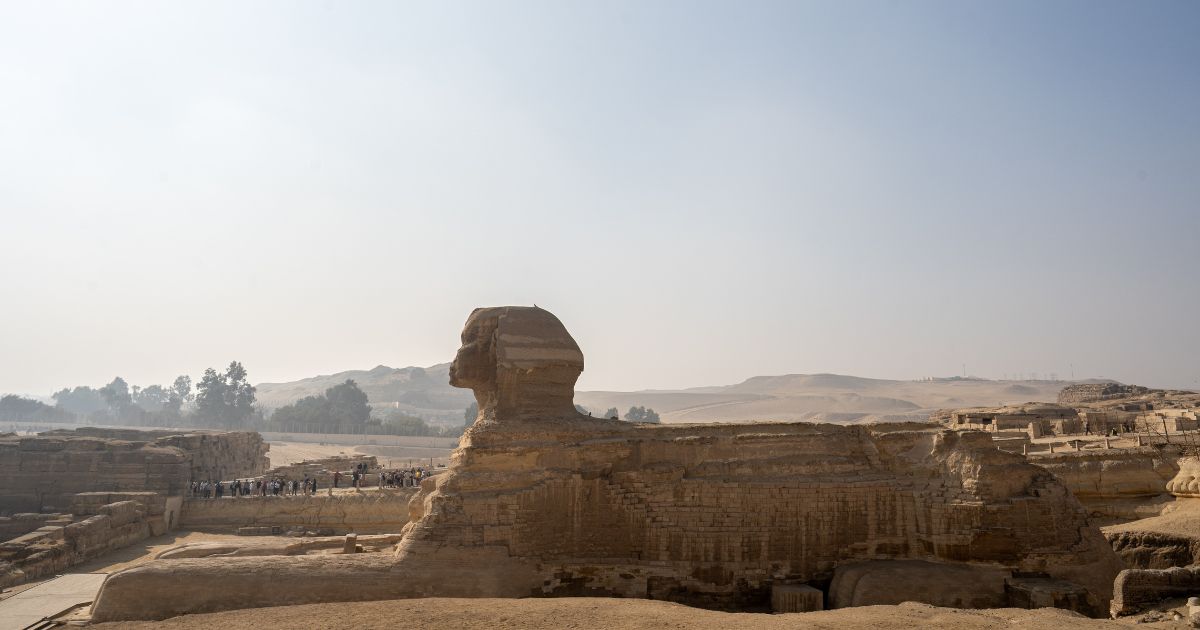
Italian researchers claim to have discovered a possible second Sphinx buried deep under the sands of Egypt — a development that would mark a significant discovery from the ancient world if confirmed.
Filippo Biondi said in a podcast interview last month that satellite radar technology able to detect ground vibrations has located a 180-foot mound of hardened sand on the Giza plateau, according to a report from the Daily Mail.
The outlet reported that scans “show vertical shafts and passageways strikingly similar to those already found beneath the original Sphinx.”
There are also “dense vertical lines believed to represent the solid walls of underground shafts rather than empty voids.”
The site of the scans is a mirrored location from the original Sphinx structure.
The geometric arrangement of the Great Pyramid of Khufu, the Pyramid of Khafre, the Pyramid of Menkaure, and the Great Sphinx indeed implies the existence of a second Sphinx at the site where radar is detecting an underground structure.
“We are finding precise geometrical correlation, 100 percent of correlation, in this symmetry,” Biondi said during the interview.
“We are very confident to announce this… we have a confidence about 80 percent.”
The Great Sphinx has another structure called the Dream Stele positioned between its two paws.
A SECOND Sphinx detected in Egypt as scans hint at ‘underground megastructure’ https://t.co/kSonYLl7HK
— Daily Mail US (@Daily_MailUS) March 26, 2026
Because the Dream Stele depicts two Sphinx figures, some have said that there may have once been two Sphinxes.
“The first Sphinx sits slightly below the surrounding surface, in a shallow depression, so it is possible the second Sphinx could be hidden beneath this higher mound,” Biondi added, per a report from the New York Post.
Rather than being made of bedrock, the area with the supposed second Sphinx is composed of hardened sand.
Biondi added that the two Sphinxes were likely used as propaganda by Pharaoh Thutmose IV in 1401 BC.
They served to justify his purported divine right to the throne of Egypt.
The New York Post noted that Biondi is not the first researcher to suggest that a second Sphinx may have existed.
Egyptologist Bassam El Shammaa posited a similar theory in recent years, noting that ancient records indicated the destruction of the second Sphinx by a lightning bolt.

Advertise with The Western Journal and reach millions of highly engaged readers, while supporting our work. Advertise Today.