Conservatives by temperament only reluctantly admit that anything, anywhere, has ever improved. But this most certainly has.
In short, the Vietnam War veterans who returned home to neglect or abuse from liberals have received their just due.
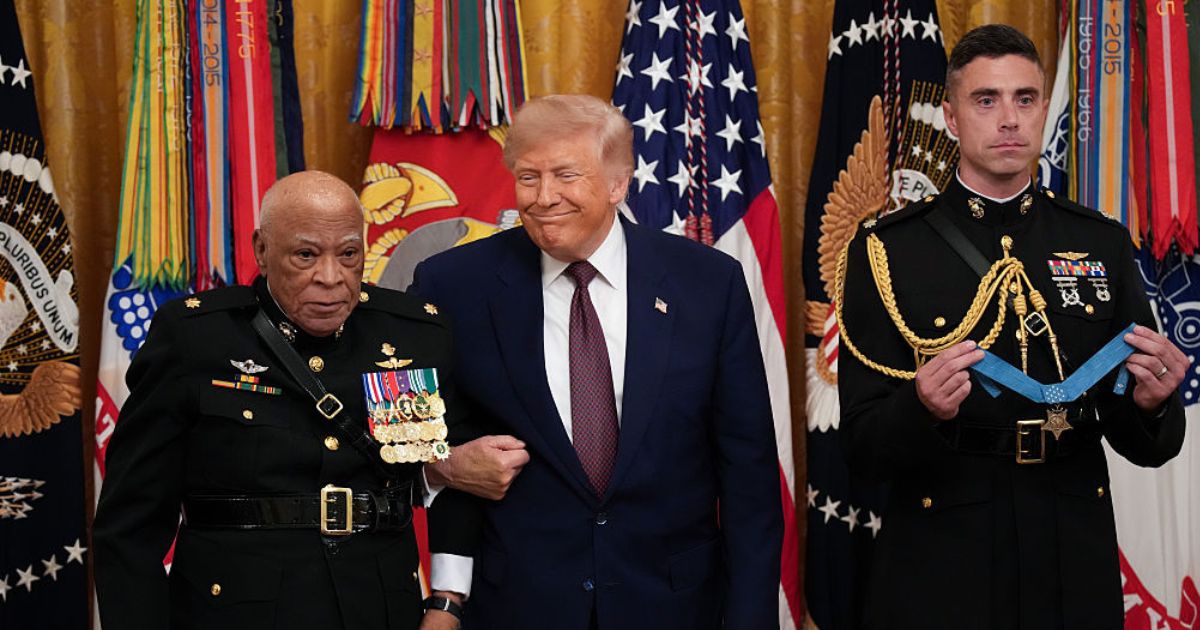
On Thursday at the White House, President Donald Trump provided literal physical support to 88-year-old Retired Marine Maj. James Capers while bestowing upon the patient, patriotic, and impossible-to-kill Capers a Congressional Medal of Honor he ought to have received decades ago.
The president stood arm-in-arm with the war hero, who appeared in his Marine uniform, weighed down by medals.
Trump then put the medal around Capers’ neck.
Then, after Capers appeared to say “Thank you, Sir,” Trump put his arm around his fellow octogenarian.
Did you remember when Democrats called Vietnam veterans war criminals and baby killers when they returned home?
Yes: 100% (26 Votes)
No: 0% (0 Votes)
Finally, the president and several others helped Capers step down from the slightly elevated platform and return to his seat.
Readers may watch the scene in the following video posted to the social media platform X:
🚨 JUST IN: President Trump personally supports retired US Marine James Capers Jr., 88, and awards him the MEDAL OF HONOR
Incredible moment ❤️🇺🇸 pic.twitter.com/epajKLzK6w
— Eric Daugherty (@EricLDaugh) June 18, 2026
In an Instagram post, the Medal of Honor Museum summarized the events that called forth Capers’ heroism:
“As a second lieutenant leading a nine-man Force Reconnaissance patrol near Phu Loc in April 1967, Capers and his team repeatedly encountered larger enemy forces while operating deep in contested territory. On the patrol’s final day, an ambush left him severely wounded by gunfire and fragmentation wounds.
“Despite significant blood loss and extensive injuries, Capers continued directing supporting fires, coordinating his team’s movements, and overseeing the evacuation. Refusing to leave before his Marines, he remained in command until every member of the patrol was safely aboard the extraction helicopter.”
Even the phrase “significant blood loss and extensive injuries” does not do justice to Capers’ experience.
As the Marine Corps noted in a 2010 news release announcing that Capers had received the Silver Star Medal, the nation’s third-highest award for valor.
Capers, a second lieutenant and patrol leader during the Vietnam War, commanded a team, codenamed “Broadminded,” that engaged a much larger enemy force on seven different occasions from March 31 to April 3, 1967, near Phu Lac, Vietnam.
On the final day, the nine-man team encountered an ambush. Each man suffered wounds, most of them severe.
Capers, however, organized a “hasty defense” and tended to his wounded men — all while taking “more than a dozen pieces of shrapnel to his legs and abdomen.”
In other words, Capers behaved like a real-life superhero.
Eight years after Capers received the Silver Star Medal, in 2018, the Marine Corps honored him during National African American History Month.
Born to a family of sharecroppers in 1937, Capers enlisted in the Marines in 1956 and shortly thereafter deployed to Lebanon. Later, he “became the first African American to join the Special Operations Community of the Marine Corps as a Sergeant of the First Force Reconnaissance Company.”
During the Vietnam War, Capers led team “Broadminded” on a series of dangerous missions, including “a POW rescue ordered by President Lyndon B. Johnson; amphibious assaults in the DMZ; recovery of a B-57 alleged to have a nuclear bomb; and search and destroy patrols in Phu Loc.”
According to The New York Times, Congress authorized the medal to Capers and two other veterans earlier this year.
Of course, Capers also remembers the treatment he and other Vietnam veterans received upon their return home.
“When we came home, there were no yellow ribbons,” he said in 2010 upon receiving the Silver Star. “There was no music playing, no bands. Most of us came home on ambulance planes, badly damaged … with post-traumatic stress disorder, which nobody understood.”
My father, a Vietnam-era U.S. Navy veteran, also endured indifference or even scorn from some who did not serve. Today, however, young people constantly see his “U.S.S. Coral Sea” ball cap and thank him for his service.
In that respect, things have very much changed for the better.
Advertise with The Western Journal and reach millions of highly engaged readers, while supporting our work. Advertise Today.