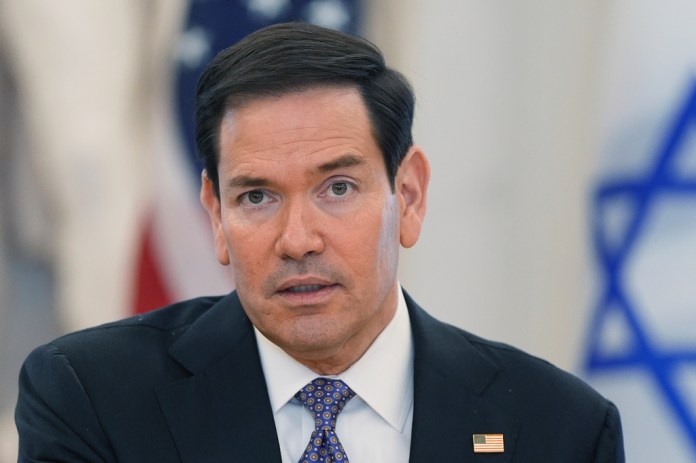
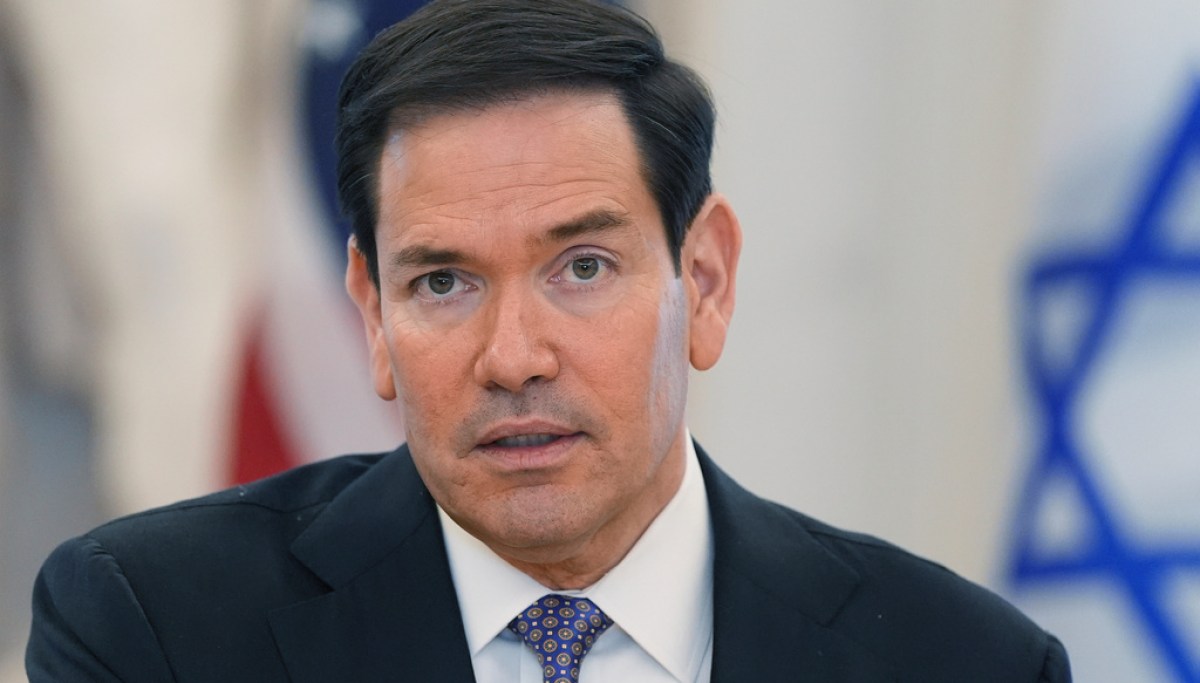
Secretary of State Marco Rubio criticized the Iranian regime, blasting the leaders of the country for using force to control shipping through an “international waterway.” Rubio said the regime is trying to hold the world hostage by controlling the Strait of Hormuz, through which over 80% of the world’s oil is transported. He said their attempt to regulate shipping through the straits was the “equivalent of an economic nuclear weapon.” Rubio made the comments on Monday in an interview with Trey Yingst on Fox News.
“Look what they’ve done with the straits – great example,” said Rubio. “The straits is basically the equivalent of an economic nuclear weapon that they’re trying to use against the world, and they’re bragging about it.”
“They’re putting up billboards in Tehran bragging about how they can hold 25 percent or 20 percent of the world’s energy hostage,” Rubio added. “Imagine if those same people had access to a nuclear weapon. They would hold the whole region hostage.”
Rubio also justified the U.S. taking military action against Iran, explaining that if the U.S. had not done so, it would impair the country from taking effective measures against geopolitical foes in the future in the region, specifically Hezbollah and Hamas, two paramilitary groups that have caused havoc in the Middle East for years. Moreover, Rubio said such measures would be drastically complicated if Iran obtained a nuclear weapon.
“We wouldn’t be able to do anything about Hezbollah, we wouldn’t be able to do anything about Hamas, we wouldn’t be able to do anything about the Shia militias in Iraq, because they’d be sitting there with a nuclear weapon saying we are untouchable,” said Rubio.
“There’s no doubt in my mind that at some point in the future if this radical clerical regimes remain in charge in Iran, they will decide they want a nuclear weapon,” he added. “And what they were trying to do, before the President took action, is to hide behind this conventional shield of drums and missiles and a large navy, hide behind that, an impenetrable conventional shield, so they can do whatever they wanted with their nuclear program.”
Rubio also discussed the potential course of action should no agreement with Iran be achieved. He mentioned the existing sanctions against Iran, which contribute significantly to economic pressure on the country. He added that further sanctions could be added. Ultimately, however, Rubio hopes the current conflict will emphasize “the threat Iran poses” and that the international community recognizes the dangers Iran represents to “global peace” and “global stability.”
US AND IRAN STUCK IN ‘GAME OF DIPLOMATIC CHICKEN’
“I would start out by reminding everybody that the level of sanctions on Iran are extraordinary, the pressure on Iran is extraordinary, and I think more can be brought to bear,” said Rubio. “But I hope that in the aftermath of this conflict, the whole world’s eyes have been opened to the threat Iran poses. Again, they want to do with the world with a nuclear weapon what they are doing now with oil. They want to hold the world hostage so they can do whatever they want. That’s unacceptable.”
“Now, one of the things that has to happen is the international community, quote/unquote, as it likes to be called but it never does anything – the international community needs to come together and say what’s happening in Iran is a threat to global peace, a threat to global stability – not just a threat to the Gulf kingdoms, not just a threat to Israel, a threat to the world, and it has to be addressed comprehensively,” Rubio said. “I hope the rest of the world will join us in the crippling sanctions and other things that we are doing to pressure that regime into making concessions it does not want to make.”