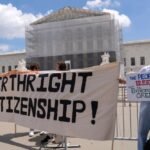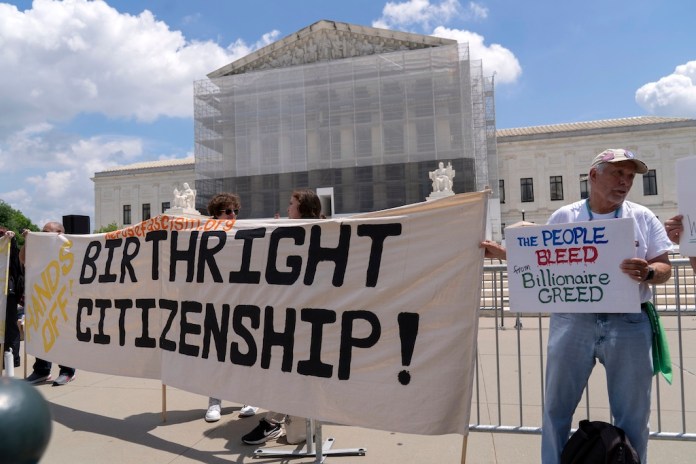
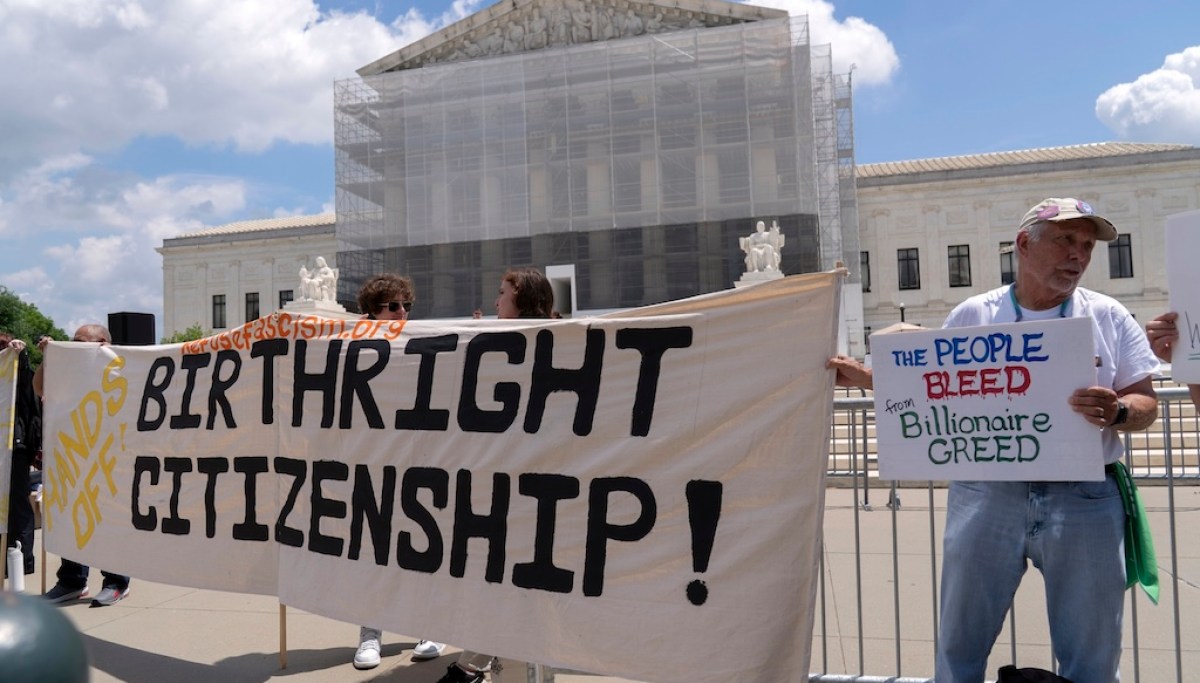
The Supreme Court will evaluate the scope of birthright citizenship for the first time in more than a century during oral arguments in a landmark case on Wednesday, providing the definitive test of one of President Donald Trump’s most controversial and litigated executive orders.
Trump said in an executive order issued on his first day back in the White House that birthright citizenship under the 14th Amendment does not extend to children born on U.S. soil to parents who are in the country illegally or on a temporary basis, such as on a visa. Under the executive order, a child born on U.S. soil who has one parent who is a U.S. citizen or permanent resident would still be granted citizenship at birth. The executive order immediately sparked lawsuits, which have blocked the order from taking effect, and has now ended up at the highest court less than 15 months later.
The Supreme Court will consider whether Trump’s executive order complies with the citizenship clause of the 14th Amendment. It will be the first time the high court has looked at birthright citizenship since the 1898 decision in United States v. Wong Kim Ark. The ruling in Wong Kim Ark established the current legal understanding that the 14th Amendment grants citizenship to nearly all babies born in the U.S. regardless of their parents’ citizenship, but the high court could reconsider that holding during Wednesday’s arguments.
DOJ argues citizenship clause has been incorrectly expanded beyond original intention
The Justice Department’s arguments center on the history of the 14th Amendment, which was ratified in 1868 immediately following the Civil War. The DOJ has argued that the citizenship clause was intended to ensure freed slaves and their children were granted citizenship.
“The Clause accomplished that objective by granting U.S. citizenship to those who satisfy two conditions: being ‘born or naturalized in the United States,’ and being ‘subject to the jurisdiction thereof,’” the DOJ’s brief to the justices said. “The Clause thus overruled Dred Scott v. Sandford, which infamously denied citizenship to everyone of African descent.”
The DOJ argued that those who ought to be given citizenship at birth are people who are “completely subject to the U.S.’s ‘political jurisdiction’ — in other words, to people who owe ‘direct and immediate allegiance’ to the Nation and may claim its protection.” The DOJ argued that Supreme Court rulings between 1868 and its 1898 Wong Kim Ark precedent supported that interpretation.
“As this Court has recognized, children of citizens meet that criterion, as do children of freed slaves, and children of aliens who ‘have a permanent domicile and residence in the United States,’” the DOJ argued. “But the Court’s earliest cases interpreting the Clause squarely rejected the premise that anyone born in U.S. territory, no matter the circumstances, is automatically a citizen so long as the federal government can regulate them.”
The DOJ also argued in its brief that the long-standing “misconception” that birthright citizenship applies to the children born on U.S. soil to two illegal immigrant parents is “untenable” with the history of the 14th Amendment, noting that Native Americans were not U.S. citizens at birth under the citizenship clause until a law passed by Congress in the 1920s granted them birthright citizenship.
An interpretation of the 14th Amendment that offers birthright citizenship to illegal immigrants is “untenable,” Justice Department officials argued. “It cannot explain the long-established exceptions to birthright citizenship, including for children of tribal Indians, who indisputably must obey U.S. law,” the DOJ said. “Yet, the executive branch has previously applied that misinterpretation to confer the privilege of American citizenship on hundreds of thousands of people who do not qualify for it.
“That misinterpretation has, in turn, powerfully incentivized illegal entry into the United States and encouraged ‘birth tourists’ to travel to the United States solely to acquire citizenship for their children,” the DOJ said.
Trump has also expressed his concerns over how the current understanding of birthright citizenship has been exploited by foreign nationals who have babies on U.S. soil and are granted citizenship despite having no ties to the country.
“Birthright Citizenship has to do with the babies of slaves, not Chinese Billionaires who have 56 kids, all of whom ‘become’ American Citizens,” Trump said in a Truth Social post on the eve of the Supreme Court’s oral arguments in the case. “One of the many Great Scams of our time!”
ACLU argues Trump’s stance would be a radical rewriting of the 14th Amendment
The ACLU, which is backing the group of people whose children could be affected by the executive order, has argued that the citizenship clause was always intended to be sweeping in nature and that the law “drew on and reaffirmed a centuries-old, common-law tradition of citizenship by virtue of birth, rather than parentage.
“In the shadow of Dred Scott and President Andrew Johnson’s veto of corrective citizenship legislation, the Clause enshrined birthright citizenship in the Constitution—beyond the reach of officials in any branch of government who might seek to overturn or narrow it,” the ACLU argued in its brief to the Supreme Court.
“For generations, all three branches of the U.S. government and the American people have understood, applied, and relied on that constitutional bedrock—embodying our American values of equality and opportunity and contributing to the thriving of our Nation,” the ACLU said.
While the DOJ argued the ruling in Wong Kim Ark supported its case, the ACLU pointed to the same 1898 decision to support its own argument, claiming that Wong Kim Ark “conclusively disposes of the government’s arguments, then and now.
“Wong Kim Ark’s basic holding is that the Clause enshrines the preexisting common law of citizenship,” the ACLU argued in its brief. “Under the common law—including the dominant American decision of the era, Lynch v. Clarke—the rule was citizenship by birth, regardless of parental nationality or immigration status. Domicile was irrelevant.”
The ACLU argued that the case is not complex, urging the high court to reject the Trump administration’s attempt to implement an executive order that it claims would unlawfully narrow the scope of birthright citizenship.
“The government is asking for nothing less than a remaking of our Nation’s constitutional foundations,” the ACLU argued in filings to the justices. “The Order may be formally prospective, applying to tens of thousands of children born every month, and devastating families around the country. But worse yet, the government’s baseless arguments—if accepted—would cast a shadow over the citizenship of millions upon millions of Americans, going back generations.”
SUPREME COURT RULES AGAINST COLORADO IN FIRST AMENDMENT DISPUTE OVER ‘CONVERSION THERAPY’ BAN
The Trump administration has been highly successful on the Supreme Court’s emergency docket since last year, only losing three of the more than two dozen petitions to the justices, but it has a split record on the merits docket.
The president has notched one win and one loss on the Supreme Court’s merits docket. The administration won a major victory in June 2025 when the Supreme Court struck down universal injunctions as unlawful in most cases, but lost a high-profile legal battle over Trump’s sweeping tariffs in February. The birthright citizenship case is widely viewed by legal analysts as an uphill climb for the Trump administration and as its most difficult case before the Supreme Court this term.
The Supreme Court will hear oral arguments beginning at 10 a.m., with a decision expected by the end of June, when the high court’s term is expected to end.