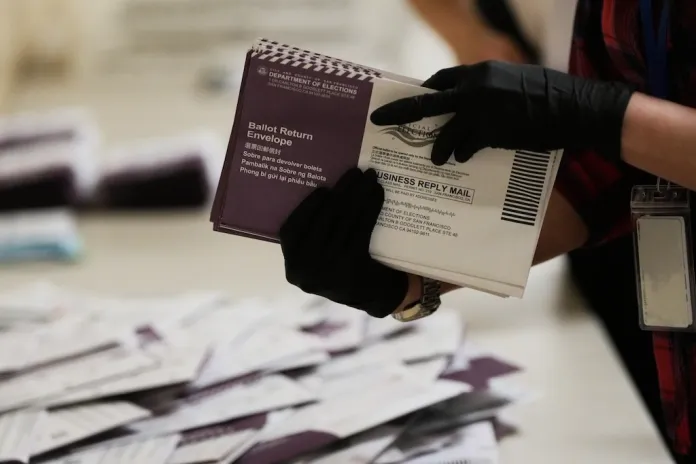
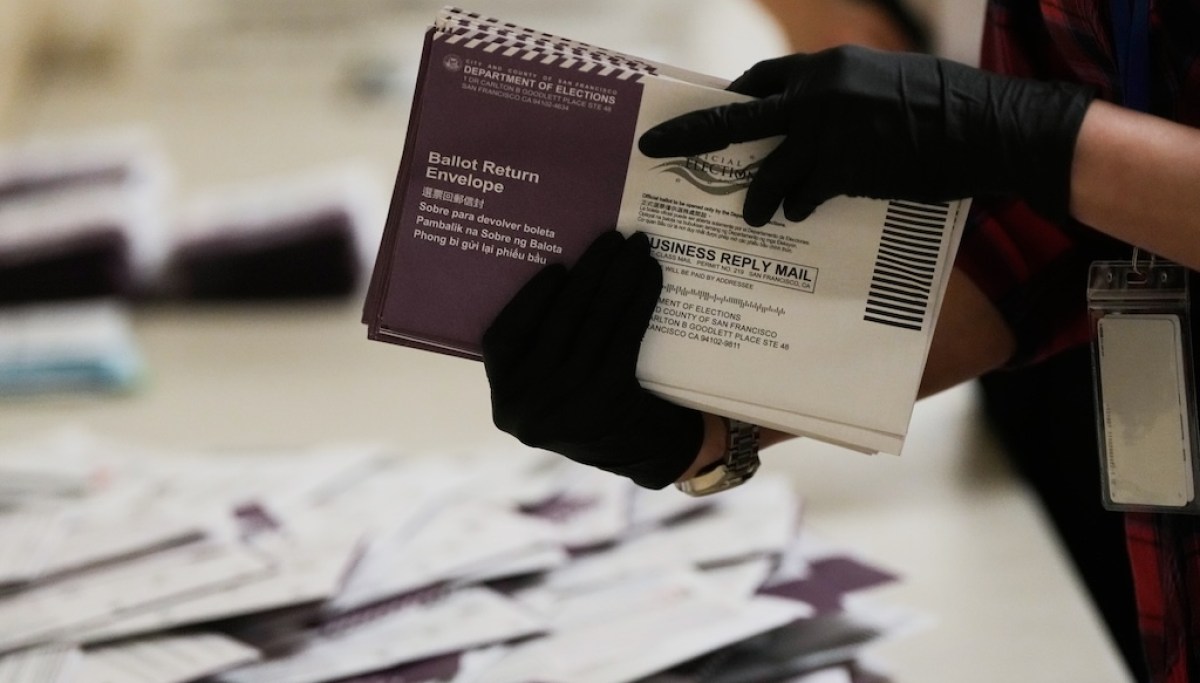
The Supreme Court upheld a Mississippi law allowing mail ballots received days after Election Day to be counted, rejecting arguments that under federal law, mail ballots must be received by Election Day to count.
The high court ruled 5-4 on Monday to uphold the Mississippi law, finding that federal law does not preempt state laws allowing the counting of ballots that are postmarked by Election Day but arrive up to five days later. Justice Amy Coney Barrett wrote the majority opinion, joined by Chief Justice John Roberts, along with Justices Sonia Sotomayor, Elena Kagan, and Ketanji Brown Jackson.
“Three federal statutes set the day for the election of Representatives, Senators, and the President,” Barrett wrote. “A Mississippi law permits the counting of absentee ballots postmarked by election day but received up to five days later. We must decide whether the federal election-day statutes preempt Mississippi’s law. They do not.”
The ruling found that the law establishing Election Day requires a voter’s decision to be made on that day, rather than to have their vote collected by Election Day, which allows the lengthy grace periods for ballots to remain in place in states that permit late arrivals.
“In sum, the election-day statutes require the electorate’s choice to be made on election day. That occurs so long as election day is the deadline for individuals to vote—as it is in Mississippi. But the election-day statutes do not set a deadline for ballot receipt, so they do not prevent Mississippi from counting ballots postmarked before election day yet received afterward,” Barrett wrote.
Justice Samuel Alito wrote the principal dissent, joined in full by Justices Clarence Thomas and Neil Gorsuch, and mostly joined by Justice Brett Kavanaugh. Alito wrote that the majority upheld Mississippi’s law “based on a flawed understanding of the election-day statutes,” and warned that the decision “opens Pandora’s box” for additional confusion and lawsuits.
“Not only is today’s decision inconsistent with statutory text, legal context, historical practice, and precedent; it also threatens to produce lamentable consequences. The majority’s holding spawns a slurry of troubling election-law questions and risks further undermining Americans’ confidence in election integrity,” Alito wrote.
The Supreme Court heard oral arguments in Watson v. Republican National Committee in March, and a majority of the justices expressed unease about the implications of allowing the Mississippi law to stand, which defines “Election Day” as when voters make their decisions rather than when the state receives their ballots. Several of the justices appeared concerned about the mess that allowing late-arriving mail ballots to count could cause in future elections. Despite those concerns, the narrow majority of the high court decided to uphold the law, only saying that federal law does not currently bar the counting of late-arriving ballots.
Mississippi Attorney General Lynn Fitch (R), whose office successfully defended the late-arriving ballot law, said that she hopes the state will amend its law to bar the counting of late-arriving mail ballots, now that the Supreme Court has affirmed that federal law does not override those laws.
“With the bedrock constitutional principle of federalism now affirmed, I am hopeful that the Mississippi Legislature will take this opportunity to amend the law and require absentee ballots be received on the same day ballots are cast at the polling place. President Trump is right to prioritize improving public trust in elections,” Fitch said.
RNC chairman Joe Gruters said that the high court’s ruling only fuels the party’s push to pass the SAVE America Act, which would change multiple federal election laws, including by barring the counting of late-arriving mail ballots, and said the GOP would not be “deterred” by the Supreme Court’s ruling to pursue election integrity matters.
“If we want fair and secure elections, Election Day should mean exactly what it says, which is why this decision makes it even more imperative that Congress pass the SAVE America Act,” Gruters said. “Democrats are inviting chaos at the ballot box by allowing elections to drag on for days and weeks after voters cast their ballots. Republicans are not going to be deterred by this decision, and the RNC will keep fighting to have elections end on Election Day as Americans want.”
The ruling was a major loss for election-integrity advocates who had hoped the high court would cut off ballot collection on Election Day. Jason Snead, executive director of Honest Elections Project, called the high court’s Monday ruling a “deeply disappointing” decision that “misses the mark.”
“Federal law is clear: all ballots must be received by Election Day to be counted,” Snead said. “The Court missed a major opportunity to reinforce election integrity and instead sides with California-style chaos.”
“As Justice Alito makes clear in his dissent, watching ballots trickle in after Election Day and flip races does nothing but damage public trust in our system of government,” he added. “Honest Elections Project will continue to fight cross the country for state laws that put a stop to late ballots and ensure that voting ends on Election Day.”
SUPREME COURT WORRIED THAT COUNTING LATE MAIL BALLOTS COULD UNDERMINE CONCEPT OF ‘ELECTION DAY’
The ruling is expected to have ramifications for the November elections in the 14 states that have laws allowing mail ballots to be received anywhere from days to weeks after Election Day.
Watson is one of four election-related cases the Supreme Court heard this term, alongside cases dealing with candidates’ ability to sue over election laws, campaign finance laws, and race-based congressional redistricting.