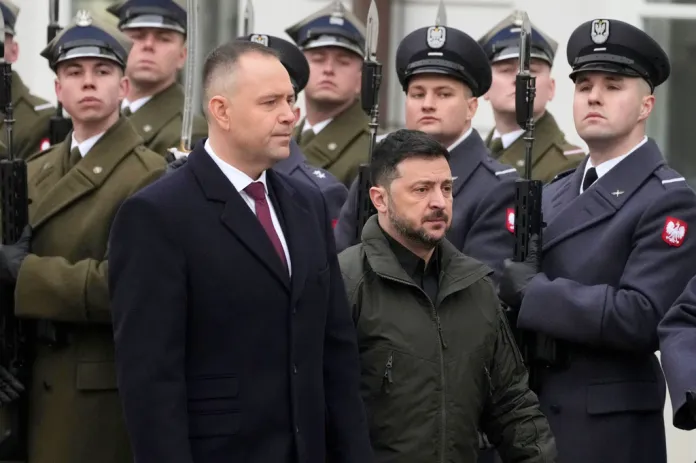
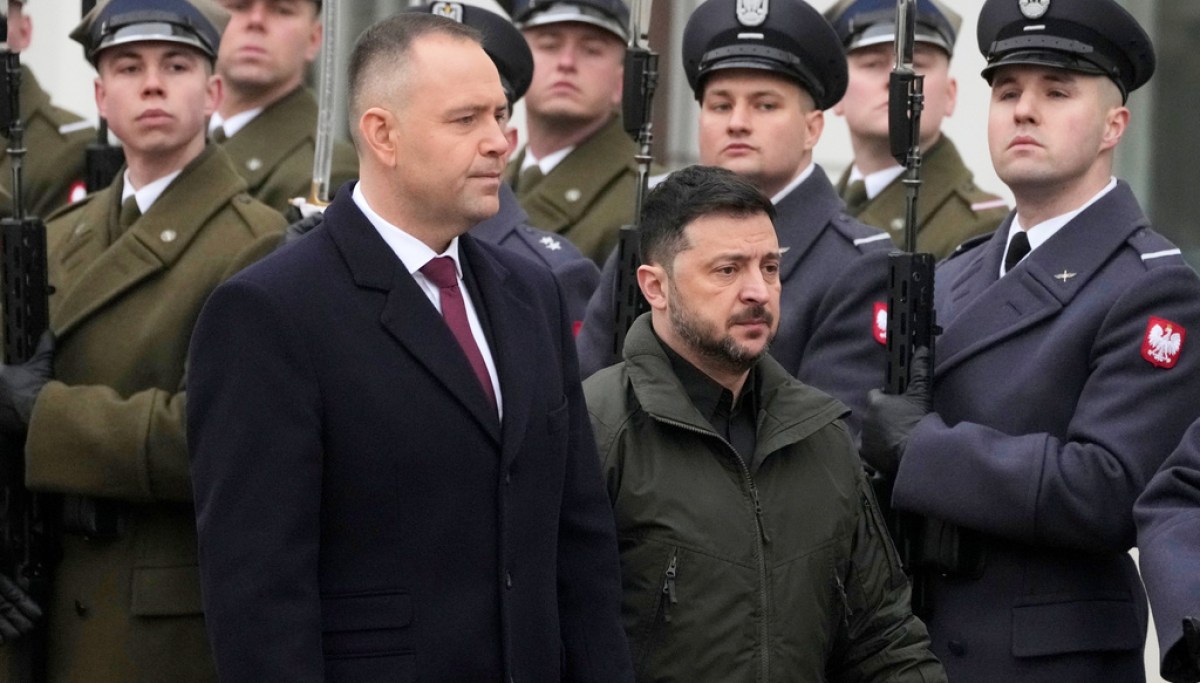
Polish President Karol Nawrocki stripped Ukrainian President Volodymyr Zelensky of Poland’s highest honor after Ukraine named a military unit after the Ukrainian Insurgent Army (UPA), a controversial World War II-era nationalist group that engaged in the mass murder of Poles.
Poland emerged as one of Ukraine’s closest allies after the Russian invasion in February 2022, providing Kyiv with some of its strongest military and diplomatic support. As the war has dragged on, however, cracks in the relationship have grown, especially as historical areas of contention reemerge, particularly the two’s contentious relationship during World War II. These tensions flared to their worst level since the invasion this week, when Nawrocki denounced and stripped Zelensky of the Order of the White Eagle, awarded to him in 2023, over the honoring of the UPA.
“We must not forget our history. We must not abandon our memory. We must not surrender the dignity of our victims. This is how we understand our duty toward those who can no longer speak for themselves. This is how we understand the significance of the Order of the White Eagle. Poland lives as long as the nation remembers. Long live Poland!” Nawrocki said in a video message on Friday.
In a longer video message, the president outlined the progress that had been made in acknowledging and commemorating the victims of the Volhynian Genocide at the hands of the UPA, saying that such progress made Kyiv’s decision to honor the group “is not only outrageous, it is also incomprehensible and deeply disappointing.”
He revealed that the issue had been privately discussed with Kyiv for several weeks before it became apparent that the negotiations were only stalling and that Kyiv had no intention of changing its position on honoring the group.
Zelensky formally responded on Saturday in a decidedly undiplomatic post on X, subtly trashing the Polish government for revoking his award while not doing so with other historical awardees that many would object to.
He said that the order was a “symbol of the highest trust of the Republic of Poland. It signifies a special bond with the Polish state and the special gratitude of the Polish People. Such a symbol requires not only merit, but also respect for the values that form the foundation of our community.”
“Therefore, if it is considered that this special symbol may remain with Catherine II, Benito Mussolini, and Gerhard Schröder, then we in Ukraine will not argue with that,” Zelensky added in a pointed remark, referring to the former Russian Tsarina, Italian Fascist dictator, and former German chancellor who pursued policies favorable towards Russia, respectively.
He proceeded to dance around the contentious topic, saying he would remain open to engagement with Poland to “avoid conflicting interpretations of the difficult and painful chapters of our shared past and to ensure proper respect for all innocent victims of the 20th century.”
Zelensky never directly addressed the honoring of the UPA, but in his most direct comment he said he was proud of “EVERY” Ukrainian warrior who fought against Russia, implicitly including the UPA.
“I am proud of our people and of EVERY Ukrainian warrior – of the millions of Ukrainian men and women who deserve unquestionable respect for the heroism the Ukrainian People have shown in defending themselves against Russian aggression,” he said.
“We believed that the Order of the White Eagle, awarded in 2023, was meant for the Ukrainian People and our army. That is what was said at the time. Today, I sent the Order back to the President of Poland. I believe the future will confirm the respect Ukrainians deserve,” Zelensky concluded.
Other Ukrainian officials denounced Poland’s move. Ukraine’s Foreign Minister Andrii Sybiha called it a “strategic mistake” and “disrespectful.” Head of the Office of the President of Ukraine Kyrylo Budanov described Warsaw’s move as an “unfriendly act toward our people, and a “gift to the Moscow aggressor, who will certainly use it against both of our countries.”
Budanov was more direct in countering Poland’s accusation, saying, “Our peoples have long-standing relations and varied pages of history —both heroic and tragic. However, this should serve as an occasion for deep reflection, not crude political speculation. Ukraine does not dictate to any other people how to teach its history. Therefore, we too reserve the fair right to our own national memory and dignity.”
He announced that he was returning his own “Gold Officer’s Cross of the Order of Merit of Poland,” gifted to him last year by the president of Poland.
Ukraine and Poland have a notoriously contentious history. The lands historically now known as Ukraine were occupied by the Polish Lithuanian Commonwealth for centuries, and many Ukrainians view their nation’s genesis as the rebellion of Cossack Hetman Boghdan Khmelnitsky against the commonwealth, an event characterized by massacres of Poles and Jews. Their relations reached a low point in the 1920s-1940s, when the new Republic of Poland had a significant Ukrainian minority.
The group at the center of the feud, the UPA, was founded by nationalists loyal to Ukrainian nationalist leader Stepan Bandera. Bandera had taken hold of the Organization of Ukrainian Nationalists (OUN) and turned it into a terrorist group primarily targeting Poles and Jews, as documented in author Grzegorz Rossolinski-Liebe’s biography Stepan Bandera: The Life and Afterlife of a Ukrainian Nationalist: Fascism, Genocide, and Cult. He was imprisoned for organizing the assassination of Polish Interior Minister Bronisław Pieracki in 1934. He explicitly modeled the group after Adolf Hitler’s Nazis and sought an alliance with them against Poland and the Soviet Union. He and many OUN/UPA leaders were prominent Nazi collaborators who helped with the mass murder of Jews in Ukraine, but later turned against the Nazis over differing strategic aims.
The primary area of contention between Ukraine and Poland is the Volhynian Genocide of 1943-1945, when, independent of the Nazis, the UPA carried out the mass slaughter of Poles in what is now western Ukraine. The first day of the genocide, July 11, when UPA fighters launched coordinated mass killings of Poles gathered for Church on Sunday, is now commemorated as the “National Day of Remembrance of the victims of the Genocide of Citizens of the Polish Republic committed by Ukrainian Nationalists” in Poland.
At least 100,000 Poles were massacred by the UPA. The killings were engineered to terrify the remaining Poles into fleeing westward, so extensive documentation was spread of the accompanying torture and mutilation. The area that now makes up western Ukraine was so thoroughly depopulated of Poles by the end of World War II that the Soviet Union decided to redraw the map of Eastern Europe, moving Ukraine and Poland westward at Germany’s expense to create the three modern borders.
While widely derided in Poland and Russia, the UPA is viewed as heroic freedom fighters for Ukrainian independence by many in Ukraine today. The group waged a guerilla war against the Soviet Union into the 1950s, and UPA emigres played a key role in reviving Ukraine’s nationalist movement during perestroika. Bandera and prominent UPA commanders like Roman Shukhevych, who led some massacres in the Volhynian Genocide, are viewed as founding fathers of modern Ukraine, and enjoy near-unanimous popularity in right-wing and nationalist circles.
STEPHEN KING APPEARS TO PRAISE HOLOCAUST ARCHITECT AS ‘GREAT MAN’ IN PRANK CALL
Zelensky, as a Russian-speaking Jew, has expressed some discomfort with the extensive honoring of Bandera and Shukhevych. He was more open about his critiques when he was a comedian, occasionally featuring sketches as part of his Kvartal 95 comedy troupe lampooning “Banderite” nationalists and referring to them interchangeably with Nazis. He took part in one sketch titled, “Even North Korea doesn’t want to deal with Banderites.”
He has avoided any direct criticism of Bandera or the UPA since becoming president, cognizant of the influence of right-wing groups within the government and the military. Brigadier General Andriy Biletsky, a former neo-Nazi politician, is one of the most influential figures in the military, leading the prestigious Azov Regiment.