Japan must acquire the military power needed for “dealing with invasions against its nation” over the next “five years,” according to a landmark security document that emphasized threats from China, Russia, and North Korea.
“Japan is finding itself in the midst of the most severe and complex security environment since the end of WWII,” Japan’s newly unveiled National Security Strategy states. “In no way can we be optimistic about what the future of the international community will bring.”
China and Russia present a grave challenge to the “existing international order” that forces Tokyo to prepare for a possible showdown this decade, according to Japan’s new security strategy. The ominous outlook has forced a reversal of Japan’s post-war disarmament, flowing from a frank acknowledgment that the United States no longer has the military power required to suppress threats to regional security.
“It is becoming increasingly difficult for the United States, Japan’s ally with the world’s greatest comprehensive power, and international frameworks … to manage risks in the international community,” the Japanese strategy paper states. “Due to the changing power balances and diversifying values around the world, strong leadership is being lost in the global governance structure at large.”
US BASE IN JAPAN TOLD TO SHELTER AFTER NORTH KOREA FIRES SUSPECTED MISSILE AT JAPAN
Japan boasts the world’s third-largest economy, but the disarmament imposed by the victorious U.S. at the end of the Second World War began a tradition that has restrained both its military power and strategic initiative for decades. Those restrictions and norms have eased, especially in recent years — Japan is in the process of acquiring 105 F-35 stealth fighter jets — and Japanese officials have embraced the idea that missile defense systems are inadequate in the face of Chinese or North Korean capabilities.
“Missile attacks against Japan have become a palpable threat,” the security strategy states. “For this reason, we need counterstrike capabilities: capabilities which, in the case of missile attacks by an opponent, enable Japan to mount effective counterstrikes against the opponent to prevent further attacks while defending against incoming missiles by means of the missile defense network.”
U.S. officials applauded Japan’s new strategy as a welcome reinforcement in an evermore dangerous world.
“Japan’s strategy converges with our own in recognizing that closer linkages among like-minded nations are paramount to protect shared interests and values and address shared challenges,” Secretary of State Antony Blinken said. “From Afghanistan to Ukraine, Japan is our indispensable partner in addressing the most pressing challenges to global stability and in supporting all nations that cherish a rules-based international order.”
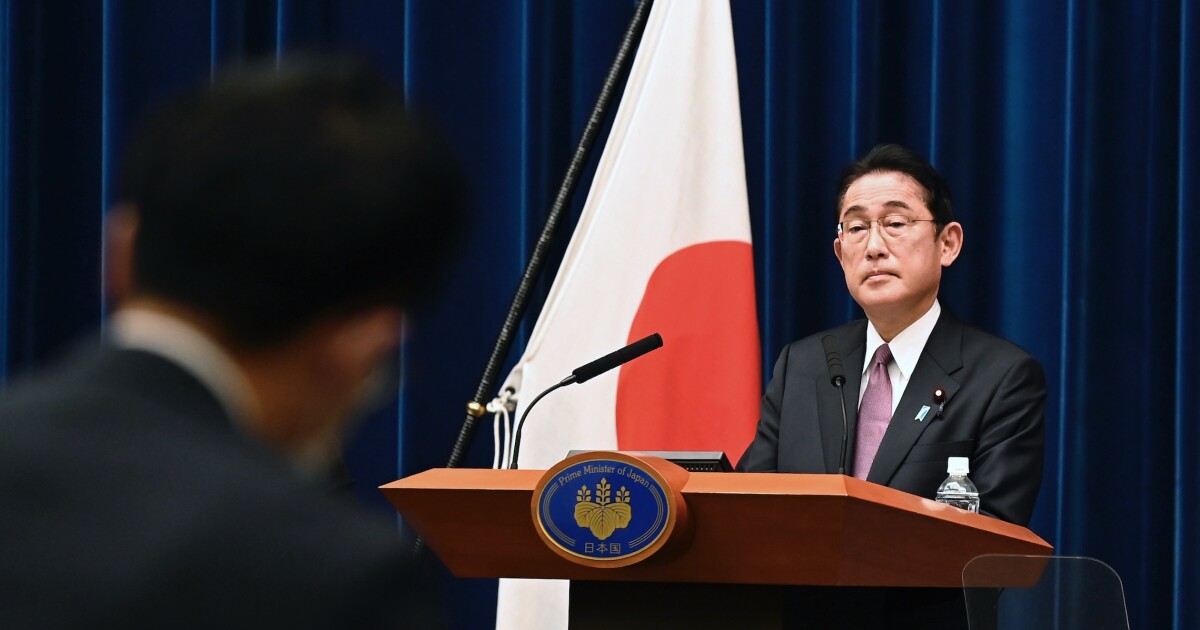
Japanese Prime Minister Fumio Kishida acknowledged that the new strategy marks “a major shift from the postwar security policy,” and a concomitant National Defense Strategy suggests that Tokyo will “promptly procure foreign-made stand-off missiles” to ensure that Japanese forces can “strike targets in [a] multilayered manner and from various locations” in a crisis — although Blinken’s team demurred when asked if the U.S. would be selling Tomahawk cruise missiles.
“Japan’s new documents reshape the ability of our alliance to promote peace and protect the rules-based world order, not just in the Indo-Pacific but around the world as well,” State Department deputy spokesman Vedant Patel said at a Friday press briefing. “As a matter of policy, though, I’m just not going to comment on arms sales or any transfers of security assets, potential or otherwise, before they go through the formal congressional notification process.”
Kishida characterized the prospective $314 billion defense spending increase as his “answer to the various security challenges that we face.” His insistence that global affairs have reached “a turning point in history” placed the new strategy as a kind of Japanese corollary to German Chancellor Olaf Scholz’s now-famous Zeitenwende address that promised a major German military buildup in response to Russia’s invasion of Ukraine.
“Unfortunately, in the vicinity of our country, there are countries carrying out activities such as enhancement of nuclear capability, a rapid military buildup, and unilateral attempt to change the status quo by force,” Kishida said. “These are also now becoming more outstanding.”
The security strategy reflects Kishida’s stated fear that China or North Korea could take inspiration from Russian President Vladimir Putin‘s invasion of Ukraine.
“Specifically, by FY 2027, five years after the formulation of the Strategy, Japan will strengthen its defense capabilities to the point at which Japan is able to take the primary responsibility for dealing with invasions against its nation, and disrupt and defeat such threats while gaining the support of its ally and others,” the strategy document states. “Furthermore, by approximately ten years from now, Japan will reinforce its defense capabilities to the point at which it will be possible to disrupt and defeat invasions against its nation much earlier and at a further distance.”
China accused Japan of trying “to hype up and even create tensions” in the region. “Japan’s new defense policy ignores facts, deviates from its commitment to China-Japan relations and the common understandings between the two countries, and groundlessly discredits China’s defense building and normal military activities,” Chinese Foreign Ministry spokesman Wang Wenbin said Friday. “Hyping up the ‘China threat’ to find an excuse for its military buildup is doomed to fail.”
CLICK HERE TO READ MORE FROM THE WASHINGTON EXAMINER
Kishida’s team implied that the “China threat” already has arrived in one form or another.
“Hybrid warfare is taking place, and gray zone situations are constantly arising,” the security strategy said. “Japan will seamlessly protect its national interests by promoting cross-governmental policies in diverse fields, including cyber, maritime and space domains, technology, intelligence, and ensuring the safety of its people at home and abroad.”