The Supreme Court handed President Donald Trump a major loss on Friday, striking down his sweeping “Liberation Day” tariffs as unlawfully implemented.
The high court ruled 6-3 that the International Emergency Economic Powers Act does not authorize the president to impose tariffs. The ruling marks a significant setback for the president’s signature economic agenda item and is a rare rebuke for Trump from the justices after a series of wins at the high court over the last year.
Chief Justice John Roberts wrote the majority opinion, finding that the law Trump cited to impose his “Liberation Day” tariffs on most countries and on Canada, Mexico, and China over the fentanyl crisis does not confer the sweeping power he claims it does.
“Based on two words separated by 16 others in Section 1702(a)(1)(B) of IEEPA—’regulate’ and ‘importation’—the President asserts the independent power to impose tariffs on imports from any country, of any product, at any rate, for any amount of time,” Roberts wrote. “Those words cannot bear such weight.”
“When Congress grants the power to impose tariffs, it does so clearly and with careful constraints,” Roberts wrote for the majority opinion. “It did neither here.”
Roberts’s majority ruling was joined by Justices Sonia Sotomayor, Elena Kagan, Neil Gorsuch, Amy Coney Barrett, and Ketanji Brown Jackson. Kagan, Gorsuch, Barrett, and Jackson each wrote their own opinions concurring with the judgment.
The three justices who dissented from the ruling were Justices Clarence Thomas, Samuel Alito, and Brett Kavanaugh, all conservatives. Kavanaugh wrote a dissenting opinion, which was joined by Alito and Thomas, while Thomas filed a separate dissenting opinion as well.
“Properly read, IEEPA does not draw such an odd distinction between quotas and embargoes on the one hand and tariffs on the other,” Kavanaugh wrote for the dissent. “Rather, it empowers the President to regulate imports during national emergencies with the tools Presidents have traditionally and commonly used, including quotas, embargoes, and tariffs.”
“The Court today nonetheless concludes otherwise and holds that IEEPA does not authorize the President to impose tariffs to deal with the declared drug trafficking and trade deficit emergencies,” he added.
During oral arguments in November 2025, the justices appeared highly skeptical of the Trump administration’s arguments that the IEEPA authorized the president to implement the sweeping tariffs.
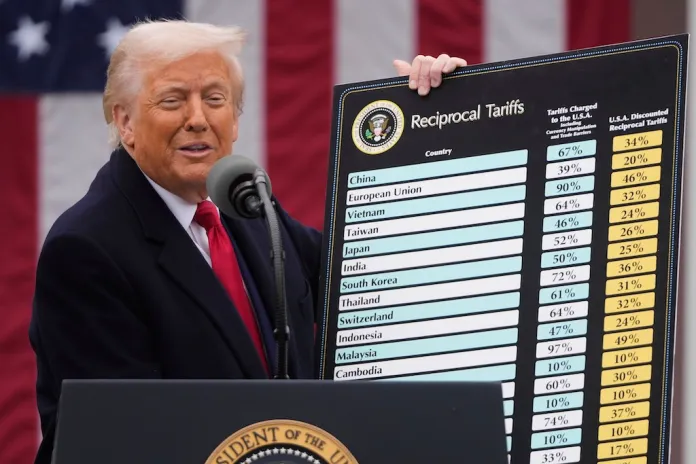
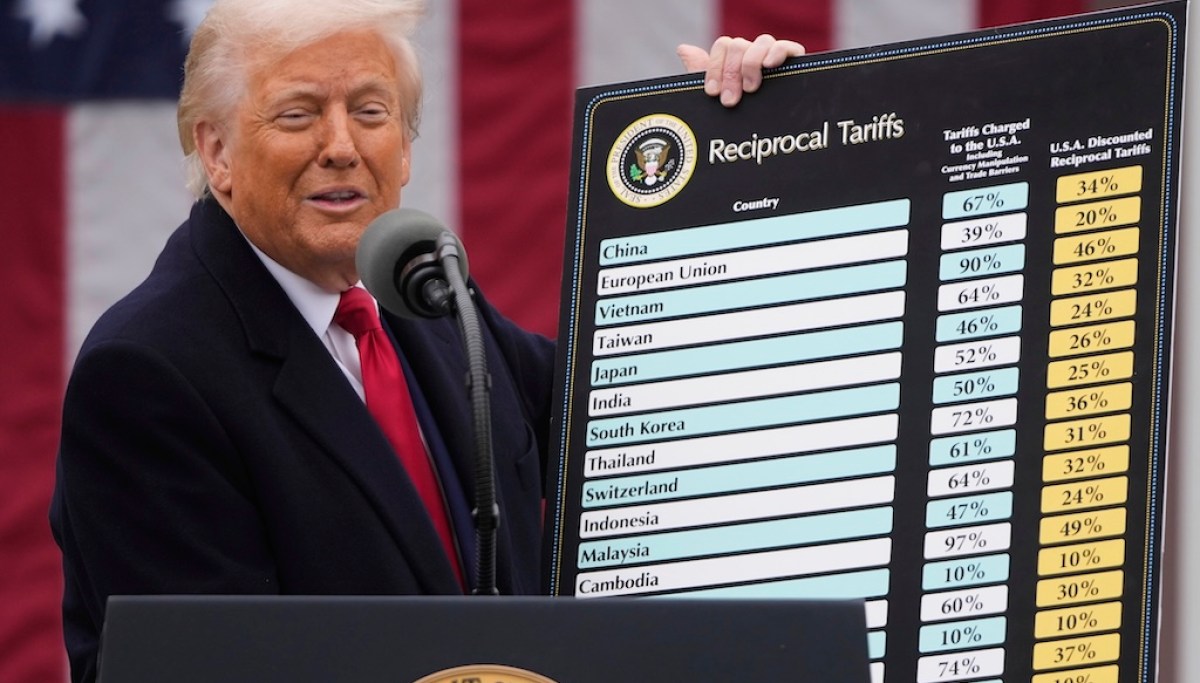
Trump used the IEEPA to implement his sweeping “reciprocal tariffs” for most countries, with a 10% baseline rate and higher rates for select countries, along with his tariffs aimed at Canada, Mexico, and China over their role in the fentanyl crisis. Other tariffs imposed by the president on aluminum, steel, and cars, among other products, are not affected by the ruling, because they were implemented using a different law.
The two consolidated cases before the high court, Learning Resources v. Trump and Trump v. V.O.S. Selections, were appealed after a trio of losses for the Trump administration in two federal district courts and one federal appeals court.
In its arguments to the Supreme Court, the Justice Department defended the president’s signature economic policy as a matter of Trump exerting his foreign policy, arguing in a brief that striking down the tariffs as unlawful would “effectively disarm the President in the highly competitive arena of international trade.”
The companies suing over the tariffs argued they were unlawfully implemented, and that the IEEPA does not grant the president the power to tariff, noting that the term “tariff” is not present in the text of the statute.
During oral arguments, Roberts grappled with how the imposition of the sweeping tariffs under the IEEPA balanced the president’s broad authority dealing with foreign powers and Congress’s inherent taxing power.
Sotomayor plainly said she did not “understand this argument” from the DOJ that the tariffs did not impose a tax, a power given to Congress under the Constitution, during the November arguments, while Gorsuch expressed concern over future uses of such a sweeping tariff power.
After oral arguments, the Trump administration projected confidence over the outcome of the case but also stated it could recreate most of the sweeping tariffs using other laws if the high court struck down the ones levied using the IEEPA.
The ruling marks the first in a set of cases the Supreme Court will decide this term slated to deal with the president’s powers and policies. The high court will also issue a ruling in the coming months with implications for the president’s firing power within the executive branch and Trump’s executive order regarding birthright citizenship.