The new White House Counterterrorism (CT) Strategy document looks to seize the initiative from terrorists and criminal cartels by taking aggressive action against hostile regimes, keeping America’s borders secure to minimize threats at home, and pushing malign foreign influence out of the Western Hemisphere.
The post Trump Counterterrorism Strategy: Aggressive Response, Border Security, Hemispheric Safety appeared first on Breitbart.
The new White House Counterterrorism (CT) Strategy document looks to seize the initiative from terrorists and criminal cartels by taking aggressive action against hostile regimes, keeping America’s borders secure to minimize threats at home, and pushing malign foreign influence out of the Western Hemisphere.
“Our new U.S. Counterterrorism Strategy is a return to common sense and Peace through Strength,” President Donald Trump said in his foreword to the plan. “As I said after our first successful counterterrorism mission, just days after I was sworn back in office – if you hurt Americans, or are planning to hurt Americans, ‘We Will Find You and We Will Kill You.’”
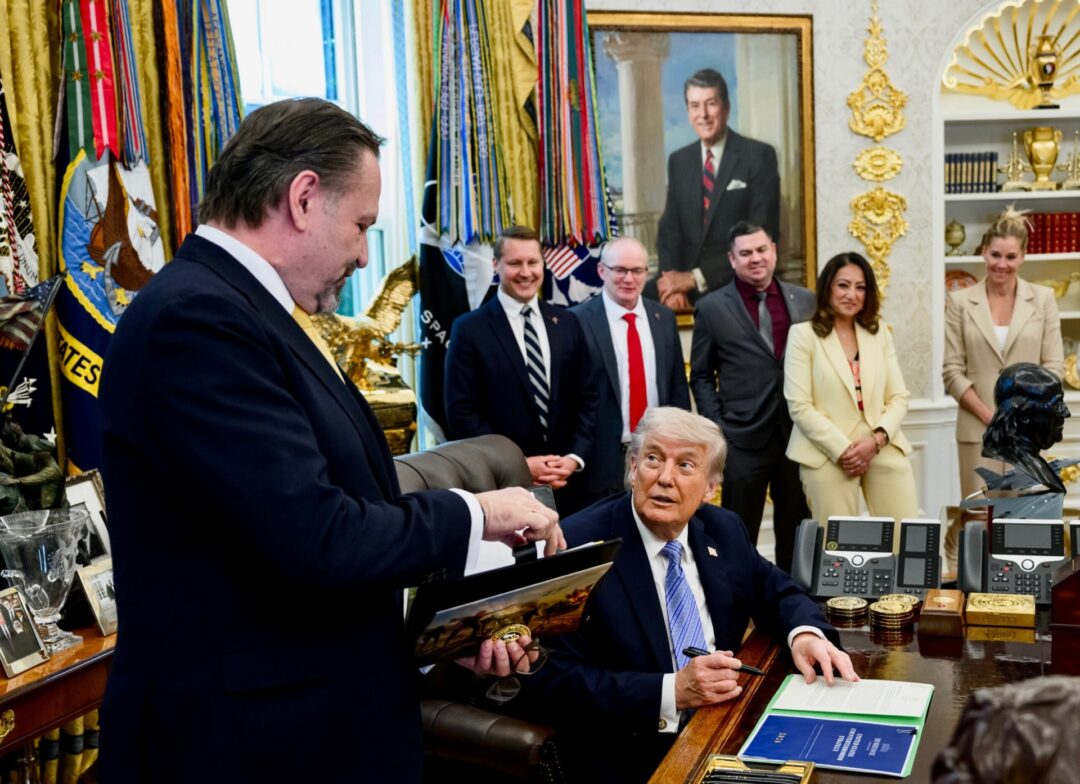
President Donald Trump signs the 2026 Counterterrorism Strategy with his team, Monday, May 4, 2026. (Official White House Photo by Molly Riley)
Trump’s introduction, and the rest of the document, were highly critical of the counterterrorism strategies pursued by both his Republican and Democrat predecessors. Trump said he returned to the White House in 2025 to find “four years of weakness, failure, surrender, and humiliation under the last administration.”
The body of the White House Counterterrorism Strategy document faulted the Biden administration for perverting national security into an endless crusade against its domestic political enemies, which destroyed public confidence in the honesty and accountability of American security agencies.
The document blasted Democrat presidents like Joe Biden and Barack Obama for ignoring the growing threat of criminal cartels, appeasing hostile powers in a way that made further hostility look profitable, and above all for throwing the borders open to admit everything from vicious criminals to hostile foreign operatives.
As for Trump’s Republican predecessors, the White House noted their unfortunate predilection for “forever war policies” in theaters like Afghanistan and Iraq, spreading American military strength thin across the globe with little to show for the effort. The Trump team also criticized the Bush administrations for failing to confront the dangers of Islamism head-on, giving a hostile ideology plenty of time to put down roots in American soil.
Both Democrat and Republican administrations have been slow to condemn or counter jihadi purges against Christians in the Middle East and Africa – an indifference not only brutal to the persecuted Christians, but dangerous to the entire world, because it allowed jihadis to consolidate their grip on territory, seize money and resources, and begin dismantling the weakened governments of Africa.
The new CT Strategy recognized that threats close to the American homeland are the most immediate and dangerous, so it prioritized “neutralization of hemispheric terror threats by incapacitating cartel operations until these groups are incapable of bringing their drugs, their members, and their trafficked victims into the United States.”
“At the same time, we will continue to find and remove the cartel and gang members who were let into our country under the Biden Administration, while using FTO (Foreign Terrorist Organization) designations to strangle the commercial and logistical sinews of their organizations,” the Trump White House vowed.
The White House held up its strikes against cartel drug boats, and the capture of narcoterrorist dictator Nicolas Maduro of Venezuela, as examples of its aggressive approach to hemispheric security. The CT document noted that maritime drug smuggling has decreased by more than 90 percent since the drug boat strikes began – and some of those smuggling and financial networks are also used by Islamist terrorists.
The White House argued that making its determination to achieve hemispheric security clear, and demonstrating America’s ability to act decisively toward that goal, was crucial to bringing America’s neighbors in the Western Hemisphere on board.
Much of the criticism directed at prior administrations concerned the mixed signals sent by a combination of lofty pronouncements and tepid action, as security threats in Latin America were allowed to fester for years on end. In contrast, President Trump has made his determination to secure the hemisphere against terrorism and organized crime crystal clear, in a way that only kinetic action and assertive prosecutions can do.
The CT Strategy’s second priority was “the targeting and destruction of the top five Islamist terror groups that have the intent and capabilities to execute External Operations against the United States.”
Those groups include al-Qaeda, the Islamic State, and their most “aggressive subgroups,” such as al-Qaeda in the Arabian Peninsula (AQAP) and ISIS-Khorasan (ISIS-K). The White House argued the importance of including the international Muslim Brotherhood (MB) as a terrorist organization, a step the Trump administration took in January 2026.
The third priority of the CT Strategy was to depoliticize security agencies that were “weaponized” under Biden and Obama, and to take action against the growing threat of “violent left-wing extremists,” whose bloody handiwork included “the assassination of Charlie Kirk by a radical who espoused extreme transgender ideologies.”
“In addition to cartels and Islamist terror groups, our national CT activities will also prioritize the rapid identification and neutralization of violent secular political groups whose ideology is anti-American, radically pro-transgender, and anarchist,” the document said, noting that some of those groups have ties to dangerous international organizations. The document specifically mentioned the left-wing terrorist group Antifa as a priority target.
The fourth priority of the CT Strategy, singled out as a “special strategic category” all its own, was to combat “non-state acquisition and use of weapons of mass destruction, especially the terrorist use of nuclear or radiological devices.”
The strategy document placed the current operation against Iran into this category, since Iran is a state actor, but the proxy groups it might furnish with nuclear weapons are not.
The White House vowed to ensure “the regime in Tehran is no longer a threat to the United States,” either directly or through its many tentacles: Hamas, Hezbollah, Iraqi Shiite militias, and the Houthi terrorists of Yemen, who must never again be allowed to hold “strategic waterways such as the Strait of Hormuz or Red Sea” hostage.
The CT Strategy presented the destruction of the Islamic State “caliphate” during the first Trump administration as an example of swift and decisive action. The Obama administration envisioned the ISIS caliphate as a generational threat, to be slowly degraded over years and decades – but “President Trump unleashed the greatest fighting force the world has ever seen, and within a matter of weeks, a jihadi insurgency which controlled vast territories across Iraq and Syria was gone.”
ISIS fell back to Africa, and has become a vicious threat across West Africa, the Sahel region, and the Lake Chad Basin, leaving governments like Nigeria and Somalia with solid control over mere fractions of their own territory.
The 2026 Trump strategy envisioned tackling these threats by “rebuilding bilateral CT relations with African governments who had been ignored or insulted by Biden-era neocolonial policies focused on globalist left-wing cultural hegemony.”
This was a blunt acknowledgement of the uncomfortable truth that some African nations have grown reluctant to partner with America or Europe on security issues because they fear agendas like homosexual and transsexual rights will be forced upon them. Some of those nations preferred to partner with Russia or China as a result, and the results have been disastrous for African and world security.
The Trump White House proposed reversing that dynamic by marrying CT cooperation with “the stabilizing effect of heightened trade and commercial relations, as witnessed by President Trump’s historic peace deal between Rwanda and the Democratic Republic of the Congo – an example of how security is a prerequisite for prosperity.”
“Common sense” and “realism” were major themes in the CT Strategy, especially on the delicate subject of expecting allies like the Europeans to begin shouldering more of the burden for their own security.
The document blasted European governments for creating “a permissive operating environment for plotting against Europeans and Americans” by allowing a “conglomerate of nefarious actors – like al-Qaeda, ISIS, cartels, and state actors” to exploit “Europe’s weak borders and diminished CT resources.”
“It is unacceptable that wealthy NATO allies can serve as financial, logistical, and recruitment hubs for terrorists,” the document bluntly declared.
“Unfettered mass migration has been the transmission belt for terrorists,” it warned. “Europe can be strong again if it rediscovers traditional principles of freedom of speech, has honest conversations about Islamism, devotes sufficient resources to mitigate terrorism and cartel threats within its nations,” and then gets serious about global threat intelligence.
“It is clear to all that well-organized hostile groups exploit open borders and related globalist ideals. The more these alien cultures grow, and the longer current European policies persist, the more terrorism is guaranteed,” the CT Strategy said, ringing an alarm bell that no prior administration of either party would have been willing to touch since September 11, 2001.
The White House envisioned an “America First” counterterrorism strategy that would bring security across the world by setting successful examples of border security and threat detection that allied nations could follow.
The Trump White House saw “America First” not as an expression of chauvinism, but of common sense and honesty that could guide and inspire the rest of the civilized world. After all, a nation that is not honest about putting the security of its own people first cannot be trusted – and a nation that fails to prioritize its own security cannot be saved.