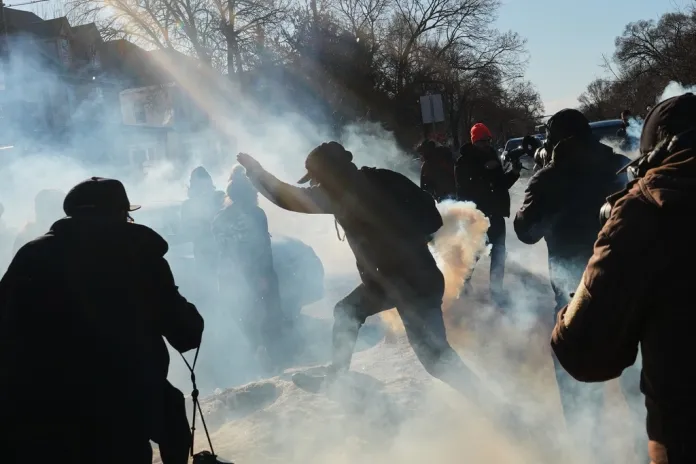
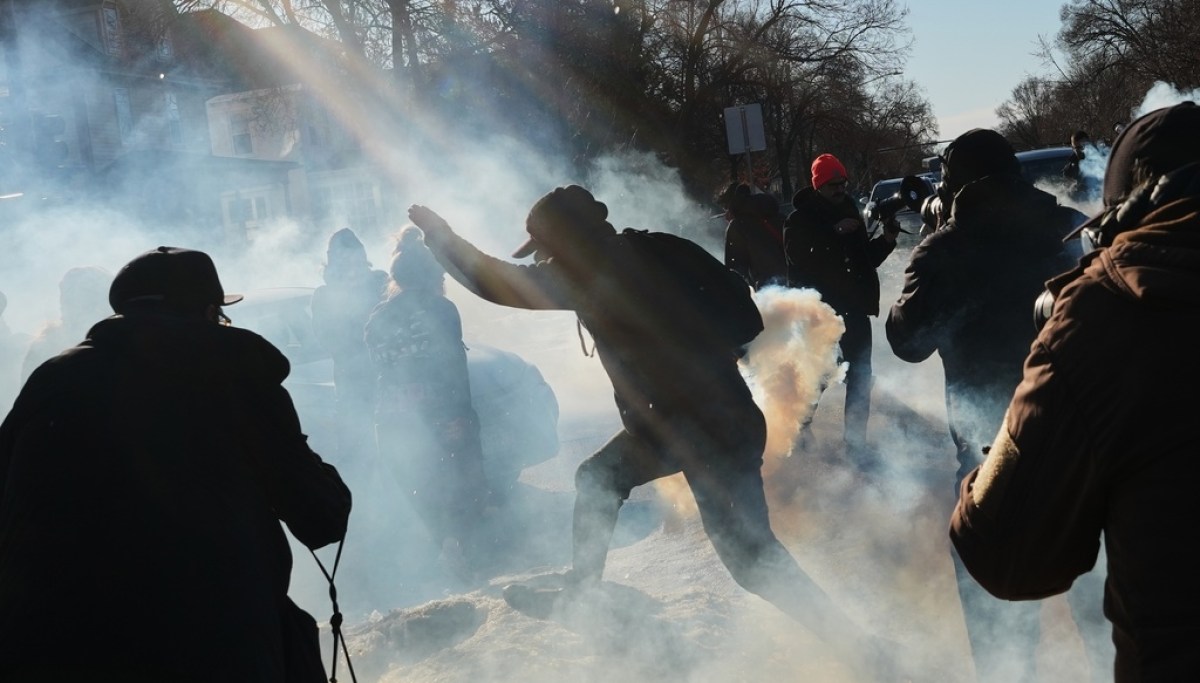
A federal appeals court on Monday blocked a lower-court judge’s restrictions on Immigration and Customs Enforcement tactics in Minnesota, handing the Trump administration a significant win as protests and legal challenges continue to surround federal immigration operations in the Twin Cities.
The 8th U.S. Circuit Court of Appeals issued an indefinite stay of a Jan. 16 order by U.S. District Judge Katherine Menendez that sharply limited how federal officers could respond to protests tied to ICE activity in Minneapolis. The stay will remain in effect while the government’s appeal proceeds.
WIN AGAINST JUDICIAL ACTIVISM IN MINNESOTA
Our great @TheJusticeDept attorneys have now obtained a FULL STAY in this crucial case.
Liberal judges tried to handcuff our federal law enforcement officers, restrict their actions, and put their safety at risk when responding to… https://t.co/j1kvm7gQGR
— Attorney General Pamela Bondi (@AGPamBondi) January 26, 2026
Attorney General Pam Bondi lauded the decision, saying lower court judges like Menendez “tried to handcuff our federal law enforcement officers, restrict their actions, and put their safety at risk when responding to violent agitators.”
“The DOJ went to court. We got a temporary stay. NOW, the 8th Circuit has fully agreed that this reckless attempt to undermine law enforcement cannot stand,” Bondi said.
That order by Menendez, an appointee of former President Joe Biden, had barred federal officers from arresting, detaining, pepper-spraying, or retaliating against individuals engaged in what she described as peaceful and unobstructive protest activity. It also restricted officers from stopping vehicles unless they had reasonable suspicion that occupants were forcibly interfering with immigration enforcement. The appeals court previously intervened on Wednesday without issuing a written decision.
In a brief per curiam decision Monday afternoon, the appeals court said the government made a “strong showing” that the injunction is unlikely to survive appellate review. The panel concluded the order was both overly broad and impermissibly vague, raising constitutional and practical concerns.
The court said the injunction effectively amounted to a universal injunction by extending relief to a sweeping, uncertified class of protesters and observers. Citing recent Supreme Court precedent, the panel said federal courts lack authority to impose such broad restrictions on executive branch operations.
The judges also faulted the order for failing to clearly define the scope of conduct agents would be prohibited from engaging in, concluding it largely directed federal officers to “obey the law.”
“Even the provision that singles out the use of ‘pepper-spray or similar nonlethal munitions and crowd dispersal tools’ requires federal agents to predict what the district court would consider ‘peaceful and unobstructive protest activity,’” the majority wrote.
Such vague commands, the court said, leave agents guessing how to respond during fast-moving protest situations and expose them to possible contempt sanctions.
The ruling comes amid sustained protests in Minneapolis following two fatal encounters involving federal agents. An ICE officer shot and killed Renee Good on Jan. 7, and a Border Patrol agent fatally shot Alex Pretti, a U.S. citizen, on Saturday during separate enforcement operations, according to authorities. Both incidents fueled demonstrations and intensified scrutiny of Operation Metro Surge, a large-scale federal immigration enforcement effort in the Twin Cities.
President Donald Trump has escalated the federal response, placing roughly 1,500 U.S. troops on standby to assist federal agents and warning that he could invoke the Insurrection Act if unrest continues. However, he indicated a strategy shift in communication with the state’s recalcitrant leadership on Monday, suggesting he and Gov. Tim Walz (D-MN) spoke and were on a “similar wavelength” with one another.
The underlying lawsuit, filed in December, alleges that federal officers violated the First and Fourth Amendment rights of six protesters. Plaintiffs claim agents boxed in a civilian’s car and pointed a rifle inside during enforcement operations. They sought classwide relief on behalf of anyone who observes, records, or protests ICE activity in Minnesota.
Menendez said in her Jan. 16 order that protesters showed an “ongoing, persistent pattern” of intimidating conduct by ICE officers. She cited extensive media coverage of aggressive federal responses to protests across the Twin Cities.
FEDERAL JUDGE SKEPTICAL OF MINNESOTA’S PLEA FOR COURT TO END SWEEPING DHS OPERATION
Although her injunction is now on pause, Menendez is still weighing a separate request from Minnesota officials to halt the broader deployment of federal immigration officers in the state. At a hearing Monday, she said she was wrestling with the scope of the request but acknowledged that federal officials have “a lot of power” to enforce immigration laws.
Minnesota argues the surge unconstitutionally interferes with the state’s authority and threatens public safety. The appeals court, however, said staying the injunction serves the public interest by preventing federal agents from hesitating while carrying out lawful duties.