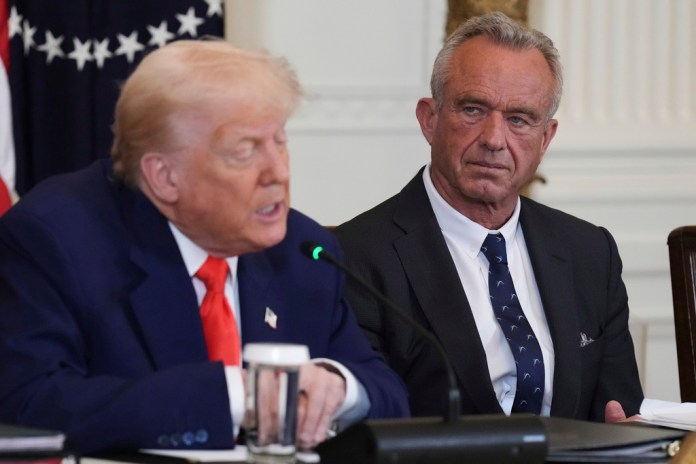
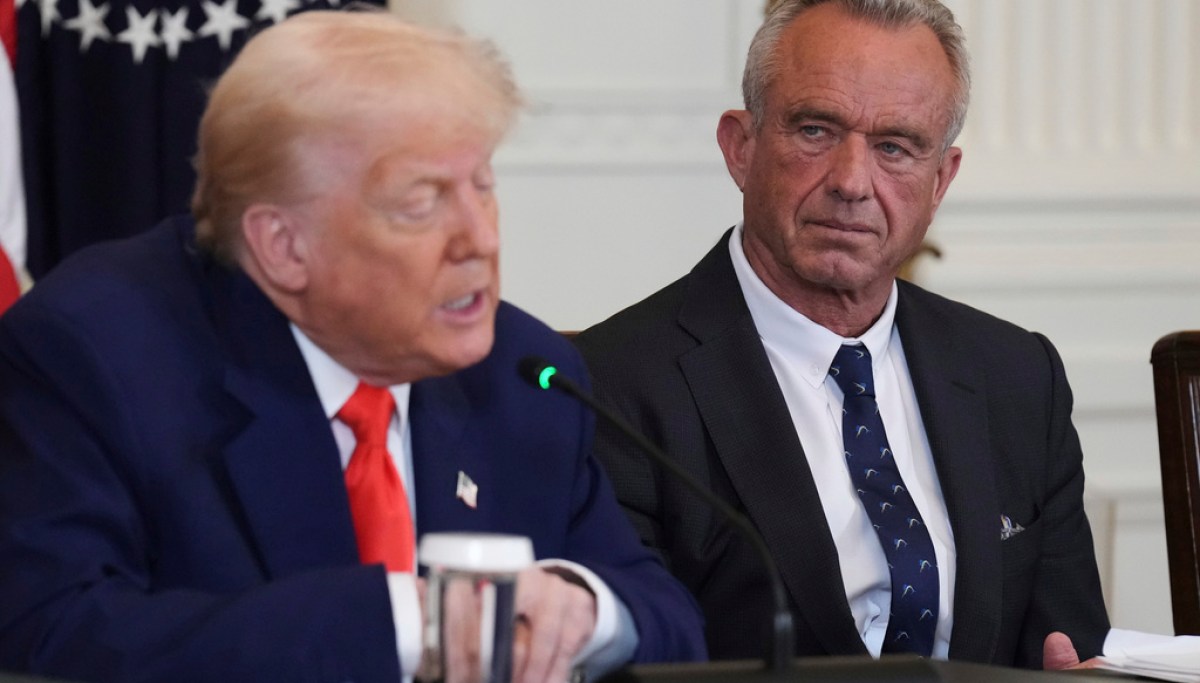
As the Iran war continues with no end in sight, President Donald Trump is leaning on his Make America Healthy Again coalition to shift the political conversation and generate more favorable headlines at home.
Over the course of two days, the strategy was on full display. Acting Attorney General Todd Blanche reclassified state-licensed medical marijuana from a Schedule I to a less-regulated Schedule III drug on Thursday. That same day, the White House announced a new deal with drugmaker Regeneron to lower the cost of its pharmaceutical products.
The Food and Drug Administration also announced actions to fast-track the use of psychedelic treatments for serious mental illness on Friday. The use of psychedelics has long been pushed for by some parts of the MAHA coalition, led by Health and Human Services Secretary Robert F. Kennedy Jr.
Environmental Protection Agency Administrator Lee Zeldin also teased on Friday that his agency is working on a “rule that would recognize advanced recycling as manufacturing under the Clean Air Act rather than waste management,” according to an op-ed he wrote in The Hill.
TODD BLANCHE ORDERS FEDERAL RECLASSIFICATION OF MEDICAL MARIJUANA AS LESS DANGEROUS
The flurry of policy moves reflects a “promises made, promises kept” push that also doubles as a political counterweight to difficult foreign policy headlines.
“Pushing MAHA policies has been a Day One priority for President Trump, and expanding medical research into cannabis and other substances for American veterans and patients was a campaign trail promise by the President,” said White House spokesman Kush Desai in a statement to the Washington Examiner. “When President Trump pledged to Make America Healthy Again, he launched a nationwide movement that the Administration is focused on delivering for with one historic policy shift after another.”
FDA FAST-TRACKS PSYCHEDELIC DRUG RESEARCH FOLLOWING TRUMP EXECUTIVE ORDER
Jon Kostas, executive director of the Association for Prescription Psychedelics, praised the Trump administration for fast-tracking of psychedelic treatments, as did other advocates.
“President Trump and this administration have shown the courage and urgency that this crisis demands,” he said. “We are grateful to see that commitment reflected in federal policy and applaud every step toward getting these life-saving medicines to the patients who need them most.”
“We’re thrilled with the administration, and we’re unabashedly supportive,” said Robert Houton, the founder of Mobilizing Accountability in Congress for a Healthier America Coalition. The group is working on Capitol Hill to champion a forthcoming Dear Colleague letter that would pressure members of Congress to enact extended data exclusivity for FDA-regulated botanical drugs.
Even the popular podcaster Joe Rogan, who had begun publicly criticizing the Trump administration over its foreign policy, appeared at the White House last week when Trump signed an executive order ordering a quick review of psychedelic drugs, including ibogaine.
The burst of MAHA-aligned policy comes as the administration faces mounting scrutiny abroad. The White House has been dogged by tough headlines following the collapse of a second round of peace deal negotiations with Tehran this week.
Trump has repeatedly declined to explain when the extension of the Iran-U.S. ceasefire will end, but special envoy Steve Witkoff and Trump’s son-in-law, Jared Kushner, will head to Pakistan on Saturday for a new round of talks.
“I don’t want to rush myself, you know, because every source says, oh, Trump is under time pressure,” Trump told reporters while speaking in the Oval Office. “I’m not. No, no, you know, who’s under time pressure, they are.”
The White House’s MAHA turn could also help shore up a coalition that has grown somewhat disappointed in the administration after more than 15 months in office.
“If you do look at the public polling on this issue, it is overwhelmingly popular with the vast majority of Americans,” White House press secretary Karoline Leavitt told reporters on Friday about rescheduling marijuana.
“And the rescheduling will lead to more research into cannabis as a drug, especially for those who need it for medical treatment,” Leavitt continued. “And so the president was willing to take this step to do that at the behest of the American public, who largely support it.”
But some experts warn that because of MAHA’s diverse coalition and interests, the recent policies won’t necessarily tamp down some of the issues within the movement.
“It’s just not a huge win,” said Jennifer Galardi, a senior policy analyst at the Heritage Foundation. “Joe Rogan isn’t the only person … just because he’s a huge influencer, like that doesn’t really carry a lot of weight with MAHA moms, which are the core foundation, I think, of the group.”
“And the thing about marijuana, there’s, in fact, a contingency of the MAHA group that decries over medicalization,” Galardi added. “Especially when it comes to psychiatric alleviation, they’re very skeptical of anything that is kind of supported by the bureaucracy or the federal government.”
Earlier this month, the White House invited MAHA advocates to a roundtable listening session that Politico reported was partly organized by Turning Point USA CEO Erika Kirk.
But despite that meeting, on Monday, more than 1,000 MAHA advocates will descend on the Supreme Court to protest the administration’s support for Bayer in a case on the handling of the herbicide glyphosate, the main chemical in RoundUp.
The Supreme Court will hear oral arguments in the Monsanto Company v. Durnell case, which will decide whether Bayer, the maker of RoundUp, should be held legally liable for not informing its customers that glyphosate could cause cancer. (In 2018, Bayer, a German biotechnology company, purchased Monsanto and its product RoundUp.)
“It will be devastating if they secure a liability shield,” Galardi said about Monsanto. “Because it will prevent states from … carving out their own laws, and basically it erases thousands and thousands of cases pending in the courts, for Monsanto, for Bayer.”
MAHA TO PROTEST OUTSIDE OF SUPREME COURT OVER ROUNDUP CASE
Yet even a disappointing ruling at the high court doesn’t mean the MAHA movement is defeated or should completely go scorched earth on the administration.
“If we lose in one area. It doesn’t mean we should abandon ship,” Galardi said. “This is who we have. This is politics. It’s ugly. It’s messy. You rarely get what you want 100% of the time; you’re lucky if you get what you want half the time.”
Gabrielle Etzel contributed to this report.