Violence in Belfast, United Kingdom, continued for another night into Thursday over the attempted beheading of a local by a Sudanese immigrant.
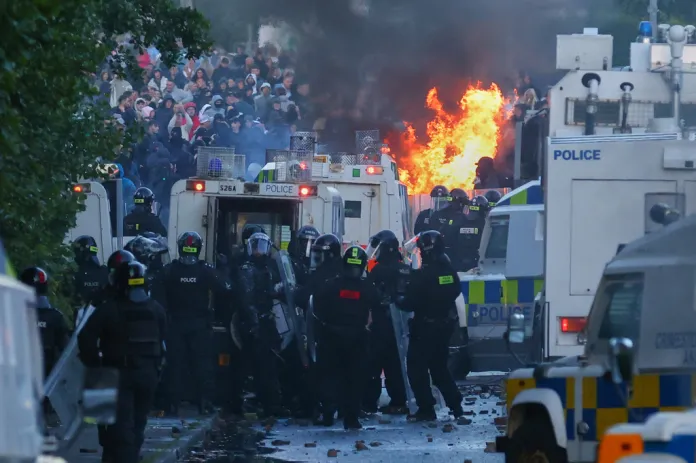
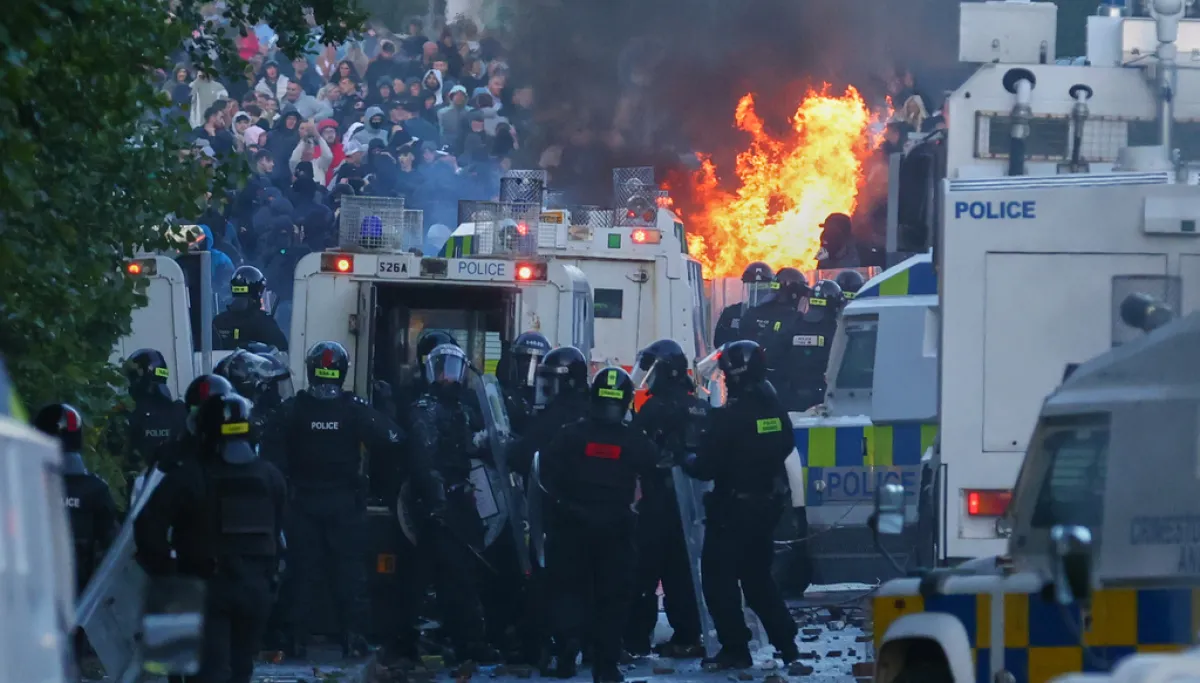
Masked crowds clad in black marched out again on Wednesday night into Thursday, where they encountered a far more concerted police response than on previous nights. In contrast to the lackluster response the night before, riot police backed by fleets of armored cars confronted the crowds, who hurled masonry, bricks, fireworks, and Molotov cocktails at them. Police responded with water cannons and rubber bullets, crowd control methods that are mostly rare in the U.K.
The Police Service of Northern Ireland leaned on their formations of armored cars, battle-tested in previous bouts of sectarian violence between Catholics and Protestants, to keep the riots in check.
With the police out in force, Wednesday night’s violence was focused between formations of rioters and riot police, lasting well into the night. Rioters smashed up sidewalks with sledgehammers to hurl bricks at police lines. Others aimed lasers directly at officers.
In total, 12 police officers were wounded, and 18 rioters were arrested.
Police Federation of Northern Ireland Chairman Liam Kelly denounced the rioters as “violent racist and fascist lawbreakers” and “bullies” who offered nothing but “hopelessness and mindless thuggery.”
Kelly said London was deploying 200 additional officers to cope with the surge in violence, but complained this was still short of the “700 officers below where we should be and some 1,200 short of the 7,500 that was promised.”
The police’s use of water cannons is somewhat controversial, as they have never been used in the U.K. outside of Northern Ireland. Then-Prime Minister Theresa May explicitly banned their use elsewhere in 2015, citing the possibility of injury.
Reports on the scene noted on Tuesday that the rioters largely avoided police, operating in fast-moving, smaller groups to strike at politically relevant targets, then melt away before police could arrive. Police on Tuesday were largely limited to dismantling poorly manned roadblocks and reacting to individual attacks.
PSNI Assistant Chief Constable Ryan Henderson spoke of the general disorder and pleaded for a return to calm, noting that the rioting had effectively shut down life in Northern Ireland.
“The streets of Northern Ireland need to return to calm and order,” Henderson said. “Our children need to feel safe returning to their schools. Businesses need to feel they could open their doors. Everyone with influence needs to do all in their power to get the thugs off our streets.”
In a line that’s become common in the Labour government and among its allies, Henderson then blamed the violence on social media companies. He said the violence was being coordinated on social media by “some in Northern Ireland, some from outside Northern Ireland, outside the island of Ireland… That toxicity is what’s bringing people onto the streets.”
Henderson claimed that “Toxic and vile” commentary about the riots was being hosted on social media, and the issue was being investigated.
“If you’re hosting material and content on your sites that’s encouraging disorder, that needs to stop,” he said.
Initial reports suggested that loyalist Protestant groups were primarily behind the rioting, with Catholics largely standing by but crucially not pushing against it. Despite this, Henderson said police so far had “no evidence” that loyalist paramilitaries were coordinating violence.
Loyalist activist Jamie Bryson told BBC Radio Ulster that loyalist groups were against the rioting, though he admitted that the rioting was largely confined to loyalist areas.
Northern Ireland’s establishment Catholic Sinn Fein political party has condemned the riots in strong terms, while the Protestant Democratic Unionist Party condemned the violence while refocusing on wider debates around immigration.
DUP Leader Gavin Robinson told BBC Radio Ulster that more must be done to protect the U.K.’s borders, and he’s against people “abusing our hospitality,” but “you cannot raise your concerns about damage to British values and then behave in such an un-British way.
“Where your neighbors, where your colleagues, where your classmates are sitting intimidated and in fear, are having their homes attacked and their livelihoods destroyed,” he continued. “That is totally unacceptable, and it is not British.”
The attempted beheading of a local in Belfast on Monday by a Sudanese immigrant has sent shockwaves around the U.K., coming shortly after outrage over the fatal stabbing of a white British student by a Sikh man that sparked similar outrage against immigrants.