A senior White House lawyer warned that suspending habeas corpus protections for illegal immigrants would likely trigger a major constitutional battle, cautioning President Donald Trump against taking up a strategy once used during the Civil War era under President Abraham Lincoln.
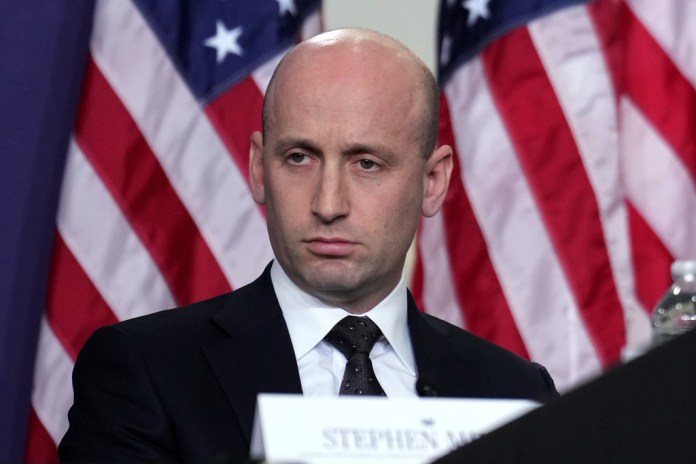
Two sets of memoranda obtained by New York Times reporters Jonathan Swan and Maggie Haberman revealed that White House staff secretary Will Scharf addressed a pair of more drastic policy proposals floated by Stephen Miller, Trump’s deputy chief of staff for policy, in May 2025. The memos, sent to White House chief of staff Susie Wiles, offered a rare glimpse into internal administration debates over the limits of executive power as Trump’s team pursued a concentrated immigration enforcement agenda. The New York Times published excerpts from the reporters’ forthcoming book, Regime Change: Inside the Imperial Presidency of Donald Trump.
One memorandum, dated April 29, 2025, addressed the constitutional writ of habeas corpus, the legal mechanism that allows detainees to challenge the legality of their confinement before a judge.
“The Writ of Habeas Corpus is a legal mechanism to challenge unjust confinement, detention, or punishment,” Scharf wrote. “It prevents, in effect, governmental actors from detaining, imprisoning, or executing individuals arbitrarily.”
Scharf, who is often seen passing executive orders to the president for his signature, prepared the document amid discussions inside the administration after Miller raised the possibility of suspending habeas corpus protections as part of the administration’s deportation efforts.
The memo laid out a detailed legal history of habeas corpus, tracing its roots to English common law and describing it as a foundational safeguard incorporated into the American constitutional system.
“The history of habeas corpus dates back to the very dawn of English common law,” Scharf wrote. “Denial of habeas corpus rights was a key grievance underlying the American Revolution.”
Scharf noted that Article I, Section 9 of the Constitution permits suspension of habeas corpus only in cases of “rebellion or invasion” and wrote that courts have generally concluded Congress, rather than the president acting alone, possesses the authority to suspend the writ.
He also argued that even when Congress has suspended habeas rights, the Supreme Court has required some alternative process that provides protections comparable to judicial review.
“The current Supreme Court, however, is likely more amenable to revisiting these questions than any Supreme Court in living memory,” Scharf wrote. The Supreme Court consists of six conservative justices, three of them nominated by Trump.
The memo reviewed historical examples ranging from Lincoln’s Civil War-era suspension of habeas corpus to Supreme Court decisions involving military detainees during World War II and the post-Sept. 11 war on terrorism.
“The only President to suspend habeas corpus without any underlying Congressional action, or to defy the courts with respect to habeas corpus matters, was President Lincoln,” Scharf wrote, noting that Lincoln later sought and received congressional authorization.
A second memorandum, dated Oct. 29, 2025, focused on the Insurrection Act, a federal law that allows presidents to deploy military forces domestically under certain circumstances.
Scharf described the law as a “break-the-glass exception” to the long-standing prohibition on using federal military forces for domestic law enforcement purposes.
The memo reviewed historical uses of the statute, including actions taken by Lincoln during the Civil War, President Ulysses Grant’s campaign against the Ku Klux Klan during Reconstruction, and President George H.W. Bush’s deployment of troops during the 1992 Los Angeles riots.
While acknowledging that courts have historically afforded presidents broad discretion under the Insurrection Act, Scharf warned that any invocation would likely face immediate legal challenges.
“Most legal analysts agree that the Insurrection Act does provide the President with exceptionally broad powers and authority,” Scharf wrote. However, he cautioned that litigation could create significant delays and “potentially obviate any advantage to be gained in terms of the flexibility that it would provide to the President.”
Neither proposal was ultimately implemented.
In a statement addressing the memos, the White House stressed that discussions of legal options do not necessarily reflect final policy decisions.
“Members of the Administration often have conversations about many different lawful options to implement the President’s agenda — with the President always being the ultimate decider,” White House spokeswoman Abigail Jackson told the Washington Examiner.
IMMIGRANTS FILED TENS OF THOUSANDS OF LAWSUITS IN TRUMP’S FIRST YEAR
The administration did, however, pursue a more aggressive immigration detention policy months later. On July 8, 2025, Immigration and Customs Enforcement adopted a new interpretation of immigration law that allowed many immigrants arrested inside the United States to be detained without bond hearings while removal proceedings moved forward. The policy sparked extensive litigation nationwide.
According to analysis and data collection by Politico, federal district courts have issued more than 15,000 rulings involving the administration’s immigration detention practices, with roughly 13,300 decisions going against the government. Many of the cases have challenged the administration’s position that immigrants eligible for removal could be detained without an opportunity to seek release before an immigration judge.