President Donald Trump warned Friday that the United States could launch another round of military strikes against Iran unless Tehran reaches an agreement, escalating his threats as Washington intensifies economic pressure on the Islamic Republic.
The post Trump Threatens Iran Strike — ‘We May Do Another Little Epic Fury’ appeared first on Breitbart.
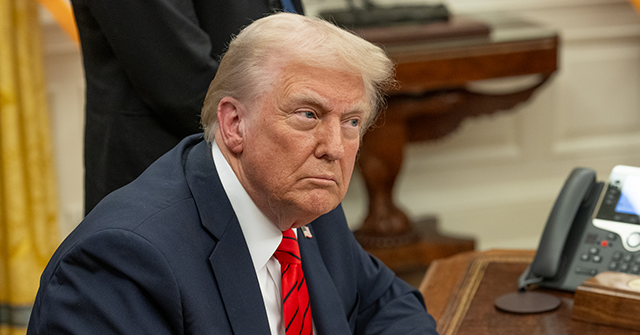
President Donald Trump warned Friday that the United States could launch another round of military strikes against Iran unless Tehran reaches an agreement, escalating his threats as Washington intensifies economic pressure on the Islamic Republic.
“We may do another little Epic Fury, or they’ll agree,” Trump told supporters at a midterm campaign rally in Fort Myers, Florida, referring to the U.S. military operation launched against Iran in February.
“If they’re smart, they’ll just say, ‘Let’s get down to business.’ But, you know, I doubt they’ll do that because perhaps they’re not smart,” he added.
The remarks marked Trump’s latest warning of renewed military action against Tehran, following his declaration Thursday that American forces had already “knocked the hell out of” Iran and might go “a little bit further.”
Earlier Friday, Trump asserted that the United States controlled the Strait of Hormuz, allowing other countries to ship oil through the strategic waterway while restricting Iran’s own exports.
“The question is, do we want to finish it off, or do we just want to let it wither? Because we’re getting everything we want,” Trump told reporters.
He went further in a separate exchange, suggesting that the United States possessed the military capability to seize Iran’s oil resources or even the country itself.
“We could take the whole country. We could take all of the oil,” he said. “And as you know, the Hormuz Strait is totally ours, and that’s the way we’ll keep it.”
The president’s remarks came as Treasury Secretary Scott Bessent declared that American efforts to isolate Iran economically had devastated its oil-export network while allowing energy shipments from the wider Persian Gulf to recover.
“Despite Iran’s efforts to disrupt energy shipments, oil exports from the Persian Gulf are roaring back and have surpassed pre-conflict levels,” Bessent wrote Friday.
“The message is clear: Iran’s threats have failed to stop the flow of energy to global markets,” he added.
In a separate statement earlier Friday, Bessent credited the administration’s Operation Economic Outcast with depleting Iran’s shadow tanker fleet, emptying its main oil terminal and exhausting its offshore reserves.
“As President Trump takes action that his predecessors long deferred, the United States is no longer managing the Iranian threat. We are ending it,” he declared.
Trump’s remarks also reflected the competing approaches to Iran detailed in a Thursday report by The Atlantic, which described Treasury Secretary Scott Bessent advocating sustained economic pressure while Israeli Prime Minister Benjamin Netanyahu has urged Trump to pursue another round of devastating strikes aimed at toppling the Iranian regime.
According to the report, the Trump administration is considering combining the two strategies, potentially launching several days of strikes after the November midterm elections against Iranian missile and drone capabilities, energy infrastructure and nuclear facilities. An outside adviser cited in the report argued that economic pressure had brought Iran close to collapse and that additional strikes “would push them over.”
The prospect of more immediate military action surfaced Friday when U.S. Ambassador to Turkey Tom Barrack suggested that American forces could strike Iran as soon as this weekend.
“Could there be a strike this weekend? Absolutely,” Barrack said during an interview with Mario Nawfal, while emphasizing that Trump remained open to a negotiated agreement.
Asked about Barrack’s remarks before his Florida rally, Trump appeared to playfully question the ambassador’s authority to predict military action.
“That’s my ambassador to Turkey. He’s a pretty powerful man, I guess,” Trump quipped.
“If that’s the case, I don’t know anything about it,” he added.
The president appeared to dismiss Barrack’s suggestion of an imminent strike without ruling out further military action.
Meanwhile, Iran has warned of retaliation if Washington resumes its military campaign.
Reuters reported Friday that two senior Iranian security officials described contingency plans to attack undersea communications cables in the Persian Gulf, including efforts to prevent repairs and prolong disruptions.
“If Iran is attacked, there will be no more red lines … from undersea cables to military bases, including covert ones,” one official warned.
Separately, Islamic Revolutionary Guard Corps Brig. Gen. Yadollah Javani threatened that Iran would become a killing ground for foreign troops if the United States attempted a ground invasion.
The escalating warnings come as Washington moves diplomatic personnel and family members out of several Middle Eastern countries. CNN reported Friday that the State Department had quietly adjusted staffing at embassies in Jordan, Bahrain, Kuwait, Qatar, the United Arab Emirates and Lebanon, in addition to ordering the departure of non-emergency personnel and family members from Saudi Arabia amid intensified attacks by the Iranian-backed Houthis.
Despite the heightened tensions, the administration continues to insist that a diplomatic agreement remains possible.
U.S. Ambassador to the United Nations Mike Waltz said Friday that the American blockade could be maintained for the foreseeable future and that Washington’s pressure campaign was intensifying, while emphasizing that decisions about the duration of the confrontation and any further military action ultimately rest with Trump.
“The president and the U.S. Navy can maintain this blockade for their foreseeable future. The maximum pressure campaign is only tightening,” Waltz said.
Joshua Klein is a reporter for Breitbart News. Email him at [email protected]. Follow him on Twitter @JoshuaKlein.